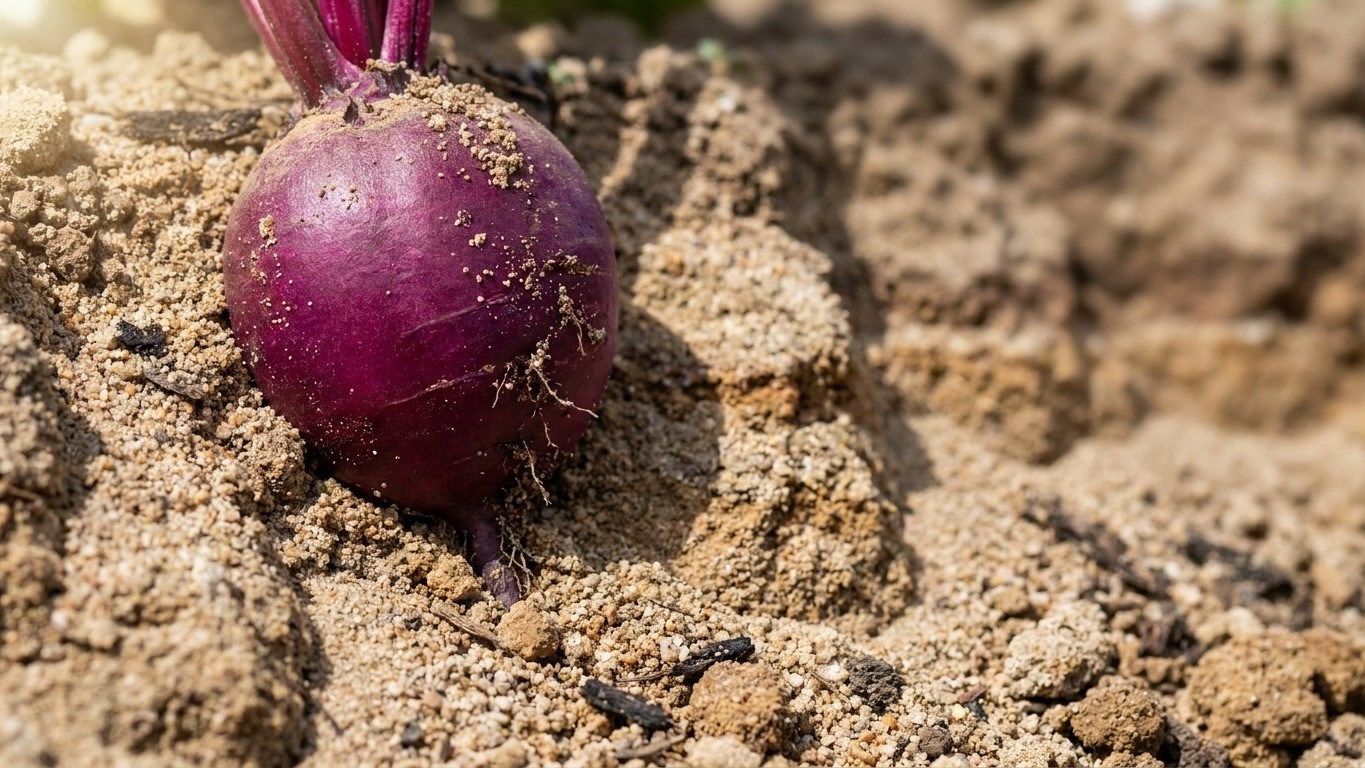

Pull beets 60 to 80 days after seeding, which in Burlington means late June through mid-July for an April sowing, and don’t leave them to sit in hot ground. Top them the day they come out. Then store the roots at 33 to 36 F, not at the freezing point. The USDA’s storage handbook records more black spot and rot at 32 to 34 F than a little warmer. Keep the big roots for storage and eat the small ones first.
The short answer
Vermont’s official state soil is the Tunbridge series, a Spodosol: sandy, acid, strongly leached, typically found under conifers. USDA’s representative values for its surface horizon read 79 percent sand, 21 percent clay and 0 percent silt, with a well-drained rating. Surface pH is about 3.5, which is strongly acid. Organic matter is about 75.0 percent, a figure that tells you the mapped surface is a natural layer of forest litter. A cultivated bed will not look like that, so treat the number as a feature of the woods, not a target for your garden.
For a beet, the match is half good and half risky. Utah State University Extension describes the crop as wanting deep, sandy, well-drained soil rich in organic matter, amended with no more than 1 inch of composted organic matter per 100 sq ft. Tunbridge ticks the sandy and well-drained boxes on paper. The catch is that ground which drains freely also dries freely. A beet seedling in sand feels a dry week sooner than one in clay would. The acidity is the other flag, and it is the reason to read Beet Soil in Vermont: What the Root Will Meet before you sow anything.
One caution matters more than any percentage here. A state spans hundreds of soil series, and this one is a starting point, not a diagnosis. River bottoms along the Connecticut and Winooski, hill-country pockets, and any lot a builder has scraped or filled can behave nothing like it. The pH of about 3.5 belongs to the mapped series, not to your bed. A soil test on your own ground is the only number that counts.
Heat is the second half of the picture, and the second place where the answer gets precise. The number of days a year Burlington passes 90 F is not published in the figures behind this page, so I won’t guess one. The 90 F mark is also not the line beets care about. The Extension guidance puts the trouble at heat above 85 F combined with water stress, and that combination makes the root woody. A hot week in July with dry soil is enough.
That woodiness is a separate failure from bolting. Bolting is premature flowering, caused by water stress in the first six weeks of the crop’s life. Woodiness comes later, from heat plus thirst on a root that is already sizing up. Different cause, different stage, different fix. Keeping both in mind is what drives the pulling schedule: sow early, so the roots are ready before the worst of summer, and pull them on time.
The six weeks that decide it here
Beets are sown in place, not transplanted, so the clock starts at seeding. Sowing 2 to 3 weeks before the last frost puts that clock in a known stretch of spring. Burlington’s last spring frost falls between April 30 and May 10, according to NOAA NCEI climate normals (the 30 to 70 percent probability band for a 32 F freeze). Count back and the sowing window runs from about April 9 to April 26. Count forward six weeks and the sensitive stretch runs from roughly May 21 to June 7.
Burlington sits on Lake Champlain, the mildest corner of the state. The Green Mountains and the Northeast Kingdom run substantially shorter, so a gardener there shifts every one of those dates later. The ground also has to be workable. Vermont’s mud season is not a myth, and a bed that is still saturated in early April is a bad place for seed regardless of what the calendar says.
What does that spring usually do? It swings. Cold snaps, thaws, wet stretches and the occasional dry, breezy week all show up in the same month. No dry-versus-wet statistic is published in the figures here, so take that as the general character of the season, not a measured rate. Because wet stretches are common, gardeners get lulled. The danger is the dry week that lands in the middle of the six, when the seedlings are small and the sandy, well-drained soil has already shed what the last rain delivered. That is where the bolting risk sits in Vermont: not in a drought spring, but in a gap between rains in a soil that can’t hold a reserve.
Seedlings in that stage also draw the attention of whatever is hungry in the garden, and What Eats Beet in Vermont, and When covers who shows up and on what schedule. For the broader sowing-to-harvest picture, Growing Beets in Vermont is the parent page.
Here is the harvest arithmetic. An April 9 sowing reaches the 60 to 80 day range between June 8 and June 28. An April 26 sowing reaches it between June 25 and July 15. The early end of each range is the safer pull, because it comes before the stretch of weather where heat above 85 F and a dry week can combine. The fall-side dates, such as when the first hard freeze arrives, are not in the figures here, so check a local source for your own town.
What goes wrong here
The failures below come from a sandy, acid, fast-draining soil and a spring that swings, followed by a summer that can run hot. Each has its own cause and its own fix.
- Bolting from early thirst. Water stress in the first six weeks after seeding triggers premature flowering. Sandy ground makes it easy to miss, because the surface looks fine while the root zone empties. Push a finger into the soil and water when it is dry below the surface, especially through the stretch from late May into early June.
- Woody roots from later heat. This is a different failure. Heat above 85 F combined with water stress toughens the root. Don’t leave a ready crop in the ground through July out of habit. Pull on the 60 to 80 day schedule, and water during hot spells so the heat is not paired with drought.
- Acid ground taken for granted. The state soil’s surface pH of about 3.5 is strongly acid, but that is the series, not your bed. Get a soil test before sowing and amend only to what it shows. Overcorrecting blind is as risky as ignoring the problem.
- Too much compost, or none. Sand holds little organic matter, so some compost helps. Utah State University Extension caps it at no more than 1 inch of composted organic matter per 100 sq ft. The 75 percent organic matter on the state soil’s map is forest litter, not a recipe for a bed.
- Storing them too cold. Every other root crop on this site rewards the coldest spot you have, and beets do not. USDA Agricultural Handbook 66 says that during storage at 32 to 34 F more black spot and rot occur than at higher temperatures, and sets the target for topped roots at 33 to 36 F with 98 percent relative humidity. Aim for the warm side of that range, not the freezing point. The handbook chapter is blunt about it.
- Leaving the tops on. Bunched beets with leaves keep for about 10 to 14 days at 32 F and above 98 percent relative humidity, and no longer. For anything past two weeks, top the roots first.
- Storing the small ones. Large roots keep much better than small ones because they lose water and shrivel more slowly. Put the big roots away and eat the small ones first.
Common questions
How many days from seeding until I can pull beets in Vermont?
Count 60 to 80 days from the day the seed goes into the ground. Beets are sown in place, so there is no transplant date to count from. In Burlington, an April sowing lands the harvest between early June and mid-July. Farther up in the mountains or the Northeast Kingdom, the whole schedule slides later.
Is colder always better for storing beets?
No. Topped roots do best at 33 to 36 F and 98 percent relative humidity. The USDA handbook records more black spot and rot at 32 to 34 F than at slightly higher temperatures. Freezing-point storage is the mistake, not the goal.
Which roots should I store, and which should I eat now?
Store the large roots and eat the small ones first. Large roots lose water and shrivel more slowly, so they hold up much better over weeks. Top every root before it goes in, since leaves shorten the life of a bunched beet to 10 to 14 days.
Can I use an unheated cellar or a pit?
The handbook says the temperature in pits (clamps) and cellars should not drop below 31 F or exceed 41 F. That is a wide band around the 33 to 36 F target, so a cellar that swings is workable, while one that dips under the floor will cost you roots. The handbook covers commercial storage and says nothing specific about a Vermont basement, so use a thermometer to see what yours actually does.