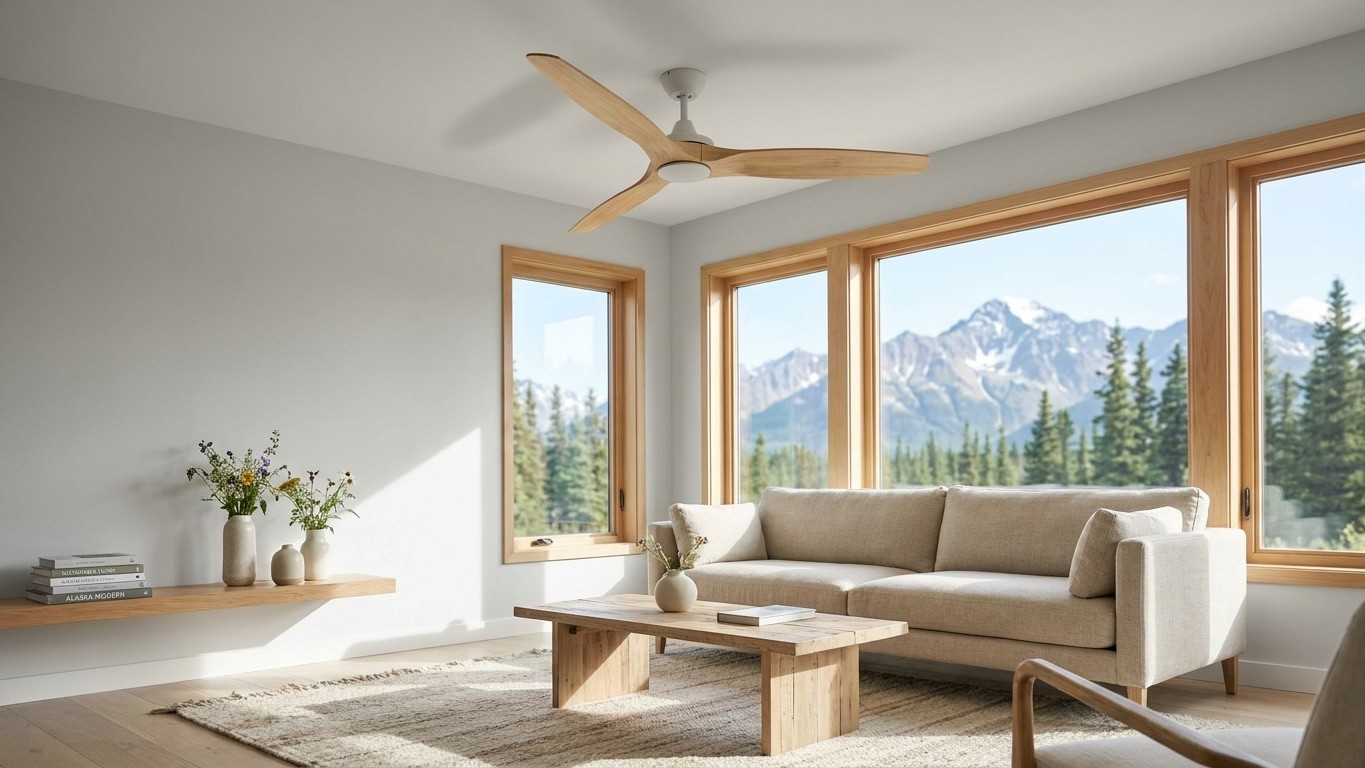

Most Vermont homes that cool at all do it without ducts. The U.S. Energy Information Administration’s 2020 Residential Energy Consumption Survey puts air-conditioning use at 67% of homes. A central unit serves 7%, and an individual unit (a ductless mini-split, a window or wall unit, or a portable) serves 60%. Ceiling fans show up in 58%. The numbers below explain what sits behind that split.
What homes in Vermont actually cool with
The survey’s state table gives three figures for air conditioning in Vermont. 67% of homes use air-conditioning equipment of some kind. 7% use a central unit. 60% use an individual unit. All three are published, and none is marked Q (the survey’s code for a sample too small to publish, which is not the same as zero).
Reading the gap
The distance between “has air conditioning” and “has a central unit” is the share running on individual equipment. In some states that gap is the entire story. Connecticut reports air conditioning in 90% of homes but a central unit in only 34%, while Alabama reports 94% and 81%. Vermont sits at the far end of that pattern. The central figure is small, and the individual figure carries nearly all the cooling.
The 58% for ceiling fans matters too. A fan doesn’t lower the air temperature, but it moves air across skin, and in a state with short hot spells many households lean on it for most of the summer.
What a share does and doesn’t say
These percentages describe what is installed. They are not a recommendation. A 7% central share says little about whether ducts are a good idea for your house. It mostly says that few Vermont houses were built with ductwork to hang a central system on. The survey covers the United States only, so Canadian provinces next door can’t be compared with these figures.
How much cooling the year actually asks for
The heat-load figure for Vermont is 5.4. That is the mean number of days a year reaching 90°F or more at a single reference station, Burlington, in NOAA’s 1991-2020 Climate Normals. It is a count of days. It is not an average temperature, and it is not a measure of the whole state. A hilltop town in the Northeast Kingdom and a valley in the south will each have their own count.
Equipment mix and heat load don’t always agree. A hot state can run mostly on individual units because its houses were built before central air was common. A mild state can be almost entirely central because a builder put ductwork in every house. What gets installed follows the era of construction and whether ducts were already in the walls, not the thermometer.
In Vermont the two figures line up: few 90°F days, a small central share, and individual units covering the rest. They don’t say how warm the nights run, how long a heat wave lasts, or how tightly a given house holds its heat. Those details decide whether a particular bedroom is miserable.
The practical reading is that cooling here is a seasonal, room-by-room job. It rarely calls for a whole-house system running from June through September. Heating, by contrast, runs most of the year, which is covered in Heating a Home in Vermont.
Wet heat or dry heat, and what it changes
NOAA’s 1991-2020 normals for the Burlington station show about 11.9 inches of rain across June, July and August, out of 37.5 inches over the year. By month, that is 4.26 inches in June, 4.06 in July and 3.54 in August, which is the driest of the three. Even the driest summer month brings well over three inches, so summers here lean wet rather than dry.
This is a measure of precipitation, nothing more. It is not relative humidity and not dew point, and it can’t be turned into a comfort rating. It also describes what one station usually sees, not a forecast and not your own lot.
Why moisture changes the job
An air conditioner does two things at once. It lowers the air temperature, and it pulls moisture out of the air as that air passes over the cold coil. Removing moisture takes run time. In a dry summer the machine’s work is nearly all temperature. In a wetter one, a large share of the work is drying.
That is why oversizing misleads. A unit too big for the room drops the temperature quickly, shuts off, and never runs long enough to dry the air. The room ends up cold and clammy. In a dry climate the same mistake merely wastes energy.
Given a wet-leaning summer and short hot spells, here is what to prioritize:
- Run time. Favor longer, steadier cycles over short bursts. A unit that cycles every few minutes isn’t drying anything.
- Fan setting. Leave the fan on auto so the coil can drain between cycles. A fan that runs continuously can blow moisture from the wet coil back into the room.
- Sizing. Size to the room, not to the hottest afternoon of the year. With only a handful of 90°F days, a unit bought for the worst afternoon will be too big for every other day.
Sizing a room unit, from the published chart
The question people type most is what size unit a room needs. ENERGY STAR publishes a cooling capacity chart for room air conditioners, pairing the area to be cooled with the capacity needed. It is a starting point, and the pairs below are reproduced as published.
| Area to be cooled (square feet) | Capacity needed (BTU per hour) |
|---|---|
| 100 up to 150 | 5,000 |
| 150 up to 250 | 6,000 |
| 250 up to 300 | 7,000 |
| 300 up to 350 | 8,000 |
| 350 up to 400 | 9,000 |
| 400 up to 450 | 10,000 |
| 450 up to 550 | 12,000 |
| 550 up to 700 | 14,000 |
| 700 up to 1,000 | 18,000 |
| 1,000 up to 1,200 | 21,000 |
| 1,200 up to 1,400 | 23,000 |
Find the line your room falls on and read across. The chart stops at 1,400 square feet, and a room beyond that isn’t covered. The steps are uneven (the jump from 450 to 550 square feet adds 2,000 BTU per hour, while the one from 250 to 300 adds 1,000), so don’t boil it down to a number per square foot.
Be clear about what this is not. It is a chart for a room unit. It does not size a central system, which needs a load calculation done for the specific house. The chart also gives no adjustments for ceiling height, sun exposure or the number of people in the room, and I won’t invent any.
What actually needs looking after here
Equipment mix decides the maintenance list. With individual units in 60% of homes and central in 7%, the first job for most Vermont households has nothing to do with ducts. The advice about duct leakage below applies to a minority.
Individual units: window, wall, portable and mini-split
These are seasonal machines. They get installed in spring, run for a few short hot spells, and come out or get covered in fall. Their filters and coils collect dust in storage, and a window unit that sat all winter needs its filter cleaned before first use. Check the seal around the sash as well, because gaps let warm, damp air back in and make the unit run longer for less result. A mini-split that also heats is a heat pump, so its filter doesn’t get a winter break.
Central systems
For the 7% with ducts, ENERGY STAR’s guidance is direct: “Inspect, clean, or change air filters once a month in your central air conditioner, furnace, and/or heat pump.” That covers three pieces of equipment together, so a heat pump owner shouldn’t assume it is advice for furnaces only. The reason is airflow. ENERGY STAR says: “Airflow problems can reduce your system’s efficiency by up to 15 percent.” A clogged filter is the cheapest fix there is.
Ducts add a second problem. According to ENERGY STAR: “In a typical house, however, about 20 to 30 percent of the air that moves through the duct system is lost due to leaks, holes, and poorly connected ducts.” That air escapes into an attic or crawlspace before it reaches a vent.
A seasonal pass, in order:
- Clean or replace the filter in every unit before the first hot spell, then check it monthly while the equipment runs.
- Window and wall units: check the sash seal and the drain path. Portables: empty or confirm the condensate drain.
- Mini-splits: clean the indoor filter and clear debris around the outdoor unit.
- Central systems: look at accessible ducts for gaps or loose joints, and keep supply and return vents clear.
- In fall, remove or cover room units, and switch your attention to heating. The guide to Heating a Home in Vermont covers that side, including the furnace and heat pump filters mentioned above.
Common questions
Do most Vermont homes have central air?
No. The 2020 survey reports a central unit in 7% of homes, against 60% on an individual unit and 67% using air-conditioning equipment of any kind.
Does a ductless mini-split count as central air?
Not in this survey. It counts a ductless mini-split, along with window or wall units and portables, as an individual unit.
How many 90°F days does Vermont get?
At the Burlington reference station, the 1991-2020 normal is 5.4 days a year at 90°F or more. It is a count at one station, so other parts of the state will differ.
What size window unit does a room of 300 to 350 square feet need?
ENERGY STAR’s room air conditioner chart lists 8,000 BTU per hour for the line running from 300 up to 350 square feet. That is a starting point for a room unit, not a calculation for a whole house.
Sources : energysaver.vermont.gov | vermontpublic.org