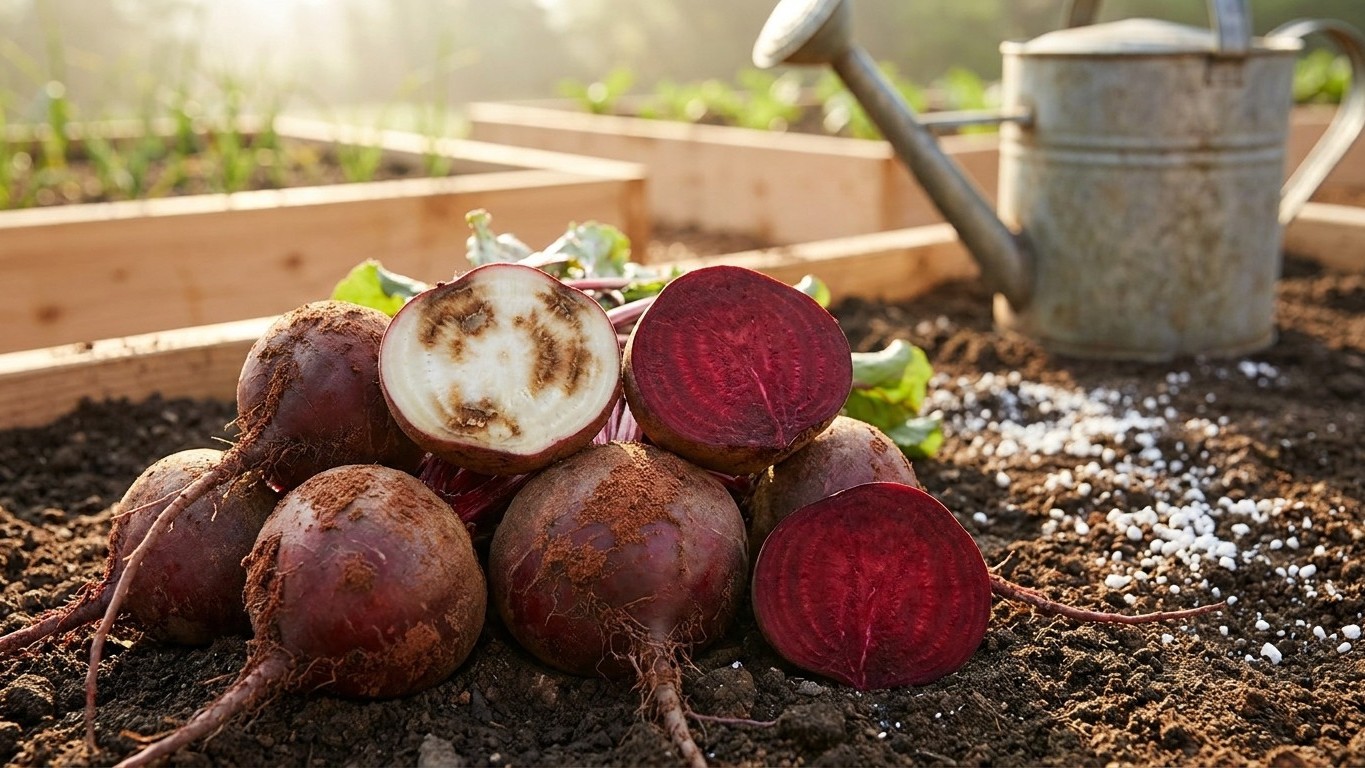

Pull Virginia beets 60 to 80 days after seeding, and get them out before summer heat settles into the row. Then top them and store the roots at 33 to 36 F. The near-freezing advice that suits other root crops works against beets. USDA’s storage handbook says roots held at 32 to 34 F develop more black spot and rot than roots held a little warmer. Colder is not better here.
The short answer
Virginia’s state soil is the Pamunkey series, an Alfisol, which is a forest soil of moderate fertility that holds nutrients reasonably well. The representative surface values are 50 percent sand, 11 percent clay and 39 percent silt (a loam to silt texture), with a surface pH of about 6.2, slightly acid. Organic matter is about 1.2 percent, and the drainage class is well drained. Those numbers come from USDA NRCS Soil Data Access, which averages the surface horizon of the 26 mapped components of the series. A state spans hundreds of soil series, so treat this as a starting point and not a diagnosis. River bottoms, hill country and any lot a builder has scraped or filled can look nothing like it, and the figures describe a mapped surface layer, not a worked garden bed.
What this soil does to a beet
Utah State University Extension describes the beet’s ideal as deep, sandy, well-drained soil rich in organic matter. Pamunkey meets the first three requirements and falls short on the last. Half sand and well drained means water moves through quickly. At 1.2 percent organic matter, little is held back for the root to draw on between rains. Beets sown in ground like this get plenty of drainage and very little buffer. The same Extension guidance caps amendment at no more than 1 inch of composted organic matter per 100 sq ft, so the fix is modest, not a heavy dose. The Beet Soil in Virginia: What the Root Will Meet page goes deeper on texture and pH. A soil test on your own bed gives you the only number that counts.
Heat and woodiness
Utah State Extension ties woody roots to heat above 85 F combined with water stress. That failure arrives late in the crop’s life, long after the early-season risk has passed. How many days a year the reference city, Virginia Beach, passes 90 F is not published here, and I won’t guess at it. What the frost data does show is that the coast is the mild end of the state. The Blue Ridge and southwest Virginia run weeks later in spring and earlier in fall, so inland gardeners have a narrower window on both sides.
The practical result is a harvest clock. Count 60 to 80 days from the day the seed went into the ground. Beets are sown in place, so there is no transplant date to count from. Start checking roots at the early end of that range, and don’t leave them sitting in a hot, dry bed to get bigger. For more on the crop as a whole, see Growing Beets in Virginia.
The six weeks that decide it here
The NOAA NCEI climate normals for the NAS Oceana station put the last spring frost between March 20 and April 3. That comes from the 32 F freeze probabilities, in the 30 to 70 percent band. Sowing two to three weeks ahead of that window means seed goes in from the last days of February to about March 20 on the coast. Add 60 to 80 days and the harvest runs from late April into early June. That is plain arithmetic on the dates above, and your own seeding date shifts it.
The first six weeks of that crop run through March and into April, and in the later sowings toward the start of May. Utah State Extension says water stress in those six weeks causes premature flowering. That is bolting: the plant decides to make seed instead of a root, and the root stops being worth eating. The bolting risk sits in this spring window and has nothing to do with summer heat.
What does a Virginia spring usually do? It swings. Cold snaps and warm spells trade places, wet weeks are followed by dry ones, and the pattern varies by region and by year. I have no published rainfall figure for it here, so I won’t pretend to one. The risk on well-drained, sandy-leaning ground is the dry, mild week in April. The surface dries out within a day or two, the seedlings are young, and the ground has little stored water to carry them. A bed that stayed soaked in March can be dust by mid-April.
The fix is boring: watch the soil, not the calendar. Push a finger in a couple of inches and water when it feels dry. Gardeners in the Blue Ridge or southwest Virginia should shift everything later, since spring arrives weeks behind the coast. Bolting from early thirst and woodiness from later heat are two separate failures with two separate windows. Watering well in April does not protect you in June.
What goes wrong here
- Bolting after a dry spell in the first six weeks. Thirsty seedlings flower early. Remedy: check soil moisture weekly through the whole six-week window and water whenever the top couple of inches are dry, even if March was wet.
- Woody roots when heat meets dry soil. Heat above 85 F combined with water stress is the trigger. Remedy: pull on schedule, between 60 and 80 days from seeding, and water through hot spells instead of letting the bed dry out.
- Thin ground that dries fast. With organic matter near 1.2 percent in the representative soil, the bed holds little in reserve. Remedy: work in composted organic matter, staying at or under 1 inch per 100 sq ft, and test your own soil before assuming it matches.
- Storing too cold. The handbook finds more black spot and rot at 32 to 34 F than at slightly warmer temperatures. Remedy: aim for 33 to 36 F for topped roots at 98 percent relative humidity, and put a thermometer where the beets sit.
- Storing with the greens on. Bunched beets keep only 10 to 14 days at 32 F. Remedy: top them first, and eat the greens fresh.
- Storing the small roots. Small roots lose water and shrivel faster. Remedy: eat the small ones first and save the large roots for storage.
- A pit, clamp or cellar that follows the weather. The band to stay inside is no lower than 31 F and no higher than 41 F. Remedy: check the temperature through winter cold snaps and warm spells, not just once at storing time.
Chewed leaves and tunneled roots are a different problem with different causes, covered in What Eats Beet in Virginia, and When.
Common questions
How many days until I can pull beets in Virginia?
Plan on 60 to 80 days, counted from seeding. Beets are sown directly in the bed, so the count never starts from a transplant. For a coastal sowing two to three weeks before the March 20 to April 3 last-frost window, that lands roughly from late April into early June.
Is the coldest part of the fridge the best place to store beets?
No. USDA Agricultural Handbook 66 puts topped beets at 33 to 36 F and 98 percent relative humidity, and it says storage at 32 to 34 F brings more black spot and rot. The handbook is free to read. The goal is near-freezing without actually freezing, with a little margin.
Should I leave the leaves on when I store them?
Take them off. Bunched beets with the leaves attached last only 10 to 14 days at 32 F and above 98 percent humidity, and no longer. Topped roots held at 33 to 36 F go much further.
Which beets should I keep for winter, and which should I eat now?
Keep the large roots and eat the small ones first. The handbook notes that large roots keep much better because they lose water and shrivel more slowly. This runs against instinct, since gardeners tend to treasure the biggest beet for a showpiece and eat the small ones last. Do it the other way around, and your winter supply will hold up far better.