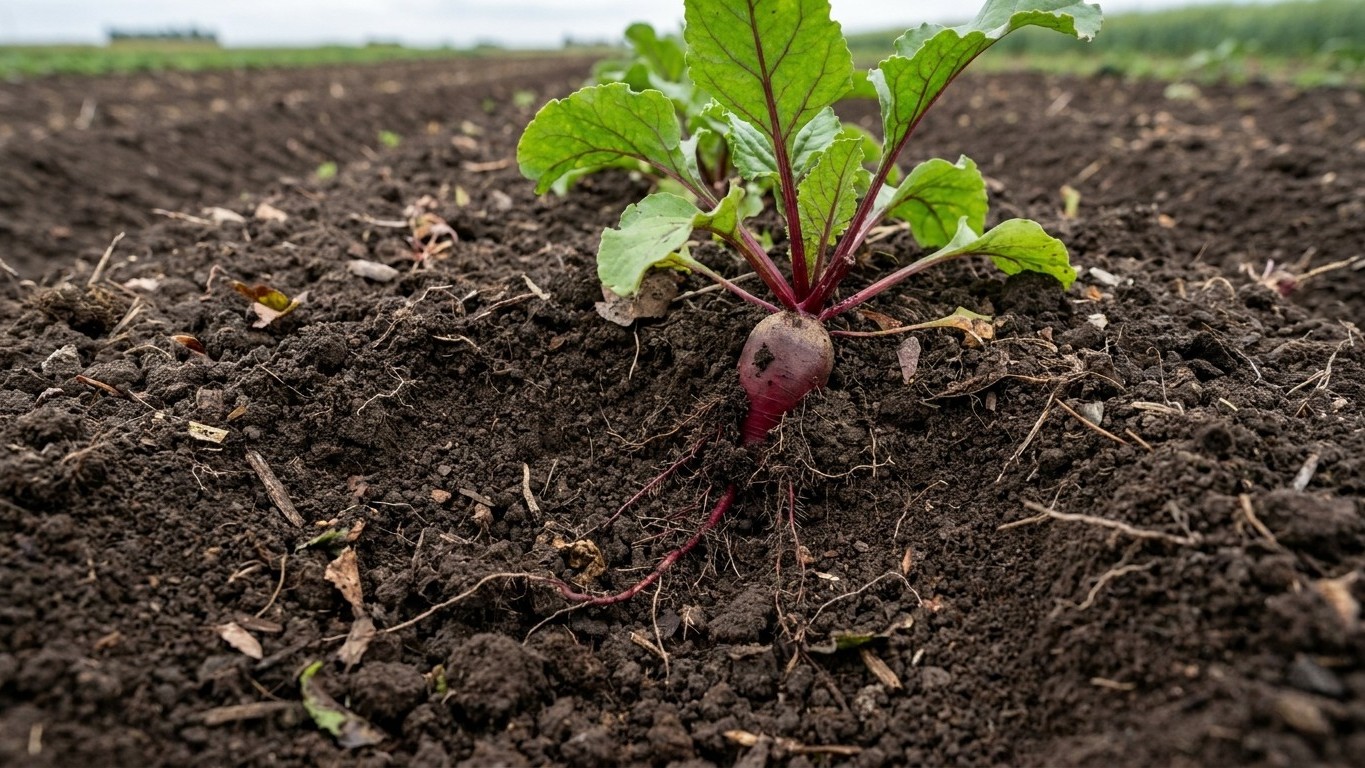

Weather and handling do most of the damage to a Virginia beet crop, more than any single bug. Thirst during the first six weeks pushes plants to flower early. Heat above 85 F combined with water stress turns the root woody. A cellar or refrigerator set too cold breeds black spot and rot after harvest. Those are three different failures with three different fixes, and the state’s representative soil, a well-drained loam, shapes the first two.
The short answer
USDA lists the Pamunkey series, an Alfisol, as the soil that represents Virginia. Alfisols are forest soils of moderate fertility that hold nutrients reasonably well. The surface layer is loam to silt: 50 percent sand, 11 percent clay and 39 percent silt. Organic matter sits at about 1.2 percent, surface pH is about 6.2 (slightly acid), and drainage is well drained. Those are representative values for the surface horizon of the major components of the series as mapped (26 components in the USDA database). They do not describe a worked garden bed, and they are not your pH.
Set that against what Utah State University Extension says beets want: deep, sandy, well-drained soil rich in organic matter. Pamunkey delivers the first three. With only 11 percent clay, water moves through it instead of pooling around the root, and the ground tends not to crack or crust the way heavy clay does. The missing piece is organic matter. At 1.2 percent, the soil has little sponge in it, so a dry week shows up fast. Utah State advises amending with no more than 1 inch of composted organic matter per 100 sq ft, so the fix is modest, not a thick blanket.
A state spans hundreds of soil series, and this is a starting point, not a diagnosis. Tidewater sand, Piedmont hills, mountain valleys, river bottoms and any lot a builder has scraped or filled can all behave differently from Pamunkey. A soil test gives your own pH and texture. The Beet Soil in Virginia: What the Root Will Meet page goes deeper on that side.
Heat, woodiness and a number that isn’t here
The reference city for this page is Virginia Beach, using the NAS Oceana weather station. The number of days a year it passes 90 F is not published in the data behind this page, and guessing would be worse than leaving it out. What the sources do give is a lower bar: Utah State says heat above 85 F, paired with water stress, makes the root woody. Since 85 F is below 90 F, a count of 90-degree days would understate how often a late crop is at risk.
Woodiness is a late failure, not an early one. It hits roots that are sizing up when summer arrives. Bolting is the early failure, and it has a different cause (see the next section). Treating both as “keep it watered” hides the timing difference that lets you plan around each.
One more limit: the data here do not cover chewing insects or wildlife, so this page does not rank them. Your local extension office is the place to ask what is feeding on leaves in your county.
The six weeks that decide it here
Beets are sown in place, never transplanted, and the 60 to 80 days to harvest run from seeding. Sowing 2 to 3 weeks before the last spring frost puts the seedlings’ first six weeks in a known stretch of the calendar. At NAS Oceana, on the coast, the last frost falls between March 20 and April 3, based on NOAA NCEI climate normals for the 30 to 70 percent band of 32 F freeze probability. That band is the middle of the range, so a later freeze is still possible.
Do the arithmetic for the coast. Two to three weeks ahead of those dates means sowing from roughly the end of February to about March 20. The first six weeks then end somewhere between about April 10 and May 1. Add 60 to 80 days from seeding and harvest lands between late April and early June. Coastal Virginia Beach is the mild end of the state. The Blue Ridge and southwest Virginia run weeks later in spring and earlier in fall, so every one of those dates shifts later there, and the harvest window gets squeezed against the fall end.
Virginia springs tend to swing instead of settling. Soaking weeks give way to dry, breezy stretches, and a warm April afternoon can follow a cold snap. That pattern puts the bolting risk in the dry gaps. Water stress in the first six weeks causes premature flowering, and young beets have shallow roots. On a well-drained, low-organic-matter loam, the top inch can dry out in a few days of wind and sun, which is exactly when the plants are most vulnerable.
The practical reading: during those six weeks, check the soil instead of trusting the forecast. A wet March does not carry a seedbed through April. The When to Sow Beets in Virginia page breaks the dates down by region, and the overview at Growing Beets in Virginia shows where this fits in the whole season.
Late sowings face the second risk. A crop that reaches sizing-up in June meets heat above 85 F, and woodiness becomes the concern. The first problem is thirst when plants are small. The second is heat plus thirst when roots are large.
What goes wrong here
The failures below come from this soil and this climate. Each has its own remedy.
- Bolting from early thirst. Water stress in the first six weeks triggers premature flowering. Keep the top of the bed evenly moist from seeding through week six, and check after any dry, windy spell.
- Woody roots from later heat. Heat above 85 F with water stress toughens the root. Time sowing so roots size up before midsummer, and water steadily when hot weather arrives. This is a separate problem from bolting and has a separate window.
- Quick drying in thin, low-organic-matter loam. At about 1.2 percent organic matter, the representative soil holds little water. Work in composted organic matter, up to the cap of 1 inch per 100 sq ft.
- Too much compost. More than that cap defeats the purpose. Stay at or under 1 inch per 100 sq ft, then let a soil test guide anything further.
- Assuming your pH matches the state’s. The 6.2 figure is a mapped surface value, not your bed. Test your own soil before adding lime or sulfur.
- Storing roots too cold. Colder is not better here. USDA Handbook 66 reports more black spot and rot at 32 to 34 F than at slightly warmer temperatures. Hold topped roots at 33 to 36 F and 98 percent relative humidity.
- Leaving the tops on. Bunched beets with leaves keep only 10 to 14 days at 32 F and above 98 percent relative humidity. Top them first if you want them to last longer.
- Saving the small roots. Large roots keep much better because they lose water and shrivel more slowly. Put the big ones in storage and eat the small ones first.
Common questions
How long do beets keep after harvest?
Bunched beets, leaves still attached, keep about 10 to 14 days at 32 F and above 98 percent relative humidity. Topped beets keep longer and should be held at 33 to 36 F and 98 percent humidity, according to USDA Agricultural Handbook 66. Remove the tops soon after harvest.
Is the Pamunkey soil what I have in my yard?
Probably not exactly. It is the soil USDA lists as representative of Virginia, but the state spans hundreds of series. Coastal sand, Piedmont clay, mountain ground and fill dirt around a new house can all differ. Use it as a hint about what Virginia ground tends to do, then take a soil test for your own numbers.
Are bolting and woody roots the same problem?
No. Bolting is premature flowering caused by water stress in the first six weeks after seeding. Woodiness comes later, when heat above 85 F combines with water stress and toughens the root. Keeping seedlings evenly moist addresses the first. Timing the crop ahead of hot weather and watering through heat addresses the second.
Can I store beets in a cellar or pit?
Yes, with limits. USDA Handbook 66 says temperatures in pits (clamps) and cellars should not drop below 31 F or rise above 41 F. Aim for the 33 to 36 F range for topped roots, and choose large roots, since they hold up better than small ones.