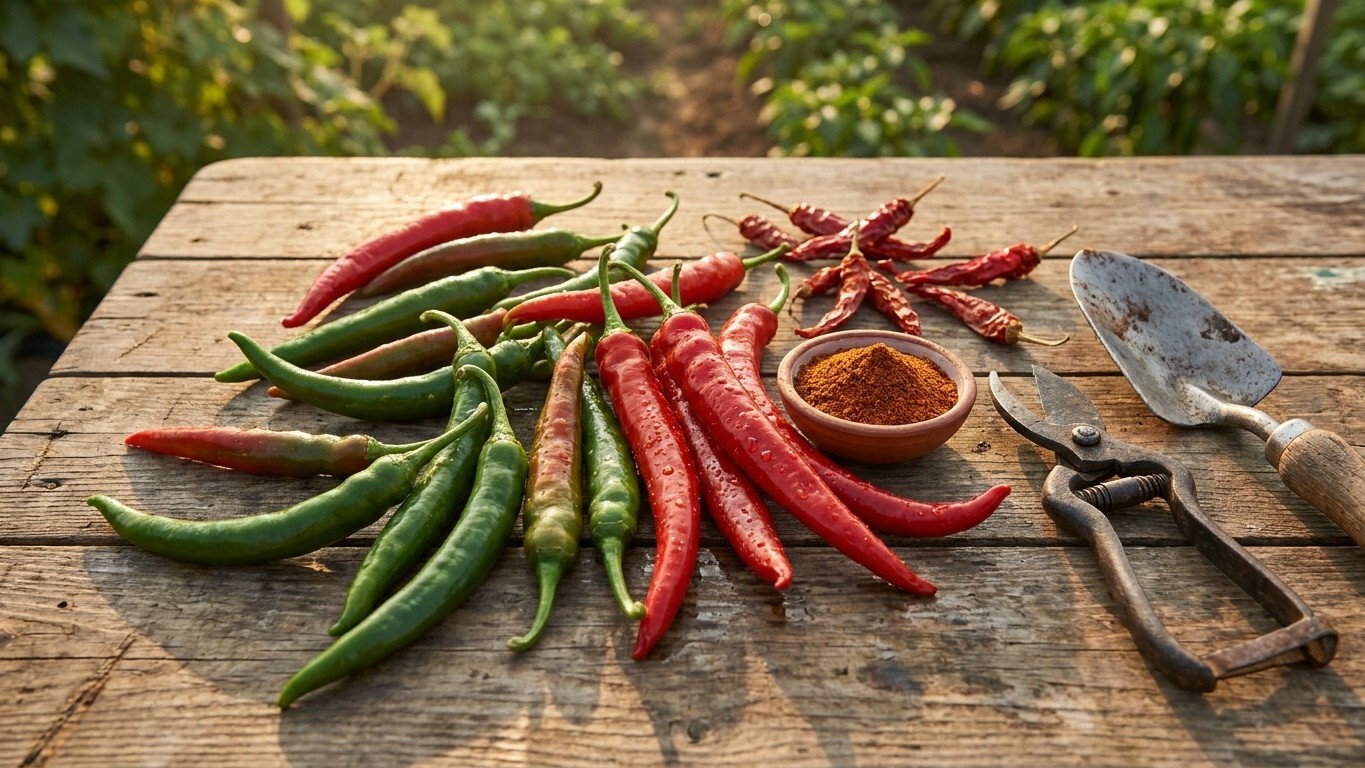

Start counting at transplanting: Clemson Extension says peppers should be ready for harvest about 70 to 85 days later. Pick when the fruit is firm and full size for its type. Then keep it out of the refrigerator. Peppers store best at 45 to 50 °F, and a home fridge runs colder than that, so the fruit pits and softens. This guide covers the timing and the storage. For the whole season, see Growing Peppers in Illinois.
The short answer
Two ends of the thermometer
Chicago, the reference station for this site, averages 14.0 days a year at or above 90 F (NOAA NCEI Climate Normals, 1991-2020). That is a heat-load number, not an average summer temperature, and it is the one that matters here. Utah State University Extension says pepper fruit set fails when days climb above 90 F. Fourteen such days a year means a few hot spells rather than a summer-long problem. They still matter, because a blossom that opens during one can drop instead of setting fruit.
The same extension source names the other end: nights below 55 F. Peppers fail at both ends, and the cool end gets forgotten because gardeners worry about heat in July and forget that a chilly night in early June does similar damage. This site does not carry summer night minima, so there is no honest number to hand you for your county. Latitude is a poor guide, and so is how cold the winters get. Watch your own nights. A cheap min-max thermometer set at plant height tells you more than any regional estimate. If it shows readings under 55 F while the plants are flowering, expect a pause in fruit set. For more on this, read Why Peppers Fail to Set Fruit in Illinois.
Picking, then storing
The 70 to 85 day window is a planning range, not a promise. It comes from Clemson Extension’s Home and Garden Information Center, and it counts from transplanting. A pepper that sat through a cool, stalled June will run late. Judge the fruit itself: firm, glossy, full size for its type. Green peppers are picked before they ripen, and those left on the plant will usually change color, trading some crispness for sweetness.
The mistake nearly everyone makes comes after the pick. Clemson gives the optimal storage conditions as 45 to 50 °F with 80 to 90 percent relative humidity, for two to three weeks. That is warmer than a domestic refrigerator. Below about 45 °F, peppers suffer chilling injury: small sunken pits appear, the walls go soft, and the fruit rots faster than it would have on the counter. Two to three weeks is the ceiling under ideal conditions, not what a basket on your porch will deliver. Full details are in the Clemson pepper factsheet.
Practically, whole peppers you plan to eat within a few days can sit on a cool counter. For longer holding, a spot you have checked with a thermometer, such as a cellar corner, beats the crisper drawer. Once a pepper is cut, it is a short-lived leftover and the fridge is fine.
When to start seed here
Illinois gardeners often start seed too early, because the calendar says spring while the soil says otherwise. Pepper transplants need 8 to 10 weeks indoors, and they go out when the soil reaches 60 F, after frost. Work backward from the transplant date and you can redo the sums for any county.
- Find your last spring frost. At the Chicago reference station, the NOAA NCEI 1991-2020 normals put the last 32 F freeze between April 11 and April 22, using the 30 to 70 percent probability band. That is an airport figure, not a state-wide guarantee. Suburban and rural gardens typically see the last spring frost later, often by one to two weeks, and more at elevation. Check your own county before you commit.
- Wait for 60 F soil. Frost-free does not mean warm enough. Take a soil thermometer reading in the morning at planting depth, and set your transplant date on the first reliable run of 60 F readings. That date, not the frost date, is the anchor.
- Subtract 8 to 10 weeks. That gives your sowing window indoors. Eight weeks gives you a stockier plant, and ten gives a larger one that may already be budding when it goes out.
- Try a worked example. This one is purely for illustration. Suppose your soil reads 60 F on May 20. Eight weeks back lands on March 25, and ten weeks back on March 11. Your sowing window is the two weeks between them.
- Add 70 to 85 days for the first pick. Using the same example, transplanting on May 20 points to a first harvest between July 29 and August 13. Treat that as a planning range, since cool nights or a stalled stretch of weather will push it later.
Sowing earlier does not buy you earlier peppers. Seedlings held too long in small pots turn leggy and root-bound, and a plant that sits waiting for warm soil gains nothing. The first fall frost date is not published here for your county, so check a local source for it, and remember that rural and suburban gardens often see it earlier than the reference city.
What goes wrong here
Illinois does not make pepper growing hard, but it does set a few predictable traps. Each of the failures below has a remedy that costs little.
- Blossom drop. Flowers fall off without setting fruit when days pass 90 F or nights fall under 55 F. With 14.0 hot days a year at the reference station, the heat version is occasional, and the cool-night version depends on your own readings. Remedy: cover plants with a light row cover on cold nights, use shade cloth during a hot spell, and avoid heavy nitrogen, which grows leaves instead of fruit. New blossoms usually follow once the weather settles.
- Sunscald. Fruit exposed to strong direct sun develops pale, papery patches that later turn sunken and tan. It shows up most often on plants that lost leaves to disease, pests or heavy pruning. Remedy: protect the leaf canopy, resist the urge to strip foliage, and add shade cloth for plants in full exposure during the hottest stretch.
- Blossom-end rot. A dark, leathery, sunken patch forms at the bottom of the fruit. It is a calcium delivery problem, and uneven watering is the usual trigger, since the plant cannot move calcium well when soil swings between dry and soggy. Remedy: water deeply and steadily, mulch to even out moisture, and test your soil before adding any calcium product. Often the soil has plenty.
- Chilling injury after harvest. This one happens in your kitchen, not your garden. Pits and soft spots appear after fruit sits too cold. Remedy: store whole peppers at 45 to 50 °F if you can, and eat them quickly if you cannot.
Holes, chewed fruit and wilting are a different category, and they come from insects rather than weather. What Eats Pepper in Illinois, and When covers those.
Common questions
How do I know a pepper is ready to pick?
Count from transplanting, using Clemson’s 70 to 85 days as a rough guide, then check the fruit. It should be firm, glossy and full size for its type. Skin that feels thin or soft means you waited too long or it was chilled. Cut the stem with pruning shears instead of yanking, since branches snap easily.
Can I leave peppers on the plant until frost?
You can, but the date is yours to find. The first fall frost is not published here, and suburban and rural gardens often see it one to two weeks earlier than the airport figure, more at elevation. Check the forecast in autumn and pick everything of usable size before a frost night.
What if my fridge has a crisper drawer set to high humidity?
Humidity is not the problem. Temperature is. Peppers want 80 to 90 percent relative humidity, which a crisper can supply, but the air in a domestic refrigerator is colder than the 45 to 50 °F range Clemson names. Below about 45 °F the pitting and softening of chilling injury start, whatever the humidity.
How long will picked peppers keep?
Clemson’s figure is two to three weeks at 45 to 50 °F and 80 to 90 percent relative humidity. That is a maximum under optimal conditions, not a guarantee. On a kitchen counter, expect far less, and eat or preserve the fruit within days. If a pepper is already pitted from a cold spell, it still works for cooking, just not for storing.