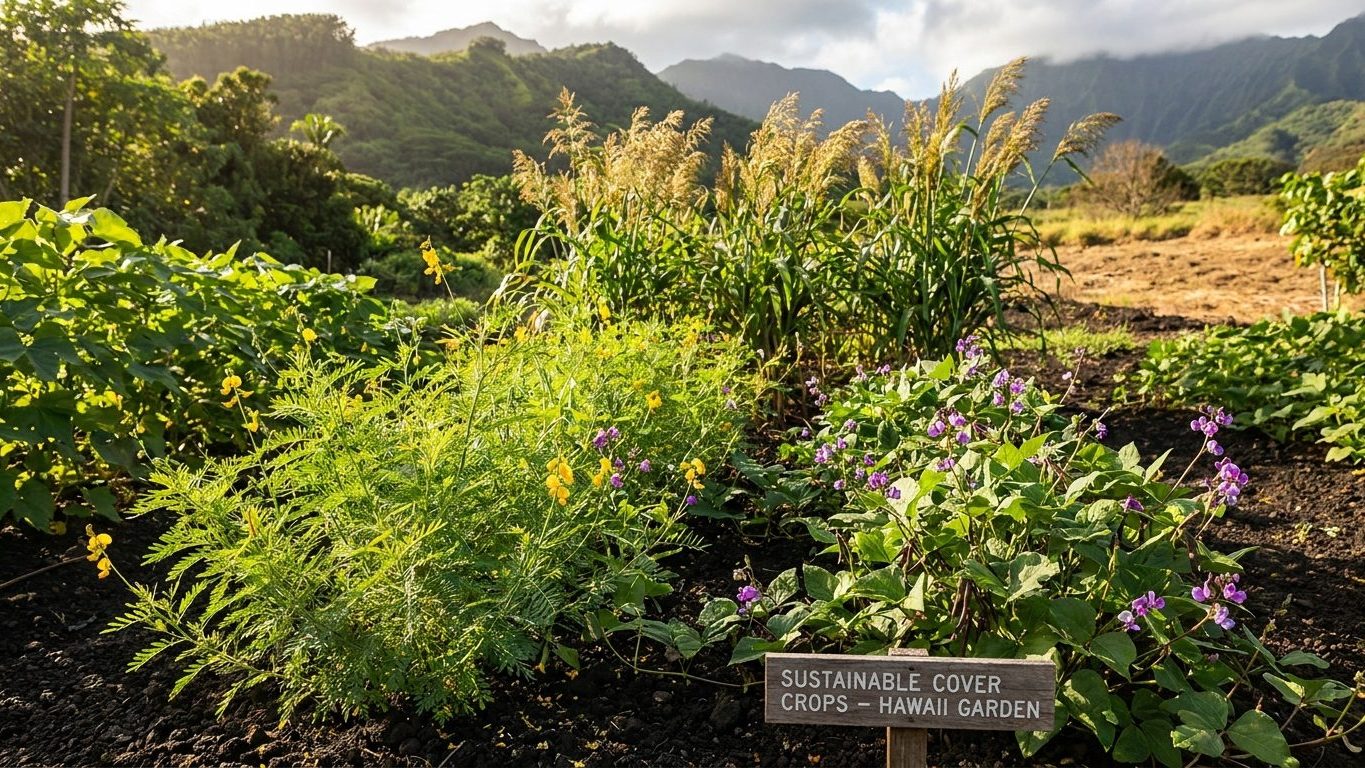

Arizona’s answer splits by elevation, not by calendar month. In the low desert around Phoenix and Yuma, summer legumes like cowpea and sesbania, plus sorghum-sudangrass, outperform everything else because they shrug off 100-plus-degree soil. In the high country above 5,000 feet, cool-season staples like cereal rye and hairy vetch behave the way they do in the Midwest, with a real winter to work around.
The short answer for Arizona
Start with the number that actually runs this state’s growing calendar: a coldest-month average minimum of 45.3°F at the Phoenix reference station, and a frost record so thin that NOAA counted a 32°F reading in only 6 of the last 30 springs. For most of the low desert, there is effectively no frost season to plan around. NOAA’s own normals list the frost-free season there at 365 days. That single fact flips the entire cover crop question: this isn’t a place where you’re racing a last-frost date, it’s a place where summer heat itself becomes the stress factor that decides what survives.
That changes which crop TYPE makes sense. Warm-season legumes and grasses built for heat, sunn hemp, cowpea, sorghum-sudangrass, guar, tolerate the 100°F-plus soil temperatures that define an Arizona summer and actually put on biomass through July and August when a lot of other regions’ cover crops would be shutting down. These are the workhorses for anyone gardening at low elevation in Maricopa, Pinal, or Yuma counties.
Cool-season options, cereal rye, hairy vetch, Austrian winter peas, crimson clover, still have a real role, but their window in the low desert is the mild stretch from fall through early spring rather than a true winter dormancy. With a coldest-month minimum sitting in the mid-40s, these crops don’t face the hard freeze-thaw cycling that kills tender roots in colder states. They grow steadily through what other regions call winter, then get terminated before the heat returns.
At higher elevations, the answer shifts again. Places like Flagstaff and the White Mountains sit at the far cold end of the state’s hardiness range, and cool-season cover crops there behave on a schedule closer to Colorado or northern New Mexico than to Phoenix. A single statewide recommendation simply doesn’t hold, which is the whole reason this page separates the desert answer from the mountain answer instead of averaging them into something vague.
If you garden in the transition zone, the mid-elevation belt around Prescott or the Verde Valley, expect a hybrid approach: warm-season legumes through the hot months, cool-season grains and vetches bracketing a milder, but still occasionally frosty, winter.
What will not work here
Cover crops bred for a slow, humid buildup fail hardest in Arizona, and the reason traces straight back to that 45.3°F coldest-month minimum paired with summer soil temperatures that regularly clear 100°F. Crops that expect a long, cool, damp spring, certain clover varieties bred for the Pacific Northwest or the upper Midwest, stall out here because the mild-to-hot transition happens fast. There isn’t a gradual six-week ramp; low desert gardeners often go from cool nights to triple-digit afternoons within a matter of weeks.
Anything that depends on weekly rainfall to establish is fighting the state’s aridity from day one. Arizona’s summer monsoon delivers moisture in short, intense bursts rather than steady soaking rain, and a cover crop that needs consistent surface moisture to germinate, certain fine-seeded clovers, some annual ryegrasses, will show patchy, unreliable stands unless a gardener is running supplemental irrigation on a tight schedule. In practice, that means the covers marketed as “low-maintenance” in wetter states often turn into the highest-maintenance option here.
Crops calibrated around a hard, predictable last-spring-frost date don’t map onto low-desert Arizona at all. With frost showing up in only 6 of 30 recent springs at the reference station, a planting calendar built on “two weeks after last frost” logic has almost nothing to anchor to in Phoenix, Tucson, or Yuma. The controlling date for cover crop termination in those areas isn’t frost, it’s the point in late spring when soil temperatures climb high enough to stop germination in cool-season species altogether.
Dense-canopy, humidity-loving covers, some vetches and certain forage radish plantings meant for close, shaded spacing, also struggle. Arizona’s low relative humidity dries out tightly spaced stands faster than the same spacing would in a humid Southeastern state, so wider spacing and heat-tolerant species generally beat anything imported wholesale from a wetter climate’s seed catalog.
And at the opposite extreme, warm-season tropical legumes pushed too early in spring, before soil has genuinely warmed, will simply sit and rot rather than germinate, since the near-absence of frost doesn’t mean the soil is warm; it just means it isn’t freezing.
What changes across Arizona
Arizona spans USDA hardiness zones 4b through 10b, according to the 2023 Plant Hardiness Zone Map, and that six-zone range inside one state is enormous. It’s roughly the spread you’d see comparing central Florida to interior Alaska’s mildest pockets, all within one state’s borders. So there is no single planting or species answer that fits both a Yuma backyard and a Flagstaff homestead, and any source that gives you one number for “Arizona” is flattening a landscape that a plant would never mistake for uniform.
The desert floor around Phoenix, Yuma, and much of Maricopa and Pinal counties sits at the warm end of that range, zone 9b to 10b territory, where the coldest-month average minimum near 45.3°F means winter cover crops rarely face damaging cold, and the real growing challenge is surviving summer heat rather than avoiding frost. Gardeners here should lean into warm-season legumes for summer and treat the cool months as the easy season, not the hard one.
Climb toward the Mogollon Rim, into Flagstaff, Williams, or the White Mountains, and the picture flips completely. These areas sit at the cold end of the state’s zone range, closer to 4b-6b, with real hard freezes and a much shorter frost-free window than anything the Phoenix data describes. Cover crop choices there should follow a conventional cool-climate calendar: cereal rye and winter peas planted with an actual frost date in mind, not the near-frost-free logic that governs the low desert.
Between those extremes sits a broad mid-elevation band, Prescott, Sedona, the Verde Valley, parts of southeastern Arizona around Sierra Vista, where both approaches can work depending on the specific site, aspect, and elevation. This page can’t tell you which zone applies to your yard specifically; the right move is checking the USDA Plant Hardiness Zone Map by ZIP code before you commit to either a desert-style or mountain-style planting plan.
Where to check this for your own county
The University of Arizona Cooperative Extension is the state’s land-grant extension service, and it’s the right next stop for anything more specific than this page can responsibly give you: https://extension.arizona.edu/. State-level pages like this one are built to explain the mechanism, why heat matters more than frost here, why the hardiness range is so wide, but a county office is the one that knows what actually grew well two counties over from you last season.
Once there, look specifically for two things. First, a local planting calendar tied to your county’s Cooperative Extension office rather than a statewide average; Arizona’s extension system runs county offices from Yuma to Apache County, and each one calibrates timing to its own elevation and microclimate rather than to the Phoenix reference station used throughout this page. Second, look for any variety trial results or demonstration garden notes specific to cover crops or green manures in your area, since county agents often track which legume or grass varieties actually nodulated well or produced usable biomass locally, information that a state-level source like this one simply doesn’t carry.
A county recommendation will always outrank a state one for the simple reason that it’s closer to your actual soil, your actual elevation, and your actual microclimate. This page exists to explain the statewide pattern, the heat-versus-frost logic, the zone 4b-10b spread, the reasoning behind which crop types make sense where. It isn’t built to replace a conversation with someone who has walked your county’s fields. Treat this as the map, and the extension office as the person who knows the terrain.
Checking this against your own garden
No date on this page beats what your own hands and eyes can tell you about your specific plot, and cover crops make that especially easy to check without any special equipment. Soil warmth by feel is the first and most reliable signal: press your palm flat into the top few inches of bare soil in the morning. If it feels cool and slightly damp rather than genuinely warm to the touch, warm-season legumes like cowpea or sunn hemp are still likely to sit and stall rather than germinate, even if the calendar says it’s late enough.
Second, watch for the first flush of male flowers on any flowering cover crop you’ve planted, sunn hemp and buckwheat both show this clearly. An early, vigorous flowering flush usually signals the plant found favorable warmth and moisture quickly; a delayed or sparse flush often means the stand is still catching up to stress from a cool snap or an inconsistent watering schedule, and it’s worth holding off on termination a little longer to let biomass build.
Third, track how fast true leaves appear after the initial seed leaves on any newly planted stand. A quick jump to true leaves, often within a week or so in warm soil, tells you the microclimate in that specific bed is running warm and fast, closer to the low-desert pattern than to a mountain-valley one. A slow, dragging emergence of true leaves, even when the calendar suggests you’re well past any risk of cold, is a real signal that your particular spot, maybe a shaded corner, a low patch that holds cold air, is running cooler than the county average and deserves its own adjusted timing going forward.