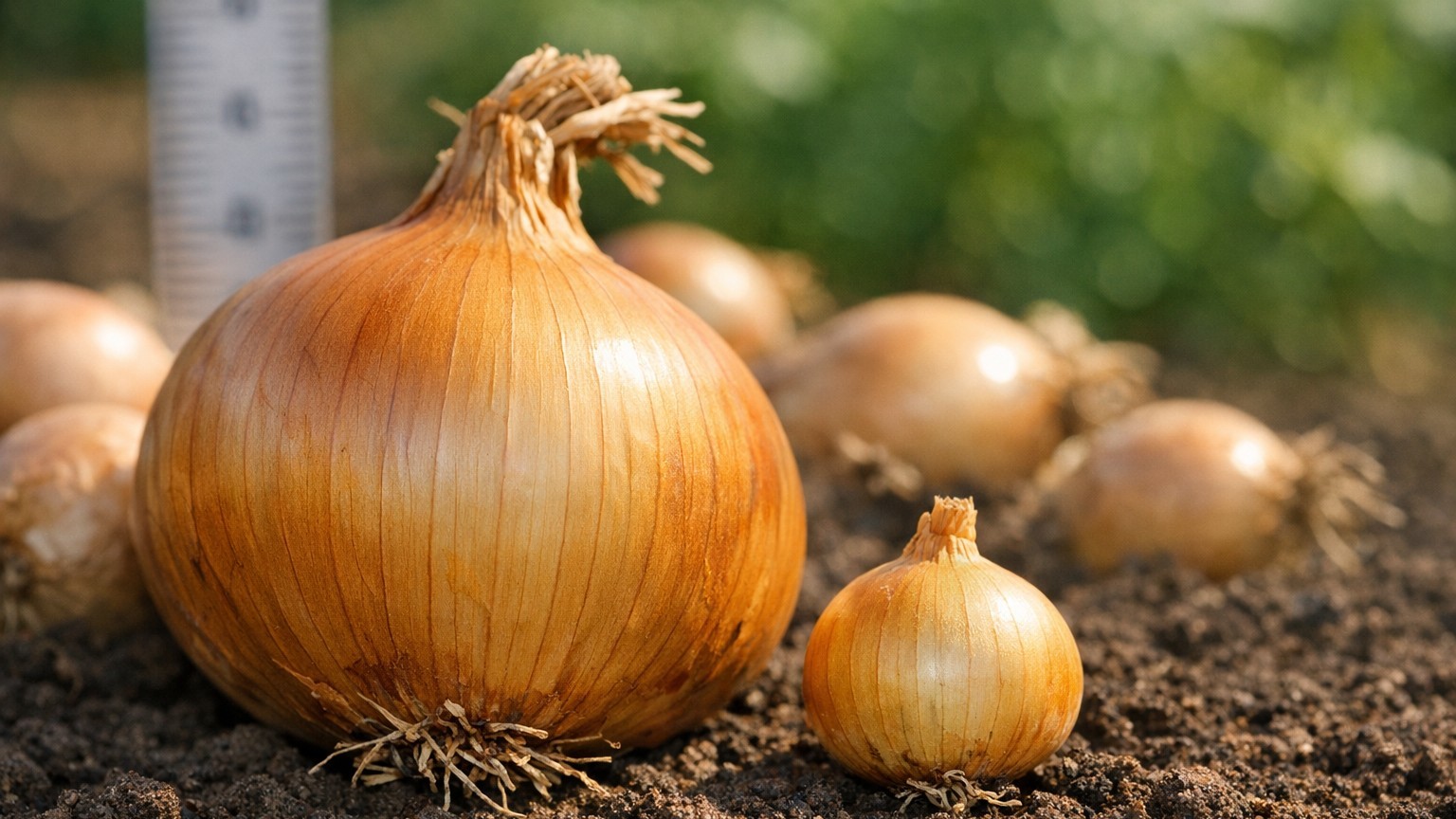

Lift onions when most of the tops have fallen over and the necks have gone soft, usually in late summer. Then cure them in a dry, airy spot until the necks are tight and the outer skins turn papery. Only then do they go into storage at 45 °F to 55 °F. In New Hampshire, day length matters more than the calendar, because it decides when each plant stops making leaves and starts making a bulb.
The short answer for New Hampshire
The reference point for this page is Concord, at 42.93 degrees north. On the longest day of the year the sun is up there for 15 h 10. That figure is a geometric calculation, so it leaves out roughly seven minutes of extra light from atmospheric refraction. It is the number an onion responds to, because bulbing is triggered by day length, not by warmth.
Clemson Cooperative Extension puts the threshold for short-day onions at about 12 hours. Long-day types hold out until the days reach 14 to 16 hours. Concord’s 15 h 10 sits comfortably inside the long-day window, which makes New Hampshire long-day country. The varieties worth growing are covered in The Best Onion Varieties for New Hampshire, and the general picture is in Onions in New Hampshire.
The mechanism sets your harvest. A long-day onion spends spring and early summer building leaves, and each leaf eventually becomes one ring of the bulb. As the days stretch toward their peak, the plant switches over and swells the base. Once the bulb is made, the tops weaken, bend at the neck and fall. You are not choosing a harvest date so much as reading one the plant has already set.
Watch for three signs: tops flopping over, necks going soft and pinched, and the outer skins starting to dry. Pull on a dry day, ease the bulbs out rather than yanking them, and treat every one like an egg, since a bruise becomes a rot spot in storage. Leave the tops attached.
Curing comes next, and it is not optional. Spread the bulbs in a single layer somewhere warm, shaded and breezy, out of any rain. They are cured when the necks are tight and the skins are papery, so the neck is your clock, not the calendar. Trim the tops to a short stub, brush off loose soil, and move them to storage. Clemson’s Home & Garden Information Center gives the target: “Ideal conditions are between 45 °F and 55 °F, and 50 to 60 percent humidity.”
What will not work here
Planting late does not delay the harvest. It shrinks it. Day length triggers bulbing on schedule whether the plant is ready or not, and whatever size it has reached by then is the size the bulb will be. A transplant set out weeks behind its neighbors, with only a few leaves, will swell into a small onion at the same moment the others swell into large ones. No amount of fertilizer in August fixes that, because the plant has already stopped making leaves.
The same logic rules out some varieties and some habits. Here is what fails in a New Hampshire garden, and why:
- Short-day varieties (Texas Early Grano and Granex-type onions, the family the Vidalia belongs to): they start bulbing at about 12 hours of daylight, long before the June peak of 15 h 10, so they bulb early on a small frame of leaves and finish as small onions.
- Any sweet onion intended for winter: sweet types have fewer protective sulfur compounds, so they soften and sprout while the pungent ones are still firm.
- Uncured bulbs in storage: a wet neck is an open door for rot, and one bad bulb can spoil the ones around it.
- Onions in a damp cellar: they want 50 to 60 percent humidity, the opposite of carrots and other roots, so a single cellar cannot hold both well.
- Bulbs with a thick, green, soft neck: these were lifted too early or fed nitrogen too late, and they will not seal.
- Damaged bulbs: nicks from digging or from maggots let rot in, and the problem shows up in January, not October (see What Eats Onion in New Hampshire, and When).
The cellar point catches people out. A root cellar that keeps carrots crisp through winter is, for an onion, a sponge. Many basements run damp in summer and fall, so a basement that feels cool and pleasant can still be the wrong place.
What changes across New Hampshire
New Hampshire is a long, narrow state, running from the Massachusetts line up to the Canadian border. Every figure above belongs to Concord, near the middle of that run. A garden on the Seacoast, one in the Monadnock region and one in the North Country are not living the same season.
The good news is that the whole state stays in the long-day group. Moving north only lengthens the longest day, and long-day onions are the ones that want that. The practical differences are elsewhere, in when the soil is workable and when the tops fall.
| Where | Latitude | Longest day | What it changes |
|---|---|---|---|
| Southern New Hampshire | Somewhat below 42.93 degrees north (check yours) | A little under 15 h 10 | Earlier spring planting and an earlier harvest, still well past the long-day threshold |
| Concord (reference city) | 42.93 degrees north | 15 h 10 | The baseline for this page |
| North Country | Higher than 42.93 degrees north (check yours) | A little over 15 h 10 | Later planting and a later harvest, with a shorter season to build leaves before bulbing starts |
Elevation adds a second layer that latitude does not capture. Day length depends only on latitude, but a high-elevation garden in the White Mountains has cooler soil and a shorter growing window than the same latitude in a river valley. Those gardens should plant as early as the ground allows, because a plant cut short of leaves yields a small bulb.
Local frost dates are not published on this page. Get them from your county extension office rather than borrowing Concord’s.
Sweet now, or onions that last
An onion’s bite comes from volatile sulfur compounds. Those same compounds protect the bulb in storage, which is why the trade-off is a matter of chemistry rather than luck. University of Missouri Extension states it plainly: “As a rule, ‘sweet’ onions do not store as well as the more pungent types.” A sweet variety carries fewer of these compounds. It is better raw and will not last the winter.
Day length lines up with this. Short-day types run sweeter and long-day types keep longer, so a southern garden produces onions to eat soon, and a northern one produces onions that carry you into spring. New Hampshire sits on the keeping side of that split.
Look at what this means for your pantry in March. If you grew pungent, long-day onions, cured them well and held them cool and dry, the basket should still hold firm bulbs with tight skins. They will make you cry at the cutting board, but they will be there. If you grew a sweet onion, expect the shelf to be empty or sprouting by then. Eat those first, in August and September, on burgers and in salads.
The sensible plan is to grow both and treat them differently. Put the sweet bulbs in a separate basket by the kitchen, and send the pungent ones to the cool, dry spot. Do not expect a sweet onion that stores. Nothing on the market gives you both.
Checking this against your own garden
Concord’s numbers are a good starting point, but they are one town’s numbers. A few checks you can finish this week:
- Look up your own latitude with any online map. If it is far from 42.93 degrees north, your longest day will differ from 15 h 10, though you will almost certainly still be in long-day territory.
- Call or visit your county extension office (UNH Cooperative Extension has offices across the state) and ask for your local average frost dates. Use those to time planting and to judge when tops should fall.
- Walk your rows and note which varieties are long-day and which are sweet. Mark the sweet ones to eat first.
- Put a cheap hygrometer and thermometer in the spot where you plan to store onions. You want 45 °F to 55 °F and 50 to 60 percent humidity. If the reading is damp, find a drier spot.
- Choose your curing space now: warm, shaded, breezy and rain-proof, such as a porch, a garage with the door cracked or a covered rack.
Common questions
Can I lift onions while the tops are still green?
You can, but the bulbs will be smaller and the necks thick and wet, which makes them poor keepers. Eat these first. For storage onions, wait until most tops have fallen and the necks have softened.
How do I know curing is finished?
The neck is tight and dry when you squeeze it, and the outer skins rustle and feel papery. There is no fixed number of days. Cool, damp weather slows curing, and warm, dry, breezy weather speeds it up.
Can I store onions in the refrigerator or with potatoes?
Refrigerators are too humid for whole onions, and potatoes give off moisture that onions do not tolerate. Store onions on their own, cool and dry, in a mesh bag or open basket with air moving around them.
What if my onions bulbed small this year?
Small bulbs usually mean the plants had too few leaves when day length triggered bulbing, from late planting, crowding or a cold, slow spring. Start transplants as early as the ground allows next year, and check that you are growing long-day varieties rather than short-day ones. Small bulbs can still be cured and stored, and they often keep well.