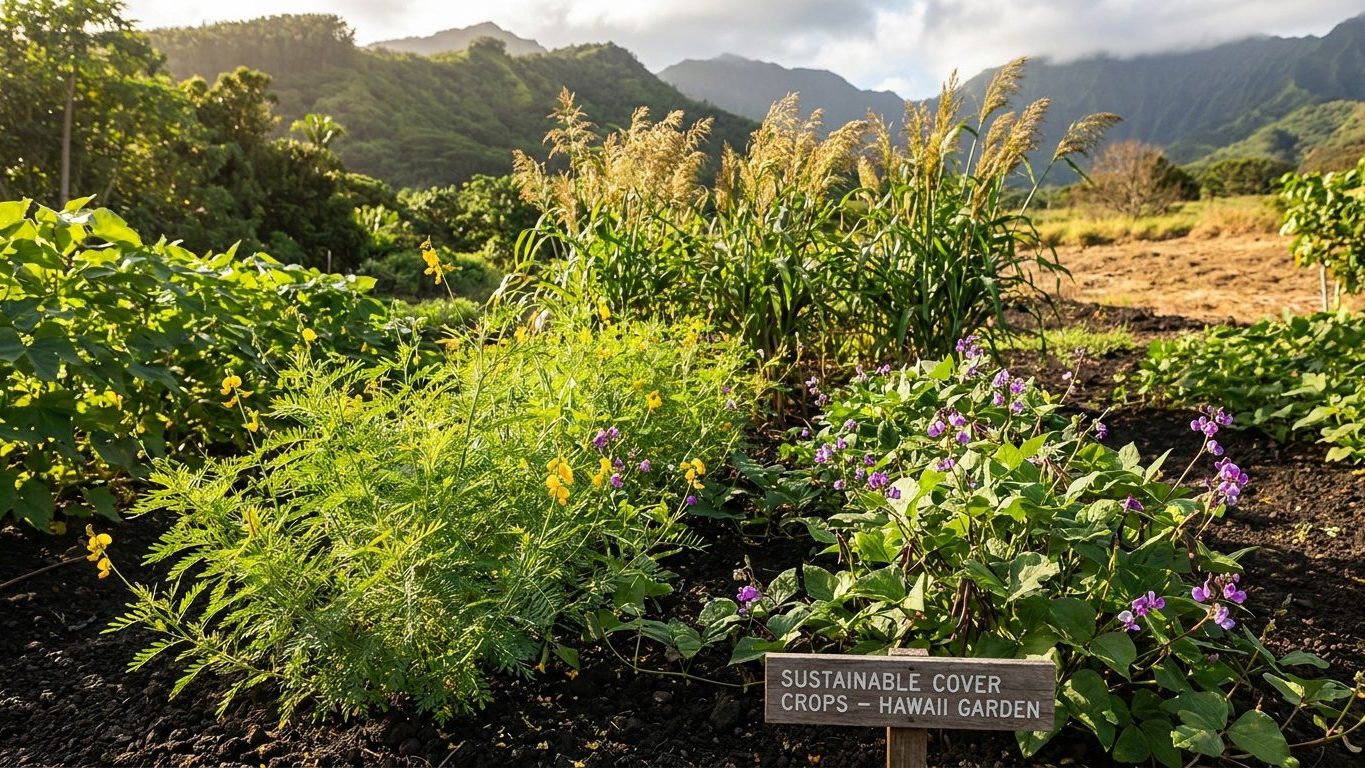

Cereal rye and hairy vetch top the list for most of Arkansas, since both shrug off the state’s coldest winter nights. Crimson clover works well in the southern half, buckwheat and sorghum-sudangrass fill the long, hot summer window between frosts. Which one fits your yard depends less on preference than on where you sit inside the state’s 6b-8a hardiness spread.
The short answer for Arkansas
Start with the frost calendar, because it decides everything else. Arkansas’s first fall frost lands somewhere between November 7 and November 20, and the last spring frost falls between March 12 and March 28 (NOAA NCEI 1991-2020 Climate Normals, station USW00013963). That gives roughly 225 to 250 frost-free days for cash crops, but cover crops actually do their work in the shoulder months, the stretch from October through March when the garden would otherwise sit bare.
Cool-season legumes and grains
Cereal rye is the safest bet statewide. Arkansas’s coldest month runs a mean daily minimum of just 30.9F, well above the temperature that would kill an established rye stand, so it survives from the Ozark uplands to the Delta without exception. Seed it after the first fall frost window closes and let it grow through winter.
Hairy vetch is the nitrogen-fixer that matches rye’s toughness. It survives Arkansas winters more reliably than crimson clover, which does better toward the 8a end of the state’s range and can take a setback in a hard freeze year further north. If nitrogen is the goal and you’re unsure which zone you’re in, vetch is the lower-risk pick.
Warm-season options for long summers
Buckwheat earns its keep in the gap between spring and fall vegetable plantings. It closes canopy in three to four weeks, but it has zero frost tolerance, so it only works between the last spring frost and first fall frost dates above.
Sorghum-sudangrass needs more room to work but Arkansas’s growing season gives it that room. With up to roughly 225 days between frost dates, there’s enough time to grow a full cycle and mow it down before it sets seed, which is the whole point of using it to break up compacted soil.
What will not work here
The frost dates above are 32F hard-freeze dates, and they overstate how much usable time tender seedlings actually get. At the 36F light-frost threshold, NWS Little Rock puts the real window at April 3 to October 31, several weeks tighter on both ends. That gap is where a lot of cover crop plans go wrong.
Timing mistakes with tender seedlings
Seed buckwheat, cowpeas, or sudangrass on the strength of the March 12-28 last-frost date, and a light frost in early April can still burn the stand back. The same mistake happens in reverse each fall: growers count on reaching November 7-20 and get caught by a light frost as early as October 31. Tender warm-season covers need the 36F dates, not the 32F ones, and that difference costs three weeks of growing time on each end of the season.
There’s a second timing trap on the cool-season side. Some growers seed oats expecting a reliable winterkill to simplify spring tillage. But Arkansas’s coldest month averages a minimum of only 30.9F, not the sharp hard freeze that guarantees an oat stand dies over winter. In a mild year, especially in the southern part of the state, oats can limp through and turn into a weedy volunteer crop the following spring instead of terminating on schedule.
Crops that rot in Delta humidity
Close-spaced clover stands planted in the humid bottomland of the Delta invite crown and root rot that the same variety would never see in a drier, more open planting. Humidity, not cold, is the failure point there. If a cover crop needs tight spacing to perform, treat that as a warning sign in the wetter parts of the state rather than a minor inconvenience.
What changes across Arkansas
Arkansas is not one garden, and the hardiness range proves it. The USDA Plant Hardiness Zone Map (2023, built on 1991-2020 normals) places the state across 6b to 8a, a full zone and a half of difference between its coldest and warmest corners. That’s not a rounding error. A zone and a half can be the difference between a legume that overwinters cleanly and one that needs replanting.
The Ozark and Ouachita uplands
The cooler end of that range sits in the northern highlands, where winter lows run harder and longer than the state average implies. Crimson clover is more exposed to winterkill there, and cover crops meant to overwinter should lean toward the toughest options, cereal rye and hairy vetch, rather than anything marketed as marginally hardy.
The southern Delta and coastal plain
The warmer end sits toward the Louisiana and Mississippi borders, closer to zone 8a. Winters run milder there, which is exactly why the oat-winterkill trick is less reliable in that part of the state, and why crimson clover performs better there than it does upstate.
Because this state-level page can only describe a range, not a point, the honest answer is that there is no single hardiness zone for Arkansas. Check the USDA Plant Hardiness Zone Map for your specific location before locking in a cold-tolerance decision, rather than assuming the state average applies to your yard.
Where to check this for your own county
The University of Arkansas System Division of Agriculture Cooperative Extension Service is the next stop, at https://www.uaex.uada.edu/. It’s the state’s land-grant extension office, and it’s built to answer the question this page can’t: what actually works on your specific soil.
What the county pages add
Look for two things once you’re there. First, a local planting calendar built around your county’s actual frost record rather than the statewide range used here, since a county in the Ozarks and a county near the Louisiana line can differ by weeks on either end of the season. Second, look for cover crop variety trial results run in or near your county. Extension agents test cover crop performance on real regional soils, and those results carry more weight than any statewide generalization, including this one.
A county recommendation beats a state one every time. This page describes Arkansas as a whole, using a single reference station’s climate normals. Your county’s extension office describes your actual dirt. When the two disagree, trust the county page, not this one.
Checking this against your own garden
Every date on this page is a probability, not a promise, and your own garden has better information than any calendar. Three things are worth tracking by hand, no equipment needed.
Three signs to track
Soil warmth by feel tells you when it’s safe to seed a warm-season cover like buckwheat or sudangrass. If the soil still feels cool and damp rather than warm through midday, it hasn’t caught up to the calendar yet, regardless of what the frost dates say.
The first true leaves on a cover crop seedling, not just the initial sprout, tell you whether your particular spot is running ahead of or behind the state’s average timing. A patch that pushes true leaves noticeably faster than a neighbor’s garden a few miles away usually sits in a warmer microclimate, maybe a south-facing slope or a spot shielded from wind.
For legumes like crimson clover or vetch, watch for the first flush of flowers. That’s your signal the plant is shifting energy toward reproduction rather than nitrogen fixation, which is usually the cue to terminate the stand before it goes to seed and becomes next year’s weed problem instead of this year’s soil improvement.