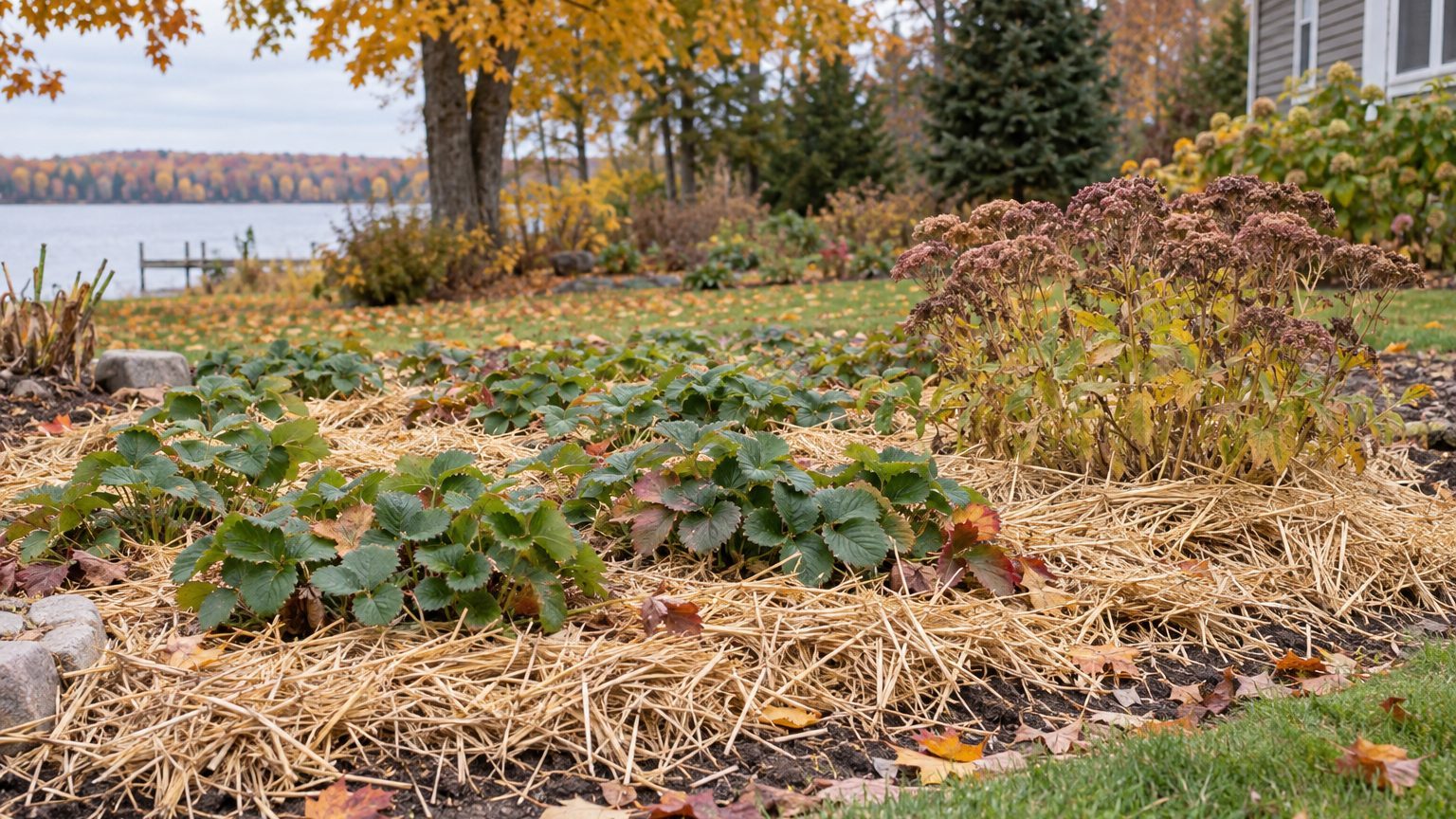

Mulch goes on after the ground starts to freeze, not before. In Saskatchewan that means waiting past the average first fall frost of September 18 (Environment and Climate Change Canada, Saskatoon station) and covering strawberries and borderline perennials only once the plants are dormant and the soil surface stays stiff through the day. A frost that blackens the squash vines is not the signal. A soil crust that no longer thaws by afternoon is.
When to put winter mulch down in Saskatchewan
Mulch does not warm the soil. It slows the exchange of heat in both directions, which makes it a blanket for whatever is underneath, warm or cold. A prairie winter wants the ground cold and steady. The damage comes from the swings: a mild spell melts the surface, the next night refreezes it, and each cycle pushes shallow roots and crowns upward a little more. Winter mulch is there to keep the soil frozen once it freezes, and to stop those cycles on days when snow cover is thin or missing.
Reading the frost date correctly
The September 18 figure comes from the Canadian Climate Normals for 1981-2010 at the Saskatoon SRC station, published by Environment and Climate Change Canada. It is a mean. In roughly one year out of two, the first fall frost lands later than that date, so treat it as the middle of a window and not as a safe cutoff. It is also one station. Northern and upland districts get their first frost earlier, which means everything in this fall sequence arrives earlier on the calendar there, not later. The First and Last Frost Dates in Saskatchewan page is the place to check how far your own district sits from Saskatoon.
The cold itself is not in doubt. At the same reference station, the mean daily minimum of the coldest month is -20.7 °C (-5.3 °F, for readers used to Fahrenheit), according to the same 1981-2010 normals. Natural Resources Canada places Saskatoon in Canadian hardiness zone 3a, using 1991-2020 data. That is the Canadian system, built on several climate variables, and it does not convert to a USDA zone. Note too that the two sources cover different decades, so the numbers describe the climate in broad strokes, not a forecast for this winter.
The window, in practice
The window opens well after the first frost, once several hard frosts have cut back top growth and the soil surface freezes at night and stays firm by day. It closes when the ground is frozen too solid to work or when snow arrives and stays, since a steady snowpack insulates better than anything you can spread. Mulch after the September 18 average first frost has come and gone and the soil surface has started to freeze, and finish before the ground locks up solid.
Mulch laid in September, while the soil is still mild, holds that warmth, stays damp, and gives mice and voles a cozy place to settle before the cold arrives. Crowns sitting in that damp, mild blanket can rot. The wait feels wrong, since a tidy garden in late September looks like the responsible one. It is the opposite. For a broader look at materials and technique, see Mulching Without Killing the Plant, and for district-level context browse the Saskatchewan guides.
Established, truly hardy perennials do not need any of this. Mulching is for strawberries, for plants in their first winter, and for anything rated for a milder zone than 3a.
Strawberries
A strawberry plant is a low crown sitting right at the soil surface, with shallow roots just below it. That is exactly the wrong geometry for a prairie winter. The crown carries next summer’s growth and flower buds, and it has almost no buffer against bare cold. A run of freezing and thawing lifts the whole plant a little more each time, tearing fine roots and leaving the crown perched on the surface, exposed to drying wind. A winter of bare ground, especially a dry one without a dependable snowpack, can do the same damage without any heaving at all.
Clean straw is the standard cover, and the word clean matters. Hay is full of seed heads and will plant a lawn of grass and weeds in your berry rows. Grain straw is hollow and traps air, which is why it insulates well, and it springs back after a wet spell better than shredded leaves or grass clippings, which pack down into a soggy mat. If you have leaves, shred them and use them elsewhere.
On depth, the only figures this article can stand behind come from the NC State Extension Gardener Handbook, which says: “A 2-inch to 3-inch layer of mulch suppresses most annual weed seeds and makes it easy to hand-pull any that do germinate.” That sentence is about weed control in North Carolina, not Saskatchewan winters, so read it as an order of magnitude and not as a strawberry-specific rule. Loose straw fluffs up when you spread it and settles over the winter, so apply it evenly and loosely, within that range, and do not pile it deeper on the theory that more is safer. A smothered crown is as dead as a frozen one.
Timing matches the logic of the first section. Cover strawberries after the plants have gone dormant and the soil surface has begun to freeze, which in most years is well after the September 18 average first frost. Plants that have taken several hard frosts, with leaves limp, darkened, or reddish, are ready. Plants still green and growing are not. In northern districts, where that September date is earlier, the dormancy signal shows up earlier too, so watch the plants and the soil instead of the calendar. If you are still deciding where to put a bed, Growing Strawberries covers site and spacing.
Spring has its own rule. Rake the straw off the crowns when new growth starts to show pale and yellowish underneath, and pull it into the aisles, where it keeps weeds down and the fruit clean. Leave it close at hand. Flowers open before the last spring frost has necessarily passed, and a few armfuls of straw back over the plants on a frosty night can save the crop.
Perennials and borderline plants
The first question is what the plant tag says, and in which system. A tag from a Canadian nursery uses the Canadian zones, and Saskatoon sits in zone 3a on that scale. A plant bought south of the border may carry a USDA zone, and the two do not translate. Natural Resources Canada states plainly that there are no simple conversions between them, because the Canadian system weighs seven climate variables and the USDA system one. If the tag does not say which system it uses, ask. Plants labeled for zone 3 or colder in the Canadian system are on safe ground. Anything rated for a milder zone is borderline and earns a winter blanket.
The plants that most often benefit are these:
- Perennials set out this year, whose roots have not had time to anchor deeply.
- Plants tagged for a milder zone than 3a, including many fancy cultivars bought on impulse in spring.
- Semi-evergreen perennials that carry leaves into winter and can dry out in wind.
- Woody-based herbs such as lavender and sage, which are only marginal here. The Getting Perennial Herbs Through the Winter guide has plant-by-plant detail.
Mulch these the same way you would strawberries: after the soil surface starts freezing, not at the first frost. For depth, the NC State Extension handbook gives two sentences. The one on trees reads: “Provide a 3-inch layer of mulch to reduce water loss and maintain uniform soil moisture and temperature around roots.” Taken with the 2-inch to 3-inch weed-control range quoted above, they point to the same order of depth. Both are general mulching guidance written for another climate, so they describe how thick a layer needs to be, not a Saskatchewan winter protocol. Staying inside that range is the discipline. Deep mulch is how a neat ring turns into a volcano.
The shape matters as much as the depth. Spread mulch in a ring around the crown, not a pile on top of it, leaving the center clear. A heap against stems and crowns holds moisture where rot starts and gives voles a sheltered path straight to the tissue they like to chew. Loose materials such as straw, shredded leaves, or evergreen boughs work well, and boughs have the bonus of catching drifting snow. Ring the crown with a 2-inch to 3-inch layer of loose mulch once the ground has started to freeze, and keep the crown itself uncovered.
What goes wrong
Winter mulch fails in predictable ways, and almost all of them trace back to timing or shape. Here is how each one looks and what stops it.
- Mulching too early. The soil is still mild under the cover, the plants never fully go dormant, and the crown stays damp. In spring you find soft, brown, sour-smelling crowns. Prevention is patience: wait for the soil surface to freeze and stay frozen.
- Mulch that mats. Whole maple or poplar leaves and wet grass clippings pack into a slick layer that sheds air and holds water. Underneath, plants rot, or a layer of ice forms. Use straw or shredded material, and spread it loosely.
- Voles and mice nesting. A thick, early, crown-hugging layer is ideal housing. The evidence is chewed crowns and bark and small runways in spring. Keep mulch back from stems, lay it after the ground freezes, and keep the beds clear of tall grass and debris that offers cover.
- Heaving anyway. Thin or patchy mulch leaves freeze-thaw cycles intact. If crowns lift out of the soil in spring, press them back gently and top up the cover before the next hard freeze.
The spring mistake
The failure that catches people after a good winter is leaving the mulch on too long. A plant smothered under straw in a warm spell grows pale, leggy, and slow, and the damp invites fungus. Strawberries are the most urgent case, because the new growth is already pushing up under the cover. Pull the cover back when new growth shows, not on a fixed calendar date, and keep it close at hand until the last spring frost has passed. That timing swings from year to year and district to district, which is one more reason a calendar date is a poor guide.
Common questions
Can I mulch strawberries right after the first frost in September?
It is too soon. The September 18 average from Environment and Climate Change Canada marks only when frost typically arrives at the Saskatoon station, and half of years bring it later. Plants are still active then, and the soil is still mild. Wait until the plants are dormant and the soil surface has started to freeze and stay frozen.
How deep should winter mulch be?
The best-sourced range available is from the NC State Extension Gardener Handbook: a 2-inch to 3-inch layer for weed suppression, and a 3-inch layer around woody roots for moisture and temperature stability. Neither figure was written for winter protection in Saskatchewan, so use them as limits and not as targets. Going deeper does not add protection and can cause rot.
Does snow cover replace mulch?
A deep, early snowpack is the best insulation there is, and in winters when it arrives on time, plants under it do well with little help. The trouble is that snow is unreliable on the prairies. Wind strips it from open beds, and warm spells can melt it between cold snaps. Mulch is insurance for the weeks when the snow is thin or gone.
Does the September 18 date apply to my town?
Only roughly. That figure comes from a single station, Saskatoon SRC, and from 1981-2010 normals. Northern and upland districts get their first frost earlier, so mulching there falls earlier on the calendar. Watch your own soil and plants. A surface that stays stiff all day and plants that have gone limp after several hard frosts tell you more than any average.