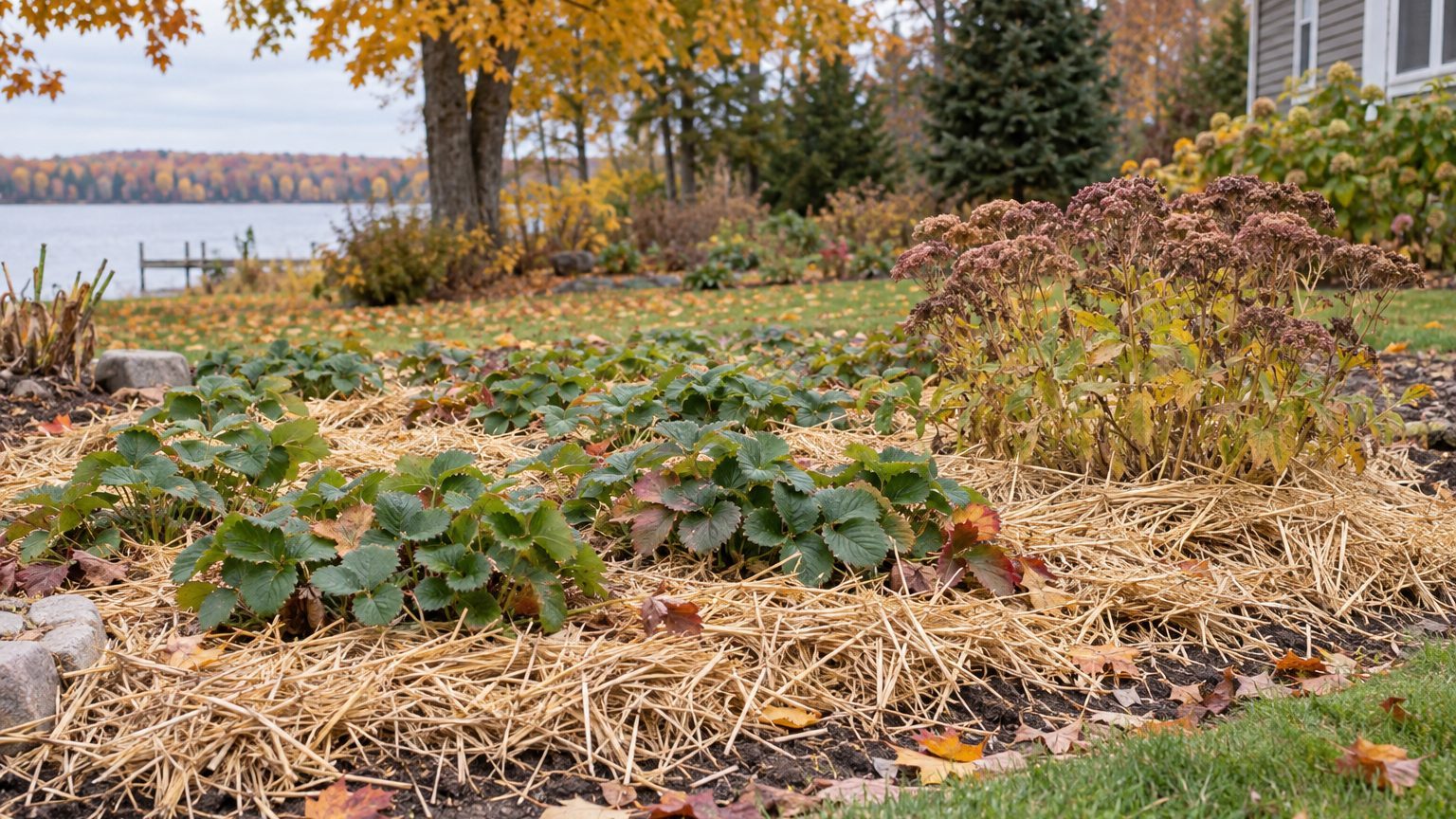

Wait for the ground, not the calendar. Winnipeg’s average first fall frost is September 22 (Environment and Climate Change Canada, 1981-2010 normals), but winter mulch belongs weeks after that, once the soil has started to freeze. Strawberries get a loose straw blanket then. Borderline perennials get a ring of mulch. Most hardy prairie perennials need nothing at all.
When to put winter mulch down in Manitoba
Gardeners raised on the idea that mulch keeps plants warm tend to get this backwards. Winter mulch does the opposite job: it keeps the soil cold and steady. The damage that kills strawberry crowns and young perennials rarely comes from the deep cold itself. It comes from soil that freezes, thaws in a warm spell, and freezes again, pushing shallow roots up out of the ground. A layer applied at the right moment holds the ground frozen through those mid-winter thaws.
Put it on too early and the logic flips. Soil still holding autumn warmth under a blanket of straw or leaves stays damp and mild, and crowns start to rot. Mice and voles, always looking for a sheltered spot before the snow, move in. So the trigger is a change in the ground, not a date on the calendar.
Why September 22 is not your date
The September 22 figure is a mean date from the Winnipeg Richardson International A station (climate ID 5023222). In roughly one year out of two, the first frost arrives later than that. It marks the middle of a window, not a safe date. It also says nothing about when the ground freezes. A first frost is a night when air dips to 32°F (0°C) or below, and soil takes much longer to follow. Plenty of gardens see a light frost in September and then weeks of mild autumn afternoons.
Plan on mulching several weeks after that first frost, once the plants have shut down and hard freezes are showing up night after night. The window closes when deep snow arrives. Snow is a better insulator than any straw, so mulch is really your stand-in for the years when snow comes late or thin. You can pin down the local timing with the First and Last Frost Dates in Manitoba ranges, then count forward from there.
Reading the ground
Skip the guesswork and check the soil. Leaves are down, perennial tops are brown or flattened, and strawberry foliage has been hit by several frosts. Push a trowel into the bed in the afternoon. If the top crust is stiff and hasn’t softened by midday, the ground is freezing. That is the moment to mulch.
Mulch after the ground starts to freeze, which is weeks after the September 22 average first frost, not on that date.
One adjustment for colder parts of the province. Northern and higher-elevation districts get their first fall frost earlier than Winnipeg, so their whole autumn sequence shifts earlier too, and the ground there freezes sooner. The Winnipeg numbers are a starting point, not a province-wide schedule. More local detail lives in the Manitoba guides.
Strawberries
Strawberry crowns are the growing point of the whole plant, sitting right at the soil surface. That makes them unusually exposed. Winnipeg’s coldest month has a mean daily minimum of -21.4 °C (ECCC, 1981-2010 normals; that is -6.6 °F for anyone comparing with US figures), and this is the average, not the record. A bare crown on a night like that is in trouble, and worse when there’s no snow on it.
Two things hurt them. One is straightforward cold with nothing over the crown. The other is heaving: repeated freeze-thaw cycles lift the plant, tear roots and leave the crown sitting on top of the soil by spring. A layer of mulch tackles both, mostly by keeping the ground from thawing and refreezing in a stop-and-start pattern.
What to use and how much
Clean straw is the standard choice. Clean means straw, not hay: hay is full of seed and turns strawberry beds into a weed nursery. Wheat or oat straw fluffs up, sheds water and traps air, which is what you want over crowns. Shredded leaves can work between rows, but whole leaves mat into a wet blanket and are a poor choice directly on the plants.
For depth, the sourced guidance comes from NC State Extension, and it is written for mulch in general, not winter straw specifically: “A 2-inch to 3-inch layer of mulch suppresses most annual weed seeds and makes it easy to hand-pull any that do germinate.” Straw is light and settles, so check after the first snowfall. Top up if crowns are showing, and don’t pile it much beyond that range. More isn’t better. Too heavy a cover holds moisture against the plants. Broader principles are covered in Mulching Without Killing the Plant.
Pulling it back in spring
The spring job matters as much as the fall one. Check under the straw as the snow melts and days warm. Growth that is pale yellow or yellow-green under the mulch means the plants are waking up and need light. Rake the straw off the crowns and settle it between the rows, where it keeps berries clean and suppresses weeds. Keep it close, because a frost night after bloom means you may want to pull it back over the plants.
Cover strawberries after the ground begins to freeze, and uncover when new growth turns yellow-green under the straw in spring. The full bed-care picture is in Growing Strawberries.
Perennials and borderline plants
Natural Resources Canada places Winnipeg in Canadian hardiness zone 3b, using 1991-2020 climate normals. That is the Canadian system, built on seven climate variables, and it does not convert to a USDA zone. Note also that the frost figures elsewhere in this article use the older 1981-2010 normals. The two datasets cover different years, so treat them as separate tools.
What matters practically is this: plants sold locally and rated for the prairies are built for these winters. A tough, established peony or daylily has no use for a mulch blanket. The plants that benefit are the ones living close to their limit. That includes perennials planted this fall or this season, shallow-rooted plants, and anything rated for a milder zone than yours that you decided to try anyway. Garden mums, lavender, some shrub roses and coral bells are common examples of plants that tend to test the limit on the prairies. The safest way to sort your own garden is to check each plant’s rated zone against 3b, and mulch the ones at or near the edge.
A ring, not a pile
Shape is what separates mulch that protects from mulch that kills. Apply it as a ring around the crown, starting a little out from the stems and covering the root zone beyond. Heaping it against the crown holds moisture there, and crowns of many perennials rot under wet cover. Think donut, not volcano.
On depth, the same NC State Extension source gives a second line, about trees: “Provide a 3-inch layer of mulch to reduce water loss and maintain uniform soil moisture and temperature around roots.” Between the two quotes, the sourced depth is 2 inches to 3 inches. Stay inside that range and keep it thinner against the stem itself.
Choosing the material
| Material | Works well for | Watch for |
|---|---|---|
| Clean straw | Strawberries, new perennial plantings | Settles over winter; hay brings weed seed |
| Shredded leaves | Around established borderline perennials | Whole leaves mat and hold water |
| Evergreen boughs | Crowns and low plants after the ground freezes | Needs a supply; holds snow in place |
| Wood chips | Around shrubs and beds year-round | Slow to shed water; keep off the crowns |
Herbs follow similar logic. Hardy perennial herbs often need less than people give them, while marginal ones are fussier about drainage than warmth. The details are in Getting Perennial Herbs Through the Winter.
Put mulch on new and borderline perennials only after the soil is freezing, as a ring 2 to 3 inches deep with a gap at the crown.
What goes wrong
Most winter mulch failures come from a handful of avoidable mistakes, and each leaves recognizable evidence by spring. Knowing what they look like lets you catch them early.
Mulching too soon
If mulch goes down while the soil is still soft and mild, the crowns sit in damp warmth. In spring you’ll find mushy, dark crowns, or plants that never leafed out. The fix is patience: wait for the trowel test, not for the September 22 average first frost, which is only the middle of a window that half of years overshoot. Frost dates and freezing soil are different events, and the soil comes later.
Matted, soggy mulch
Whole leaves, especially maple, pack into a wet mat that starves crowns of air. Come spring it looks like a gray-brown sheet stuck to the ground, often slimy underneath. Use straw or shredded leaves instead, and keep cover loose and airy.
Voles and mice
Rodents look for shelter that is dry and close to food. A thick mulch layer laid over unfrozen ground is ideal. The giveaway is small runways through the straw and chewed crowns or bark at the base of woody plants. Delay mulching until the ground is freezing, keep it away from the trunks and crowns, and don’t pile it deep beyond the 2-inch to 3-inch range.
Forgetting to uncover
Leave straw sitting on strawberries too long and new growth comes up pale and stretched, with fewer flowers and more rot. Check the plants as the snow melts, and pull the mulch back once you see yellow-green shoots. Uncover once growth starts, but keep the straw handy through the last spring frost range.
Common questions
Can I mulch strawberries right after the first frost?
Not in most years. A first frost only means air temperature dipped to freezing. The soil is usually still warm, and mulching then invites rot and rodents. Wait until the ground itself begins to freeze, which in Winnipeg is well past the September 22 average first frost.
Is Winnipeg’s timing right for the whole province?
Only as a starting point. The figures come from one station, and northern and higher-elevation districts get their first fall frost earlier, so fall jobs, including mulching, move earlier there. Use your own garden’s soil as the final check.
Do I need to mulch perennials that are rated for zone 3b?
Established plants rated for your zone generally don’t. Mulch is for plants at the edge of their range, new plantings and shallow-rooted plants. Natural Resources Canada rates Winnipeg as Canadian zone 3b, so compare each plant’s rating against that, remembering it is a Canadian system and not a USDA one.
How do I know when to take mulch off in spring?
Lift a handful of straw over the crown once the snow is gone. Yellow-green growth under it means the plants need light. Pull the straw back between the rows and leave it close by, since a frost after bloom can call it back into service.