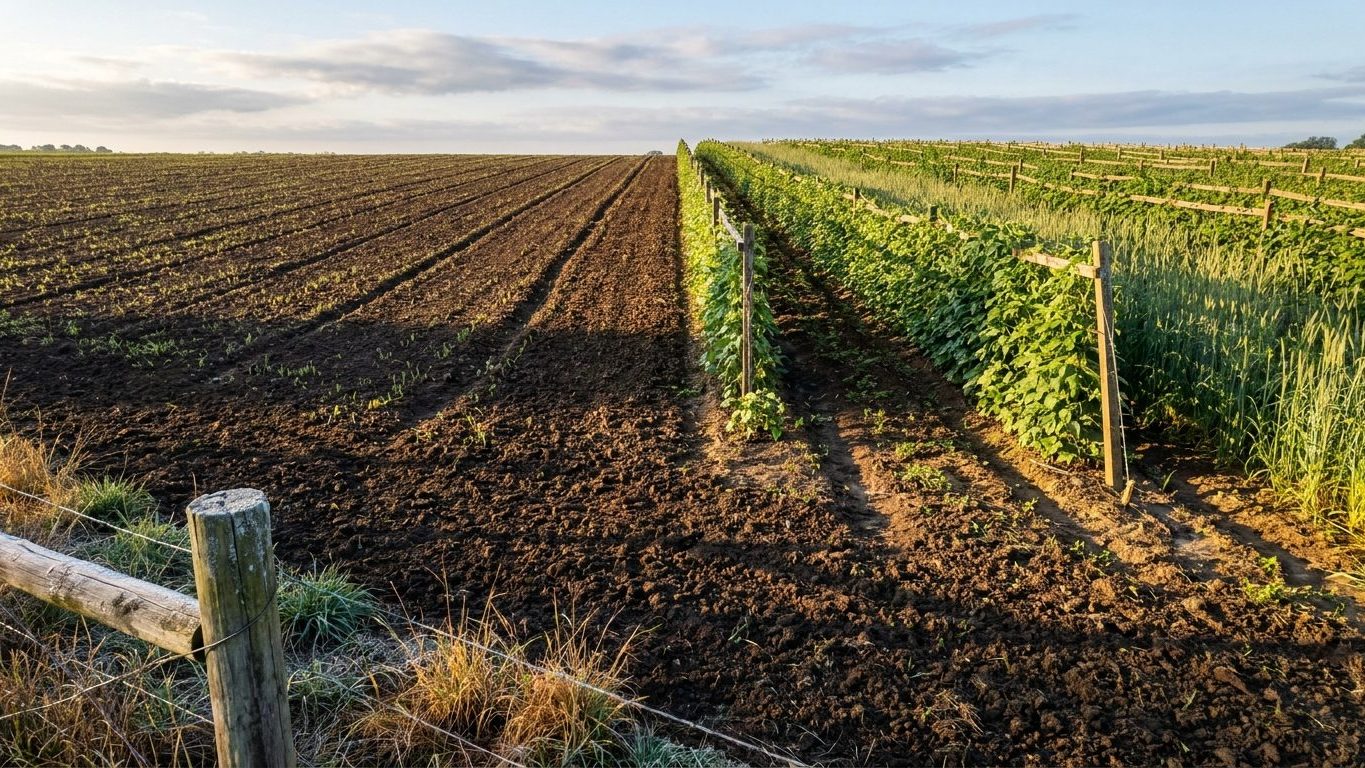

In Delaware, hardy cover crops go in from late summer into early fall, while frost-tender ones wait for spring warmth. The dates below come from one airport weather station, so most gardens will want to shift them. Everything here is a starting point for the state as a whole. The parent guide, Cover Crops for Delaware Gardens, covers the bigger picture.
The short answer for Delaware
Sow hardy cover crops in late summer to early fall, so they are up and rooted before the first fall frost window of October 26 to November 7. Sow frost-tender cover crops in spring, after the last spring frost window of April 3 to April 14.
Those windows come from the NOAA NCEI 1991-2020 Climate Normals, specifically the 32°F freeze probabilities (the 30-70% band) at station USW00013781, the reference-city airport station. So they are a probability of a freeze at 32°F, not a date on which one will arrive. A freeze can show up before the window or slip past it.
The other number that shapes the calendar is the cold itself. The mean daily minimum of the coldest month at the Wilmington reference station is 25.6°F. That is the average night, not the record low. An average night well below freezing kills every frost-tender species outright, while hardy ones such as cereal rye keep growing slowly through winter.
| Marker | Reference-city figure | What it means for sowing |
|---|---|---|
| Last spring frost | April 3 to April 14 | Earliest sensible window for tender summer covers such as buckwheat |
| First fall frost | October 26 to November 7 | Hardy covers should be up and rooted before this window opens |
| Coldest-month mean daily minimum | 25.6°F | Tender species die; hardy ones survive |
Gardens outside the airport’s footprint usually run behind it. Suburban and rural plots often see the last spring frost later and the first fall frost earlier, by one to two weeks, and more at elevation. For fall sowing, that means treating the airport’s October 26 as a ceiling, not a target. Which species suits which window is a separate question, handled in The Best Cover Crops for Delaware.
What will not work here
Tender species sown in fall fail first. With an average coldest-month night of 25.6°F, buckwheat and other frost-tender covers die at the first freeze. That is fine if you want a winter-killed mulch, and a waste if you wanted living roots holding soil until spring.
Sowing late is the second trap. Delaware’s frost-free stretch runs about six months, from the April window to the October-November one, and that generosity makes people complacent. Mild October days feel like permission to sow in November. Slower starters, legumes like crimson clover and hairy vetch among them, can sit as tiny seedlings when hard cold arrives, and tiny seedlings fix little nitrogen and cover little ground. Cereal rye forgives lateness better than anything else, which is why it dominates fall recommendations.
Then there is the airport problem. Wait for October 26 because that is the number you found, and a rural garden may already be a week or two past its own frost. The reference figure describes a flat, paved, urban-edge station. Open fields and low pockets where cold air pools behave differently.
Spring has its own mistake. April 3 to April 14 is the stretch where freeze odds sit in the 30-70% band, so a freeze after April 14 is less likely but not ruled out. Sowing buckwheat on the first warm afternoon in the window is a bet, and an unprotected seedling loses it. Waiting until the window has plainly closed costs a week or two of growth, while an early sowing can cost the whole stand.
One thing this page cannot judge is rainfall. It carries no precipitation figures for Delaware, so it cannot say how dry your late-summer seedbed will be. If the soil is dust-dry, sowing just ahead of a forecast rain beats hauling a hose around every few days, which few gardeners sustain.
What changes across Delaware
The USDA Plant Hardiness Zone Map (2023 edition, built on 1991-2020 normals) puts Delaware in zones 7a to 8a. That spans three half-zone steps (7a, 7b, 8a), so there is no single answer for the state. A gardener at one end of that spread and one at the other should not use identical calendars.
Zones deserve a careful reading. The USDA system rests on one variable, the average annual extreme minimum temperature. It says whether a plant survives the winter low. It says nothing direct about when the last spring frost lands or the first fall frost arrives. Two gardens in the same zone can therefore have frost dates a week or more apart.
The reference station is in Wilmington, at the state’s northern end. Gardens farther south, and those near the water, generally sit toward the milder end of the range, with more room before fall cold. A reader in the north, or anyone on a cold-air-prone patch, should shift fall sowing earlier and spring sowing of tender covers later than the airport figures suggest. Delaware is low and flat, so elevation matters less here than the contrast between open farmland, town lots and sites close to tidewater.
To find your own zone, use the USDA Plant Hardiness Zone Map and enter your ZIP code. Do not guess from a neighbor’s tomatoes or from a county line. Then treat that zone as one input and your frost dates as another.
Where to check this for your own county
Start with University of Delaware Cooperative Extension, the state’s land-grant extension service. Delaware has three counties, and the extension has staff and publications that speak to local conditions in each.
Look for two things. The first is a local planting calendar for cover crops, with sowing dates keyed to your area rather than a statewide guess. The second is a list of the varieties trialled in your county: which rye, clover or vetch actually established and overwintered on soils like yours. Trial results beat any general rule, because they come from real plots under real Delaware weather.
This page does not have a Delaware county cover crop calendar, and it will not borrow one from another state. Extension calendars are also usually published per species, not per state, so check the one that matches what you intend to sow. Winter-hardy small grains and summer annuals run on opposite halves of the year.
A county recommendation beats a state one. This page is the state one: reference-city frost figures, a zone range and general reasoning. It gets you into the right month. The county answer gets you into the right week. If the two disagree, go with the county.
Checking this against your own garden
Your garden’s own behavior outranks every date above. Three observations cost nothing and need no equipment.
Soil warmth by feel. Push your hand a few inches into a bed in the morning. Soil that feels cold and clammy is not ready for tender seed, and a bed that feels noticeably warmer than another tells you which spot warms first. Compare a sunny, sheltered bed with an open or shaded one, and you have mapped your microclimate.
The first flush of male flowers. On squash and cucumbers, male blooms open before female ones. Note the date they appear and which bed opens first. Warm beds flower early, and the order stays fairly consistent year to year. Jot it down, and you have a personal benchmark for when your garden crosses into summer.
The first true leaves. After cotyledons, a seedling’s first true leaves mark real establishment. Watch how many days your sown cover takes to reach that stage in different spots. A patch that is slow in fall is a patch that needs earlier sowing next year.
Some gardeners also time this by the Moon: when to plant cover crops by the moon, as almanac tradition rather than fact.
Common questions
Can I still sow cover crops in Delaware after November 7?
November 7 is the late end of the first fall frost window at the reference station, so sowing after it is a gamble. Cereal rye is the likeliest to give something back from a late sowing. Slow starters seldom do. Rural gardens may have passed their own frost date earlier.
Is April 3 safe for sowing buckwheat?
No. April 3 to April 14 is the freeze-probability window at the airport station, and April 3 is the early edge. A rural garden may see frost later. Wait until the window has closed and your soil feels warm.
Do I use the same dates in Sussex County as in New Castle County?
Not necessarily. The reference figures come from a station in the north, and the state spans zones 7a to 8a. Check your county extension office for local dates.
Should I sow before or after clearing the vegetable bed?
Time it to the frost window, not to the harvest. If a bed is still producing as late summer turns to fall, the hardy cover has to wait or be worked in between rows. A late-sown cover in a cleared bed will do far less than an on-time one, so plan the cover around the frost dates rather than the other way around.