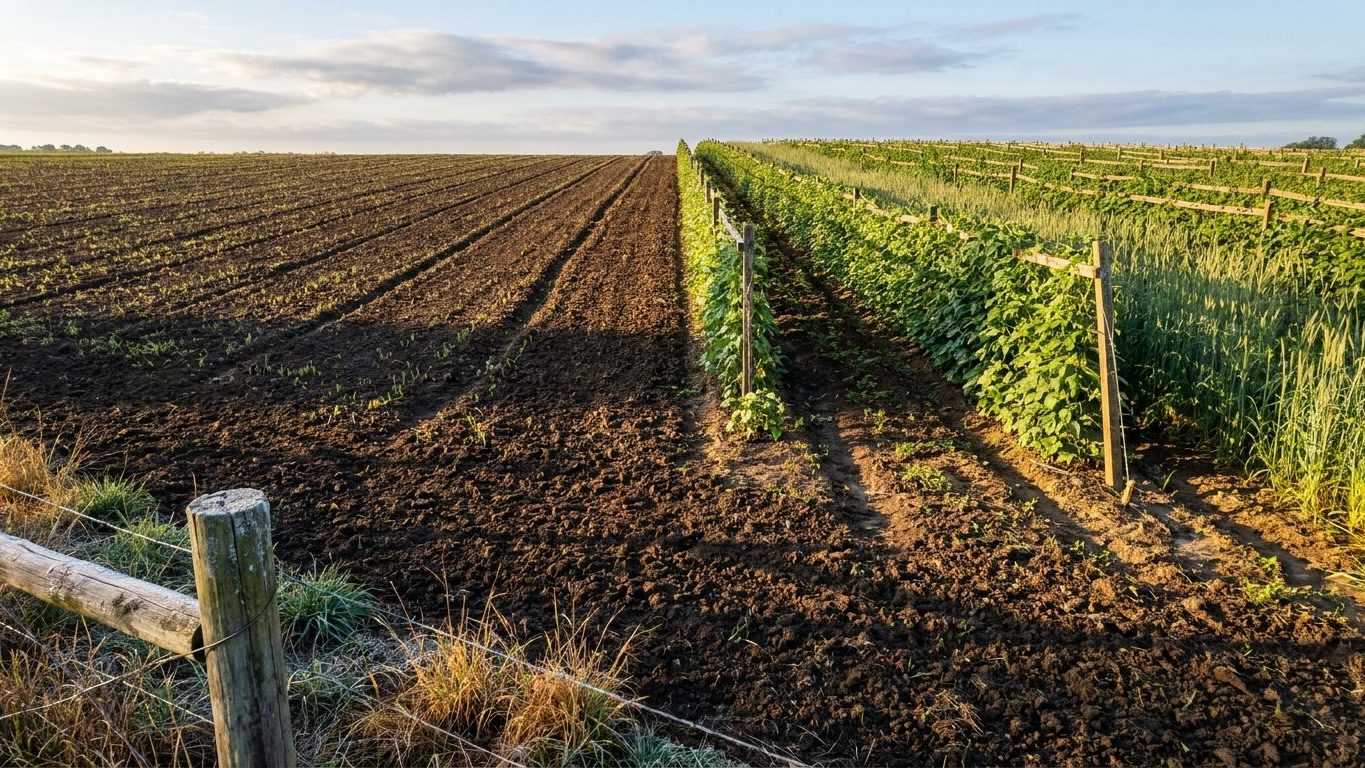

Sow cover crops in Hawaii whenever you can count on moisture, which in the lowlands means almost any month. There is no frost date to wait for. NOAA’s 1991-2020 normals for the Honolulu reference station show zero days per year at or below 32°F. The sowing calendar here is set by rainfall, elevation, and whether your garden faces the wet or dry side of its island.
The short answer for Hawaii
For lowland and mid-elevation gardens, the sowing window is open all year, and the thing that closes it is dry soil, not cold air. Sow when the seedbed will stay damp long enough for seedlings to root, either because rain is dependable or because you can irrigate. Then time the sowing backward from the day you want to plant your food crop, so the cover reaches flowering and gets cut before that date.
What a frost date measures
On the mainland, a “last spring frost” is a probability: the date after which the chance of a 32°F freeze drops below some percentage, often 10 or 50. A first fall frost is the mirror image. Both depend on freezes actually happening often enough to calculate. In Hawaii’s inhabited areas they don’t. NOAA’s 1991-2020 Climate Normals return a not-computable flag for every freeze percentile at 32°F and 36°F, which is the data’s way of saying there is nothing to compute. You can check the NOAA NCEI normals for the Honolulu station yourself.
Frost does occur in Hawaii, but only on the high volcanic summits of Mauna Kea, Mauna Loa, and Haleakala. Nobody gardens there. So any calendar built on frost dates, including the ones printed on mainland seed packets, has no starting point in the islands.
What sets the window instead
The coldest month at the Honolulu reference station still has a mean daily minimum of 66.8°F. That is warmer than the overnight lows many mainland gardeners see in midsummer. Seeds don’t stall for lack of warmth in the lowlands, and growth doesn’t pause for winter.
That leaves rainfall as the gate. On many leeward coasts the drier stretch of the year and the wetter stretch are well separated, and sowing just ahead of dependable rain saves a lot of hand-watering. Windward sides get moisture much more evenly, so the window is wider there, though you will want a few dry days to prep the bed. If you are choosing among species for those conditions, The Best Cover Crops for Hawaii covers that decision by type. For the wider picture of why cover crops earn their place in island soils, start with Cover Crops for Hawaii Gardens.
One gap to flag: this page does not have a county-by-county rainfall calendar, and it will not invent one. Section four tells you where to get it.
What will not work here
Mainland timetables fail first. Advice like “sow winter rye in September and let the cold kill it in spring” depends on a winter that does not exist here. With a coldest-month minimum of 66.8°F, nothing is going to freeze-kill your cover crop. It will keep growing until you stop it, and a cover crop that sets seed becomes next season’s weed problem.
Cold-dependent tricks and termination
Cover crops chosen because they “winterkill” are the clearest mismatch. On the mainland, frost does the termination work for free. In Hawaii, you are the frost. Plan to cut, mow, or crimp every cover crop on purpose, and do it at flowering, before seed forms. Plants bred for a cold-season cycle may also behave oddly in constant warmth, growing fast and lanky rather than building the dense mat you were after. If a variety’s description leans on “winter hardy” or “vernalization,” it was written for somewhere else.
Waiting for a safe date is a quieter failure. A new gardener who read mainland guides may hold off sowing until “after the last frost” and lose months of soil cover. In the lowlands there is no such date, so the wait buys nothing, and bare soil in a tropical downpour loses topsoil quickly.
Weekly watering and tight spacing
On the dry leeward side, a once-a-week soak does not carry seedlings. Seeds sprout after the first watering, then the surface dries out under strong sun and wind, and the tender roots die before the next soak. Either irrigate lightly and often until the seedlings have true leaves, or sow just ahead of dependable rain and skip the hose.
On the windward side the problem reverses. Constant moisture and humidity punish dense, close seeding. Thick stands stay damp, invite mildew and fungal disease, and shade out their own lower leaves. Heavy rain can also wash broadcast seed off a slope before it germinates, so on sloped ground you need light raking or a covering of mulch to hold it down. Wide, even stands that dry out between showers do better than a packed carpet.
Last, the slowest cover crops make little sense where you are trying to turn the bed over quickly for food crops. Heat speeds everything up, so a species that needs a long maturing season on the mainland may be ready much sooner here, and one that was already slow may simply hold your bed hostage.
What changes across Hawaii
Hawaii is not one garden. The USDA Plant Hardiness Zone Map (2023, built on 1991-2020 normals) places the state anywhere from zone 9a to 13a. Those zones rest on a single variable, the average annual extreme minimum temperature, and four zones’ worth of spread means there is no single answer for the state. The warm end belongs to sea-level coasts. The cool end belongs to higher ground. Honolulu is the reference point behind the 66.8°F figure used on this page, and other parts of the state differ from it.
Which zone applies to you depends on your exact spot, and this page won’t guess. Look up your address on the USDA map instead, then use the table below as a rough guide to what to shift.
| Setting | What to shift in your sowing |
|---|---|
| Leeward lowland | Tie sowing to the start of dependable rain or to your irrigation capacity. Expect the shortest wet window and the fastest drying. |
| Windward lowland | Wide sowing window. Favor open spacing and good drainage, and avoid heavy broadcast seeding on slopes. |
| Higher elevation | Soil is cooler, so germination and growth run slower. Allow more weeks between sowing and flowering, and scale back plans that assume lowland speed. |
A reader up the slope of a volcano should assume cooler soil and a slower cover crop than the Honolulu numbers suggest, even though frost is still not part of the picture for gardens at normal living elevations. A reader on a dry leeward coast should assume the opposite problem, moisture, comes first. Same state, nearly opposite planning questions.
Where to check this for your own county
For anything more specific than this page, go to the University of Hawaii College of Tropical Agriculture and Human Resources (CTAHR) Extension, the state’s land-grant extension service. Look for two things: a planting calendar for your island or district, and any cover crop varieties that have been trialed in your county rather than in a general test plot elsewhere.
The difference matters more in Hawaii than in most states. A trial on a wet windward farm tells you little about a dry leeward lot a few miles away, and a result at sea level may not carry to a garden up the slope. Ask whoever answers which site the trial ran on, what the rainfall and elevation were, and how long the cover crop took to reach flowering. Those details let you judge whether the result fits your ground.
A county recommendation beats a state one, and this page is the state one. It tells you the frame (no frost calendar, rain and elevation rule, exposure matters) but not the weekly specifics for your zip code. Treat its guidance as a starting point, then let the local numbers overrule it wherever they disagree.
One honest limit: the page does not have a Hawaii county calendar or trial results in hand, so it names none. If an extension office gives you a date that differs from anything here, go with theirs.
Checking this against your own garden
Your own observations outrank every date on this page. Three things are worth watching, and none needs equipment beyond your hands and eyes.
- Soil warmth by feel. Push your hand a few inches into the bed in the morning. Soil that feels cool compared with a lowland neighbor tells you that you are at an elevation or in a shaded pocket where germination and growth will lag, so allow extra weeks.
- First true leaves. After the seed leaves, the next set is the real test. If seedlings reach it before the soil dries out, your timing and moisture are working. If they stall or die before it, you sowed too far ahead of the rain.
- First flush of male flowers. On grass-type covers this is the tassel, and on others the first blossoms. This is your cue to cut, and the number of days from sowing to that moment is your own local growth rate, more reliable than any seed packet.
Write down the sowing date and the date of each sign. After one cycle you will have a calendar for your exact spot, and after two you will know how much it shifts with the seasons.
The Moon calendar is a separate, older custom: see when to plant cover crops by the moon, written as tradition rather than fact.
Common questions
Can I sow cover crops in Hawaii any month of the year?
In the lowlands, yes, as far as temperature goes. There is no freeze in inhabited areas, and the coldest month still averages a daily minimum of 66.8°F at the Honolulu reference station. What limits you is moisture, so sow when rain is dependable or you can irrigate.
Is there a last frost date I should wait for?
No. NOAA’s 1991-2020 normals show zero days per year at or below 32°F for the Honolulu station, and the freeze percentiles cannot be computed. Frost happens only on the high summits of Mauna Kea, Mauna Loa, and Haleakala, not where people garden.
Why don’t mainland cover crop calendars work in Hawaii?
They are built around frost dates and winter cold, including crops chosen to winterkill. Here nothing freezes, so you must terminate the cover crop yourself, and dates keyed to frost have no meaning.
Which hardiness zone is Hawaii in?
The USDA 2023 map places the state across zones 9a to 13a, so there is no single answer. Check the USDA map for your own address rather than relying on a statewide figure, and keep in mind that the zone reflects minimum temperature only, not rainfall or exposure.