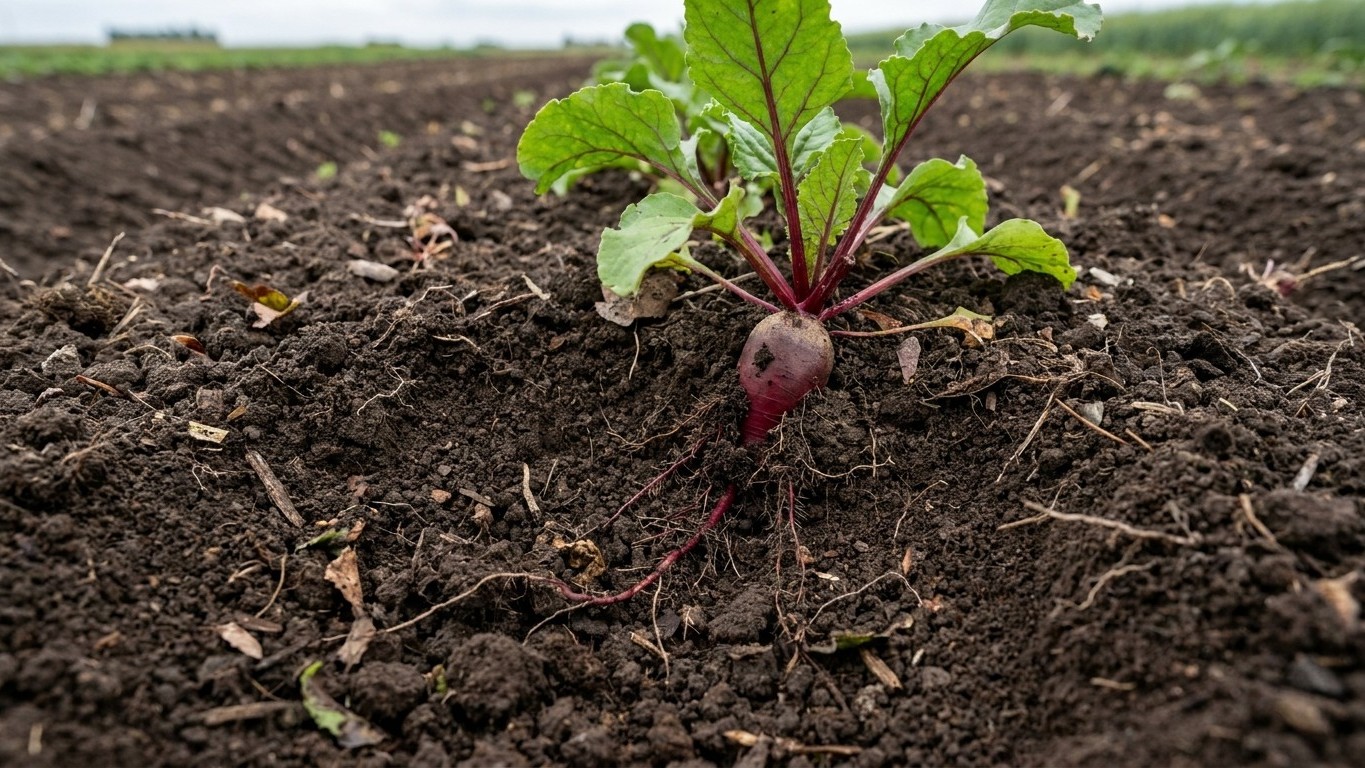

Pull Kentucky beets 60 to 80 days after the seed went into the ground, counted from sowing, because beets are sown in place and never transplanted. Get them out before warm weather and dry soil turn the root woody. Then comes the part that surprises gardeners used to carrots and potatoes: storage. Top the roots right away and hold them at 33 to 36 F, not at the lowest temperature you can manage. For beets, colder is not better.
The short answer
What the Crider numbers say to a beet
Kentucky’s official state soil is the Crider series, an Alfisol, which is a forest soil of moderate fertility that holds nutrients reasonably well. USDA records its surface horizon as loam to silt: 5 percent sand, 19 percent clay and 76 percent silt. Organic matter sits around 3.0 percent, surface pH is about 6.2 (slightly acid), and the drainage class is well drained. Those are representative values across 255 mapped components of the series, from USDA NRCS Soil Data Access. They describe the soil that stands for the state. They do not describe your bed.
That caveat matters. A state spans hundreds of soil series, and river bottoms, hill country and any lot a builder scraped or filled will behave differently. Treat Crider as a starting point, then send a sample to your county Extension office for your own numbers. The pH above is the series’ pH, never yours.
Now cross it against what a beet wants. Utah State University Extension describes the ideal as deep, sandy, well-drained soil rich in organic matter, amended with no more than 1 inch of composted organic matter per 100 square feet. Crider gives you the well-drained part and is deep enough for a root crop. It is not sandy at all, with only 5 percent sand against 76 percent silt. Fine silt tends to pack and crust when beaten by rain, and a crust is a hard thing for a beet seedling to push through. So the soil’s habit is to drain well but seal at the surface, and the work in your bed is keeping that surface open and evenly moist.
Heat, and the 90 F question
The brief for this page asked for the number of days a year Louisville passes 90 F. That count is not published here, and I won’t guess at it. What matters more is that the beet’s own threshold is lower. Utah State Extension says heat above 85 F combined with water stress makes the root woody. Every day you count at 90 F understates the days that bother a beet. Woodiness is a late-season failure of the root, and it is separate from bolting, which belongs to the first weeks of growth (more on that below).
The practical reading: sow early enough that the roots size up before real summer heat arrives, then pull them rather than leaving them to sit through the first hot, dry stretch. Beets that stay in the ground into warm weather are the ones that turn tough. For the wider picture of the crop in this state, see Growing Beets in Kentucky, and for what the root will meet underground, Beet Soil in Kentucky: What the Root Will Meet.
The six weeks that decide it here
Where the calendar lands
Sowing two to three weeks before the last spring frost is the standard timing for beets. For Louisville, NOAA NCEI climate normals put the last 32 F freeze between March 24 and April 4 (the 30 to 70 percent probability band). Work backward and the sowing window runs from roughly March 3 to March 21. Count 60 to 80 days forward from those dates and harvest falls from early May into the first part of June.
One adjustment. NWS Louisville warns that this urban station runs later in spring and earlier in fall than the surrounding rural parts of Jefferson County. A rural garden should expect a tighter window than the one the station shows. Treat the dates as a guide and watch your own thermometer.
Where the bolting risk sits
Bolting is premature flowering, and Utah State Extension ties it to water stress in the first six weeks. If you sow in the second week of March, those six weeks run to about the end of April. That is the stretch that decides whether a beet makes a root or sends up a flower stalk.
What does a Kentucky spring do in those weeks? It swings. Cool, soaking spells alternate with warm, breezy days that dry the top inch of soil quickly, and a well-drained silt dries from the surface down faster than many gardeners expect. The risk is not the wet stretch, which is the crusting problem. The risk is the dry week in mid to late April, when the seedlings are small, the roots are shallow and nobody is watching the bed because it rained ten days ago. A soil that drains well gives the beet less cushion in that dry week.
So the early weeks call for steady moisture, not heavy soaking. A light mulch of finely shredded material or a thin cover over the seed row slows surface drying and softens the crust. Check the top inch with your finger rather than the calendar. Once the roots are sizing up, the later failure takes over. Heat above 85 F plus thirst makes woodiness, and that is a different problem with a different fix: harvest on time and keep the bed from drying out in the final weeks. Do not merge the two into a single instruction to keep it watered. The first protects the plant’s decision to make a root. The second protects the quality of a root that already exists.
What goes wrong here
In the bed
- Bolting from early thirst. A dry week in the first six weeks pushes the plant toward flowering. Remedy: mulch the row lightly, check moisture by hand every few days in April, and water before the seedlings wilt, not after.
- Woody roots from later heat. This is a separate failure. Heat above 85 F combined with water stress toughens the root. Remedy: count 60 to 80 days from seeding, pull on schedule, and keep the bed evenly moist in the last weeks before harvest.
- Crusted surface and patchy stands. Silt-heavy ground tends to seal after a hard rain, and since beets are sown in place, a failed row means reseeding. Remedy: cover the seed with a thin layer of fine compost or screened soil, and keep the surface damp until the seedlings are up.
- Too much compost. More organic matter feels like a gift, but the guidance from Utah State Extension is no more than 1 inch of composted organic matter per 100 square feet. Crider already carries about 3.0 percent at the surface. Remedy: stay under that limit and let a soil test, not instinct, tell you what else is missing.
- Assuming your soil is Crider. River bottoms, hill ground and builder fill can be nothing like it. Remedy: test before you amend, and read Beet Soil in Kentucky: What the Root Will Meet for what the root meets below the surface. Damage from insects and animals is covered in What Eats Beet in Kentucky, and When.
After the pull
- Leaving the leaves on. Bunched beets, tops attached, keep only about 10 to 14 days at 32 F and above 98 percent relative humidity. Remedy: top them first, the same day you harvest, before anything goes into storage.
- Storing them too cold. Every other root crop invites you to chill it hard. USDA Agricultural Handbook 66 says the opposite for beets: at 32 to 34 F, more black spot and rot occur than at slightly higher temperatures. The target for topped roots is 33 to 36 F at 98 percent relative humidity. Remedy: put a thermometer where the beets will sit. A refrigerator set at its coldest may land in the range the handbook warns about. For cellars and pits, the handbook says the temperature should never drop below 31 F or climb above 41 F. The full text is in the USDA handbook (PDF).
- Saving the small roots. Large roots keep much better because they lose water and shrivel more slowly. Remedy: set the big ones aside for storage and eat the small ones first. It feels backward, since gardeners usually hoard the best specimens, but the shriveling rate favors keeping size in the cellar.
Common questions
How do I know when a beet is ready to pull?
Start with the calendar: 60 to 80 days from the day you sowed the seed. A target root size is not published in the sources behind this page, so I won’t give one. Check the date, brush back a little soil at the shoulder, and pull a test beet before the whole row.
Can I leave beets in the ground until I need them?
In a spring planting, that is a gamble. Heat above 85 F with water stress makes the root woody, and Kentucky warms up fast after the harvest window opens. Pulling and storing at the right temperature is a safer plan than hoping the weather stays cool.
What is the best storage temperature for beets?
For topped roots, 33 to 36 F at 98 percent relative humidity. Bunched beets with leaves on last about 10 to 14 days at 32 F. At 32 to 34 F, black spot and rot increase compared with slightly warmer storage, which is why colder is not better here.
Is Crider soil what is in my garden?
Possibly, and possibly not. Crider is the state soil, not a guarantee for any particular yard. A state spans hundreds of soil series, and a soil test on your own bed is the only reliable way to know your texture, pH and nutrient levels.