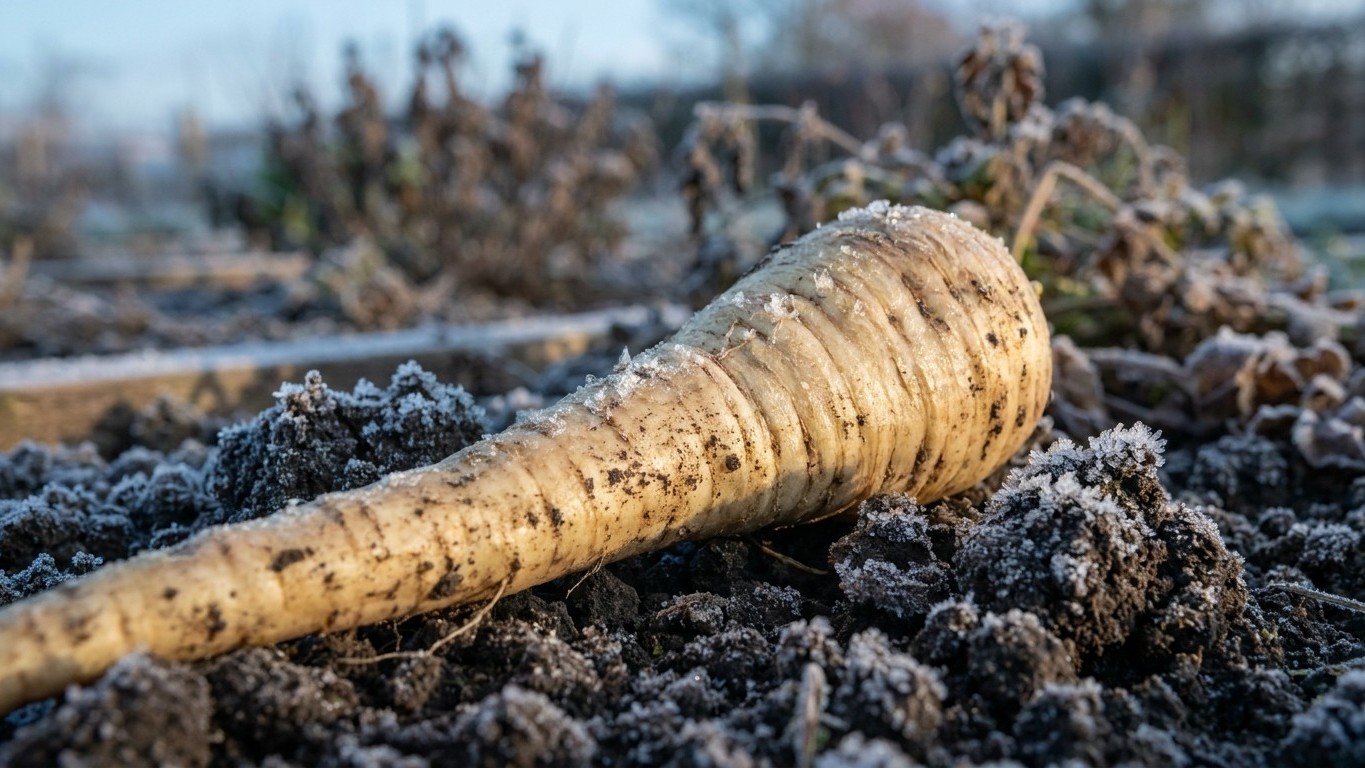

Lift parsnips in Kentucky after several weeks of hard frost, which in practice means December onward, not the day the first frost shows up in early November. Roots dug then are sweet. Stored properly, they keep four to six months, but only at 32 to 34 °F and 98% humidity, and never beside apples. Below: the frost math, the sowing arithmetic, and the failures that spoil the crop here. For the basics of the crop itself, start with Growing Parsnips in Kentucky.
The short answer
Does Kentucky deliver several frosty weeks? The numbers say yes. At the Louisville reference station, NOAA NCEI Climate Normals put the mean daily minimum of the coldest month at 27.8 °F. That is more than four degrees below freezing on an average night, not on a record-setting one. A parsnip grown here will sweeten, not merely grow.
The mechanism comes from Utah State University Extension: parsnips taste best after several weeks of cool, frosty weather, which converts stored starch to sugar. The operative word is exposure. A hardiness zone tells you whether a plant survives the coldest night of the year, and a parsnip survives almost anything. Sweetness depends on how many weeks the roots actually sit in frost, and a comfortable zone number does not guarantee that. Louisville’s winter minimums do, which is why the sweetening question has a good answer here. The longer version is in Will Parsnips Sweeten in Kentucky?
When to lift
The first fall frost at the Louisville station falls between November 2 and November 12 (the 30 to 70 percent probability band for a 32 °F freeze). Count several weeks from there and you land in December. Leave the roots in the ground, dig what you need, and pull one as a taste test before committing the row. Treat the last spring frost, March 24 to April 4, as the outer edge of the season. By then the ground is warming and the plant is about to restart.
One caveat on the dates. The Louisville station is an urban one, and the National Weather Service in Louisville warns that it behaves differently from the rural parts of Jefferson County around it. Rural gardens should expect a tighter window than these dates suggest, so wait for the taste, not just the calendar.
How long they keep
USDA Agricultural Handbook 66 says parsnip roots can be stored 4 to 6 months at 32 to 34 °F with 98% relative humidity (USDA Handbook 66, commercial storage). That is a long keeper by any standard. It also assumes a cold, wet, steady chamber that almost no house provides. A kitchen fridge gets the temperature close and the humidity wrong, so expect less than the full six months from a household setup.
Parsnips are not chilling sensitive, so cold is not the danger. Ethylene is. They produce very little themselves, but exposure to low levels of the gas in cold storage turns them bitter. Keep them away from apples and any ripening fruit. Top the leaves after harvest, but do not trim into the crown.
Does the season fit?
The arithmetic
Parsnips are sown in place, and the 100 to 120 days run from seeding, not from transplanting. Work it through with the Louisville dates.
- Start with the last spring frost: March 24 to April 4.
- Sow 2 to 3 weeks before it. Three weeks ahead of March 24 is about March 3, and two weeks ahead of April 4 is about March 21. Your sowing window runs from early March to the third week of March.
- Wait for germination. It takes 14 to 21 days, and the row looks like bare soil the whole time. Do not dig it up or re-sow before three weeks have passed.
- Add 100 to 120 days to the sowing date. A March 3 sowing reaches 100 days around June 11 and 120 days around July 1. A March 21 sowing reaches 100 days around June 29 and 120 days around July 19.
- Compare that with the first fall frost, November 2 to November 12. The latest maturity date, July 19, leaves about 106 days to spare before November 2. The earliest, June 11, leaves about 154 days before November 12.
- Subtract the frost weeks you need. Those weeks are the real cost, since sweetening needs several of them after the first frost.
What the count means
The fit is comfortable, even generous. The roots finish growing in early to mid summer, months before the first frost. Nothing about the calendar forces a gamble, and a sowing that slips by a few weeks still finishes ahead of November. Even a June 1 sowing plus 120 days lands on about September 29.
The wrinkle is the reverse of the usual worry. The season does not run out, but the roots sit mature through the hottest months, so the plant does not suffer from a short season so much as from a long wait. Watch the rows through summer. Pests keep working while you wait, and What Eats Parsnip in Kentucky, and When covers who shows up and when. Rural gardens, as noted, should plan on a somewhat tighter window than the city station shows, so give yourself margin on both ends.
What goes wrong here
Failures in the ground
- Forked roots from heavy or stony ground. A root that hits clay or a stone splits and forks. Utah State University Extension recommends deep sandy soil, and says heavy soil must be double dug. Kentucky soils vary from one county to the next, so a state soil map is a starting point, not a diagnosis. Push a spade down and see what you hit before you sow.
- Forked roots from overwatering. This is a separate cause with a separate fix, and it can happen in perfectly good soil. Water in steady, moderate amounts and let the top of the bed dry between waterings, instead of keeping it soaked.
- Bare soil that is not failure. Germination takes 14 to 21 days. A gardener who sees nothing at day ten and re-sows risks a row of mixed ages. Mark the row, wait three full weeks, and keep the surface from crusting over in the meantime.
- A winter too mild to sweeten. Averages hide variation. The coldest month averages 27.8 °F at night, but an unusually warm winter, or a sheltered city plot, can give fewer frosty weeks than the normal suggests. The root will still be a good parsnip, just a less sweet one. The fix is patience: leave the roots in the ground longer and taste before you lift the whole row.
Failures after harvest
- Bitter roots from ethylene. Parsnips stored beside apples or other ripening fruit turn bitter, even at the right temperature. Give them their own spot, and remember that a fruit bowl on the counter or an apple in the crisper counts as a source.
- Rot or shrivel from the wrong conditions. The four to six months in the handbook assume 32 to 34 °F at a steady 98% humidity. At home, plan on a shorter life and check them every couple of weeks.
- Damage from trimming too close. Cut the tops after harvest, but stay out of the crown. Cutting into it invites trouble in storage.
Common questions
When should I start lifting parsnips in Kentucky?
Wait until several weeks after the first fall frost, which at the Louisville station arrives between November 2 and November 12. That points to December. Taste one root first. If it is sweet, lift what you need and leave the rest in the ground.
How long can I leave parsnips in the ground?
The facts for this page give no ceiling for in-ground holding, only the frost window. A sensible outer edge is the last spring frost, March 24 to April 4 at the Louisville station, because warming ground restarts growth. Rural gardens may see that window sooner or later, so check the row, not just the date.
How long do lifted parsnips keep?
Four to six months at 32 to 34 °F and 98% humidity, according to USDA Agricultural Handbook 66. Most homes cannot hold those conditions steadily, so expect less, and check the stored roots regularly.
Why did my stored parsnips turn bitter?
Ethylene is the likely cause. Parsnips are not chilling sensitive, but low levels of the gas from ripening fruit such as apples cause bitterness in cold storage. Store them apart from fruit, and top them without cutting into the crown.