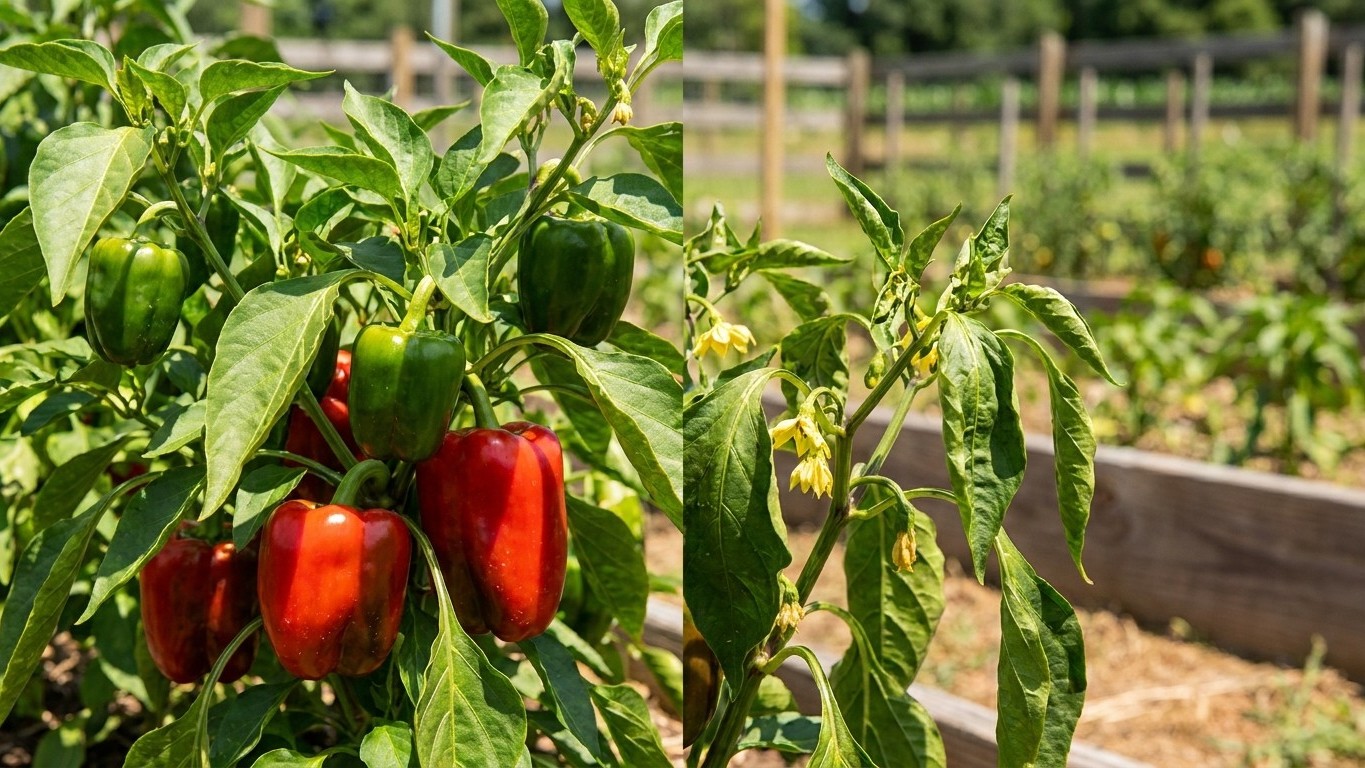

Mostly it’s the weather. Peppers in New York lose ground at two ends of the thermometer: hot days above 90 F and cool nights below 55 F both stop fruit from setting. Add a seed-starting calendar that begins in late winter and three predictable failures (dropped blossoms, scalded fruit, rotted bottoms), and you have the real list of what eats into a harvest here. This page covers the climate side. It does not carry a date-by-date insect calendar, and it won’t invent one.
The short answer
The hot end
At the New York City reference station, NOAA NCEI Climate Normals count 12.2 days a year at or above 90 F. That is about one day in thirty, averaged over many years, so any given summer can run lighter or heavier. Utah State University Extension draws the pepper line in the same place: fruit set fails when days climb above 90 F. Those twelve-odd days are the ones to plan around.
What the number measures matters. It is a heat load, not an average summer temperature. A July that averages out comfortably can still hold a three-day spike past 90 F, and a spike is what a flowering pepper registers. Spread over a whole summer, 12.2 days works out to a handful of hot spells rather than a hot season. My read: that makes heat something to manage with shade and steady water, not a reason to skip the crop.
One caution on scope. This is the New York City figure, taken at a dense urban site. Gardeners upstate or in the Adirondacks will see a different count, and this page does not publish one for those places. Treat 12.2 as a reference point, not as your own number. If your plants are flowering and not producing, Why Peppers Fail to Set Fruit in New York walks through the full diagnosis.
The cool end
Fruit set also fails at the other end of the range: nights below 55 F. This site does not carry summer night minima, so there is no figure here to hold your garden against. You have to watch your own nights. A min/max thermometer set at plant height beside the bed and read each morning costs a few dollars and settles the question with real data. Latitude is no guide, and neither is how cold January gets, so this page does not guess from either.
Start the log on transplant day and keep it going until the plants stop flowering. One night under 55 F is a flag worth noting. A run of them is the signal to act, usually with a row cover thrown over the plants at dusk and pulled off in the morning. Heat and cold take turns, and a gardener who tracks only one of them will be surprised by the other.
For the bigger picture on the crop in this state, start with Growing Peppers in New York.
When to start seed here
The calendar runs backward from the day the plants go outside. Utah State University Extension says to transplant after frost, once the soil reaches 60 F, and that transplants need 8 to 10 weeks indoors. Two anchors, one subtraction. Here is the arithmetic in words, so you can redo it for your own county.
The arithmetic, step by step
- Find your last spring frost date. For New York City, NOAA NCEI Climate Normals put it between March 23 and April 3, the band where the probability of a 32 F freeze falls between 30 and 70 percent (NOAA NCEI station data). That is the city figure, not a statewide one. Upstate New York and the Adirondacks frost later in spring, so look up the station nearest your county.
- Find the date your soil reaches 60 F. A soil thermometer pushed a few inches down gives the real reading. Frost-free air is not the same as warm soil, and peppers need both.
- Take the later of the two dates. That is your transplant day.
- Subtract 8 weeks and 10 weeks. In days, that is 56 and 70. The two results bracket your seed-starting window.
- Run one example to check yourself. Suppose your soil hits 60 F on May 15 (an illustration, not a forecast). Seventy days back is March 6, and 56 days back is March 20. Seed goes into trays somewhere between those dates.
- Count forward to harvest. Clemson Cooperative Extension says peppers should be ready for harvest about 70 to 85 days after transplanting. Add that to your transplant day and compare it with your first fall frost date, which this page does not carry. If the two collide, the answer is a faster variety, and Pepper Varieties That Ripen in a New York Season covers that choice.
Two clocks are easy to confuse here. Clemson counts harvest from transplanting, and the time from flower to ripe fruit runs from flowering. Neither one starts the day seed goes into the tray. Sowing earlier than the window does not shorten either count, and a seedling that outgrows its pot just waits for soil that has not warmed yet.
What goes wrong here
Three failures account for most of the grief that heat, cold and strong sun cause in a New York pepper bed. Each has a cause you can see and a fix you can apply in the same week. Insect and animal damage is a separate subject, and this site does not carry a dated calendar for it.
Three failures and their fixes
- Blossom drop in a hot spell or a cool night. Flowers fall off instead of becoming peppers when days top 90 F or nights dip below 55 F. In the city that hot threshold is reached on 12.2 days in an average year. The fix for heat is shade cloth over the hottest afternoons and even watering. The fix for cold is a row cover at dusk, removed in the morning, plus your own night log so you know when to bother.
- Sunscald. Pale, papery, sunken patches appear on the side of the fruit that faces the sun, and they invite mold. It shows up where the sun is strong and leaf cover is thin, which often means plants stripped of foliage or stressed by heat. Leave the leaves on, shade the bed during a hot spell, and pick fruit that is exposed.
- Blossom-end rot. A dark, leathery patch spreads across the bottom of the fruit. It is tied to uneven moisture and to calcium failing to reach the fruit, and the cause is not always a calcium-poor soil. Keep water steady, mulch the bed to even out swings, and test the soil before you add calcium of any kind.
After the harvest: the fridge mistake
Clemson Extension gives the storage conditions plainly: 45 to 50 F with 80 to 90 percent relative humidity, for two to three weeks. That is warmer than a household refrigerator. Below about 45 F, peppers pit and soften, which is chilling injury, and it is the mistake nearly everyone makes with a good harvest. Two to three weeks is also a ceiling under ideal conditions, not a promise, so plan on using the fruit sooner. A cool, humid spot in a cellar or basement can come close, and the surplus can be cooked or frozen.
Common questions
How many days above 90 F does New York get?
At the New York City reference station, the NOAA NCEI Climate Normals show a mean of 12.2 days a year at or above 90 F. That figure belongs to the city. This site does not publish a count for upstate locations or the Adirondacks.
What night temperature is too cold for peppers?
Utah State University Extension puts the line at nights below 55 F, where fruit set fails. This site does not carry summer night minima for New York, so you have to read your own thermometer rather than infer the number from latitude or winter cold.
How early should I start pepper seed in New York?
Eight to 10 weeks before your transplant day, which is after the last frost and once the soil reaches 60 F. In New York City the last spring frost falls between March 23 and April 3, but soil warmth usually sets the actual date, and upstate gardeners should expect later frost dates.
Can I keep harvested peppers in the refrigerator?
Not for long. Clemson Extension recommends 45 to 50 F, and a refrigerator runs colder than that. Below about 45 F peppers pit and soften from chilling injury. Even under ideal conditions, two to three weeks is the maximum.