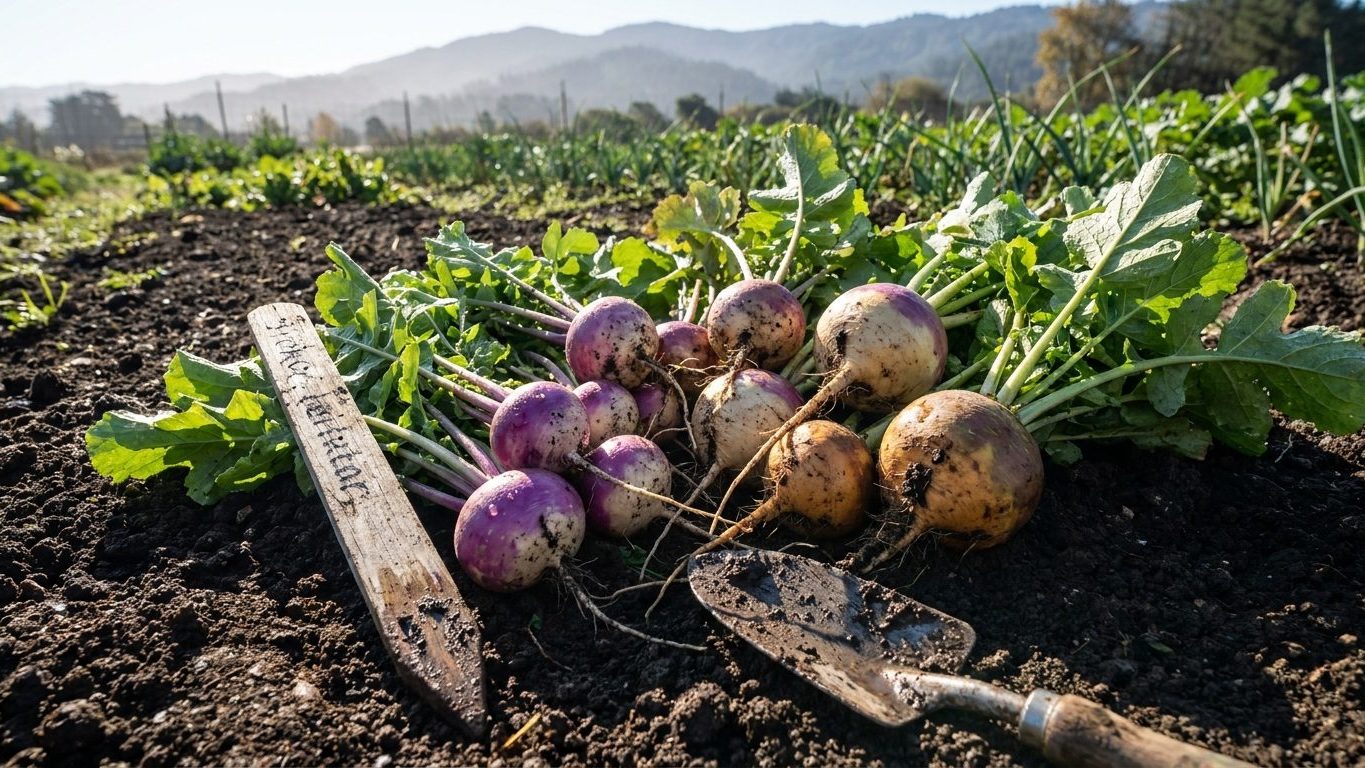

For South Carolina, pick quick-maturing turnips (globe roots, small salad types or greens varieties) and sow them for fall and winter harvest. Rutabaga can work too, but it is the riskier choice. Mild winters let fall crops sit in the garden for months, while hot, humid summers punish anything slow or sown late in spring. Type and timing count for more than variety names.
The short answer for South Carolina
The frost dates explain why. At the Charleston airport station, NOAA’s 1991-2020 Climate Normals put the last spring frost between February 28 and March 17, and the first fall frost between November 20 and December 5. Those dates are the 30-70% band of probability for a 32°F freeze. They are not a promise that frost will or won’t arrive on a given day. Peninsular Charleston is milder than the airport station, and the Upstate runs several weeks tighter at both ends.
The coldest month at the reference station has a mean daily minimum of 38.9°F. That figure matters for winter hardiness, and it says a turnip planted in autumn will not be killed by an ordinary South Carolina winter. The state’s problem is not cold. Spring is short on cool weather because heat arrives soon after the last frost, so the useful cool season is autumn into winter. The sowing calendar for turnips in South Carolina works out the dates inside that window.
Here is how the types stack up for this climate.
| Type | Best season here | Heat tolerance | Verdict |
|---|---|---|---|
| Small salad turnips | Fall, early spring | Low | Reliable if sown on time |
| Globe roots (purple-top, white-fleshed) | Fall | Low to moderate | The workhorse choice |
| Greens-type turnips | Fall through winter | Moderate | Most forgiving, cut repeatedly |
| Rutabaga | Fall only | Low | Possible, with less margin |
Rutabaga is slower than any turnip and wants a long stretch of cool weather to size up. A South Carolina fall gives it that only if it goes in early enough to establish while the soil is still warm, which is also when stress is highest. Gardeners who want it should treat it as an experiment next to a safe turnip bed. The broader picture is in growing turnips and rutabaga in South Carolina.
What will not work here

Spring sowing late in the season fails first. With the last frost as early as February 28 to March 17, the window for a spring turnip closes fast. A planting that has not sized up by the time warm weather settles in turns woody, sharp-flavored or bolts to flower. Those roots are not worth cooking.
Slow varieties lose the same race from the other side. Rutabaga sown in spring has almost no chance of reaching a good size before heat arrives. In the fall, the first freeze arrives between November 20 and December 5 in the airport-station band, but because winter here is mild (38.9°F mean daily minimum in the coldest month), the limit is not a killing freeze. The real limit is how much cool-weather growth the plant gets before it stops. A variety that needs a very long season is gambling on both ends.
Humidity is the second killer. South Carolina summers and early falls are muggy, and tight spacing keeps leaves wet and air still. Crowded turnip rows invite foliar disease and rot, especially when late-summer thunderstorms soak the bed. Thin seedlings early and give each plant room to dry out between rains. A packet’s close-spacing advice, written for drier regions, does not transfer well.
Weekly watering by the calendar also fails, in a different way. Hot weather in early fall dries a seedbed in a day or two, and turnip seed needs steady moisture to come up evenly. A deep soak once a week misses the point. Light, frequent watering until germination, then deeper watering afterward, fits the state better. Mulch helps on sandy soil.
Finally, soil matters on the coast. Sandy Coastal Plain soils drain fast, which helps with rot but dries quickly, and they can harbor root-knot nematodes that leave knotted, stunted roots. If a bed has a history of them, greens-type turnips grown for leaves are more forgiving than roots you hope to harvest clean. Rotating beds helps. This page does not have county-level nematode data, so treat that as a flag to check, not a diagnosis.
What changes across South Carolina
South Carolina is not one garden. The USDA Plant Hardiness Zone Map (2023 edition, built on 1991-2020 normals) lists the state at 7a-9a. That is a wide spread, so there is no single answer for every reader. The zone is built on one variable, the average annual extreme minimum temperature, which is a different measure from the 38.9°F mean daily minimum of the coldest month cited above for Charleston. Both are true. They answer different questions.
For turnips, hardiness zone matters less than the length and timing of the cool season, but the spread still tells you which end of the state you are on. Near the coast, winters are mildest, so fall plantings can stand and be harvested for longest, and a late sowing can still succeed. The Charleston reference dates are already milder on the peninsula than at the airport station.
In the Upstate, both frost dates are tighter by several weeks. That means the spring window opens later and the fall freeze comes sooner. A reader in the north or at higher elevation should shift fall sowing earlier, so roots size up before hard cold, and should lean toward the fastest types. Rutabaga carries the most risk there, because it is the slowest crop to finish.
Which zone applies to a given yard is something to look up, not guess. The USDA’s Plant Hardiness Zone Map lets you enter a ZIP code. Use it to see where you sit inside the 7a-9a range, then adjust dates earlier or later from the Charleston reference accordingly.
Where to check this for your own county
The number to trust most is the one written for your county. Start with Clemson Cooperative Extension, the state’s land-grant extension service. Every county has an office, and agents there know local soils, pests and the dates that suit that part of the state.
Look for two things. The first is a local planting calendar for fall and spring vegetables, ideally one that lists cool-season crops such as turnips by county or region. The second is any variety trial results: which turnip and rutabaga types were grown near you, how they performed, and which were dropped. Trial data beats a seed packet’s national claims.
One caution about what this page could verify. The Clemson calendars on file here cover lawn species (bermudagrass, zoysiagrass, centipedegrass and St. Augustinegrass), not vegetables, so none of them apply to turnips. Don’t substitute a lawn calendar for a garden one. Ask the county office, or search Clemson’s Home & Garden Information Center for vegetable material.
Be plain about hierarchy. A county recommendation beats a state one, and this page is the state one. It is built from a single weather station’s normals and a statewide hardiness range, so it can tell you the shape of the decision but not the exact week for your soil.
Checking this against your own garden
Your own observation outranks every date above. Three things are worth watching, and none needs equipment.
- Soil warmth by feel. Push a hand into the bed in the morning. If it still feels warm like a sunlit patio, fall seed will germinate fast but seedlings may stress. If it feels cool and damp, you are in the comfortable zone. This tells you how quickly your bed sheds summer heat, which differs between a shaded raised bed and an open, sandy row.
- First true leaves. The seed leaves come first, then the rough, lobed true leaves. If seedlings reach that stage quickly and stay upright, your timing is right. If they stall, yellow or lean, the bed is too hot, too dry or too crowded.
- The first frost in your yard. Note which spot frosts first, the low corner or beside the house wall. That is your microclimate, and the gap between those two spots is how much room you have to extend or shorten the season.
Keep notes for a season or two. A scribbled sowing date and a harvest date will refine this page’s generalities better than any outside source.
Common questions
What is the best type of turnip for South Carolina?
Fast-maturing types sown in fall. Globe roots and greens-type turnips are the safest choices, and small salad types work well when sown on time. All of them finish before heat or humidity becomes a problem.
Can I grow rutabaga in South Carolina?
Yes, as a fall crop, but with less margin than turnips. It is the slowest to mature and does not tolerate summer heat, so sow it early in the fall window and expect smaller roots in warmer areas.
Will winter kill my turnips?
Not usually. At the Charleston reference station, the mean daily minimum of the coldest month is 38.9°F. Upstate winters are colder, so check your county’s guidance there.
Do I use the same dates in the Upstate as on the coast?
No. The frost dates here, February 28 to March 17 for the last spring frost and November 20 to December 5 for the first fall frost, come from the Charleston airport station. The Upstate runs several weeks tighter at both ends, so shift your sowing accordingly.