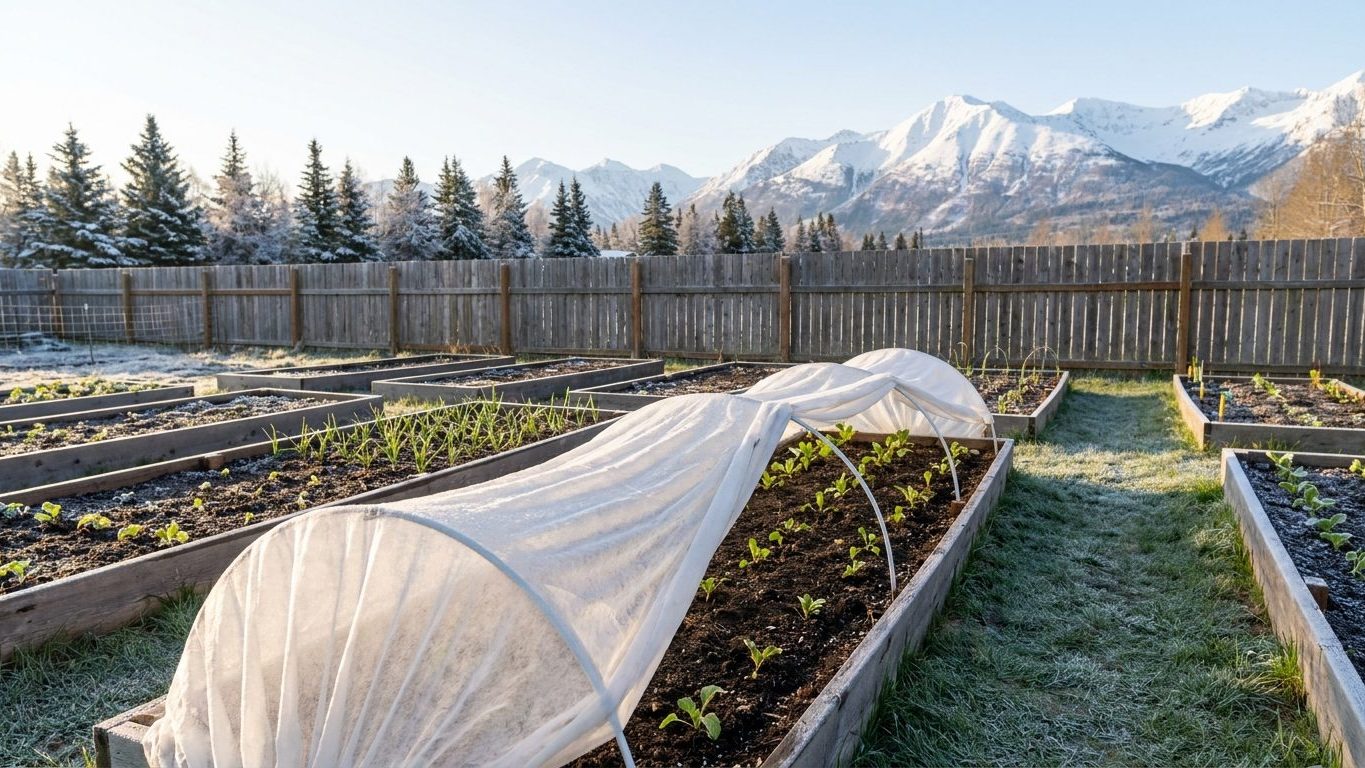

Cover your garden on the nights a freeze is forecast, not on a calendar date. For Atlanta, the reference city for this page, the odds of a 32°F freeze sit in a middle band from March 11 to March 29 in spring and from November 13 to December 1 in fall. Outside those windows a freeze is less likely, never impossible. Elsewhere in the state, the dates slide.
The short answer for Georgia
Cover tender plants when the overnight forecast approaches 32°F, and expect that to happen in two stretches: late winter into early spring, and late fall. The NOAA NCEI 1991-2020 Climate Normals for the Atlanta station give the dates below. They are not deadlines. Each one marks where the probability of a 32°F freeze falls in a 30-70% band, so they describe odds, not certainty.
| Season | Atlanta window (30-70% freeze probability band) | What it means for covers |
|---|---|---|
| Last spring frost | March 11 to March 29 | Keep covers within reach on transplants and early sowings through the window, and a little past it |
| First fall frost | November 13 to December 1 | Cover warm-season holdouts such as peppers and tomatoes on clear, calm nights as the window opens |
Why the odds matter more than the dates: the coldest month in Atlanta has a mean daily minimum of 35.6°F. That is the average night, and it sits only 3.6 degrees above freezing. Average nights are mild, so a hard freeze is something that happens on a particular night when a cold air mass arrives and the sky clears. A cover is a tool for those nights. It is not a roof for the season.
Cold air settles hardest on clear, still nights, because the ground radiates its heat upward with nothing to hold it. A sheet or row cover draped over plants slows that loss and can keep the air around the leaves a few degrees warmer than the open air. Put it on in the afternoon, while the soil is still holding the day’s warmth, and pull it off the next morning once the sun is up and the air is above freezing.
The practical rhythm is to watch the forecast low, not the calendar. If a low near 32°F shows up in the window, cover. If it shows up outside the window, cover anyway. The dates tell you when to start paying attention. For the materials themselves, Which Season Extenders Work in Georgia covers what holds up here, and Extending the Growing Season in Georgia places this question in the larger picture.
What will not work here
Treating March 29 as safe. The window’s late end is where the odds drop to 30%, which is not zero. A gardener who sets out tomatoes on March 30 and puts the covers away has made a bet at roughly one-in-three odds that no freeze follows. Same logic in fall: by November 13 the odds are already building, so leaving peppers uncovered until the window closes means you have probably already met a freeze.
Permanent, sealed winter coverings fare badly too. Georgia nights are often cold, but the days frequently are not. With a mean coldest-month minimum of 35.6°F, a sunny afternoon under clear plastic or a tight cover can overheat a plant quickly, and humidity trapped overnight invites fungal disease on greens and strawberries. Covers here are on-and-off tools. The gardener who closes a low tunnel in December and walks away until March is likely to come back to cooked or moldy plants.
Heavy-duty structures built for a short season are also overkill for much of the state. The Atlanta figures give a long gap between the last spring and first fall freeze, so the problem is rarely too little time. The problem is a cold snap landing at the wrong moment. A gardener who invests in a heavy high tunnel to win a month of warmth is solving a Minnesota problem with a Georgia budget. Light fabric, buckets, and old sheets usually do the job.
Thin covers laid directly on foliage fail on the coldest nights. Leaves touching a cover transfer cold straight through, so frost damage shows up exactly where fabric lay against the plant. Hoops or stakes that hold the cover off the foliage fix this, and so does a layer of dry mulch around the base of the plant, which holds soil warmth.
One more failure is trusting the Atlanta numbers outside Atlanta. The station sits at an urban airport, and that heat island runs warmer than the surrounding countryside. A gardener in a rural valley or at higher elevation can see a freeze when the airport does not. Dates built on that station can leave you uncovered on the wrong night.
What changes across Georgia
Georgia does not have one growing climate. The USDA Plant Hardiness Zone Map (2023, built on 1991-2020 normals) places the state anywhere from zone 6a to 9b. That is a spread of several zones, built on a single variable, the average annual extreme minimum temperature. There is no single answer to “when do I cover,” only a spread of answers that depend on where in the state you stand.
The Atlanta figures anchor this page. The reference station sits at 33.63 degrees north, and that latitude belongs to Atlanta, not to the whole state. A reader near the northern border or on the southern coast is working at a different latitude, and should check their own. Latitude shapes day length, which matters for crops such as onions that respond to the length of the day, not just the temperature.
For readers in North Georgia and the mountains, the shift is toward earlier fall freezes by several weeks, per the cautions attached to the NOAA data. If you garden there, start watching forecasts in October, not mid-November, and expect the spring window to run later than Atlanta’s. Elevation compounds it: cold air drains downhill and pools in low spots, so a garden at the base of a slope can freeze when the one above it does not.
Readers on the coastal plain run milder. Covers matter there on fewer nights, and the fall window opens later than Atlanta’s. Mild does not mean exempt. A single hard freeze can still take out basil, peppers, and young transplants, so the habit of keeping a sheet nearby pays off even where freezes are rare. To find your own zone, use the USDA map directly rather than guessing from a neighbor’s experience.
Where to check this for your own county
The most reliable local source is University of Georgia Extension, the state’s land-grant extension service, with offices that serve counties across Georgia. A county recommendation beats a state one every time, and this page is the state one. It gives the Atlanta-anchored window and the logic behind it, while the extension agent in your county knows how your local frost pockets, soils, and elevation behave.
Look for two things there. First, the local planting calendar for your county, which shows when growers there put out warm-season crops and what frost dates they plan around. Second, the varieties trialled in your county, since a tomato that performs well in the coastal plain may struggle in the mountains, and the trials tell you what has actually been grown where you live.
This page does not have a county-level calendar in its verified data, so it does not offer one. Rather than borrow numbers from a neighboring state’s lawn or garden publications, go to the source that serves your county. A phone call or visit to your county office can answer questions a web page cannot, such as how late the last frost came last year in your area.
Checking this against your own garden
Your own observations outrank every date on this page. Three are worth watching, and none needs equipment.
- Soil warmth by feel. Push your hand a few inches into the bed in the morning. Soil that feels cold and damp tells you the spot drains slowly or sits in shade, and a bed that feels noticeably warmer near a south-facing wall tells you where your frost-tender plants have the best chance.
- The first flush of male flowers. On squash and cucumbers, male flowers open before female ones. When they appear in your garden, the plants are settled and growing, and the date they show up in your yard compared to a neighbor’s tells you how much warmer or cooler your site runs.
- The first true leaves. Seedlings put out rounded seed leaves first, then the real leaves that look like the mature plant. Slow arrival of true leaves under a cover, or on seedlings in a shaded corner, shows you which spots hold back growth.
Keep notes for a season: the dates of the last freeze you saw in spring and the first in fall, and which spots froze while others did not. After a year or two you will have a frost calendar for your yard that no state page can give you.
Common questions
Do I cover plants every night in the Atlanta window?
No. Cover on nights when the forecast low approaches 32°F. The window tells you when freezes become possible, and the forecast tells you which night.
Is March 29 a safe date to stop covering?
Not a guaranteed one. The March 11 to March 29 range is a 30-70% probability band for a 32°F freeze at the Atlanta station, so odds remain at the late end. Keep covers handy a little past it.
Do these dates apply in North Georgia?
Not directly. North Georgia and the mountains freeze several weeks earlier in fall than Atlanta, so start watching forecasts sooner. Check University of Georgia Extension for your county.
Can I leave a cover on all winter?
It is a risky habit. With the Atlanta coldest-month mean minimum at 35.6°F, sunny days can overheat a sealed cover and trapped humidity can invite disease. Cover for the cold nights and open up when the weather warms.