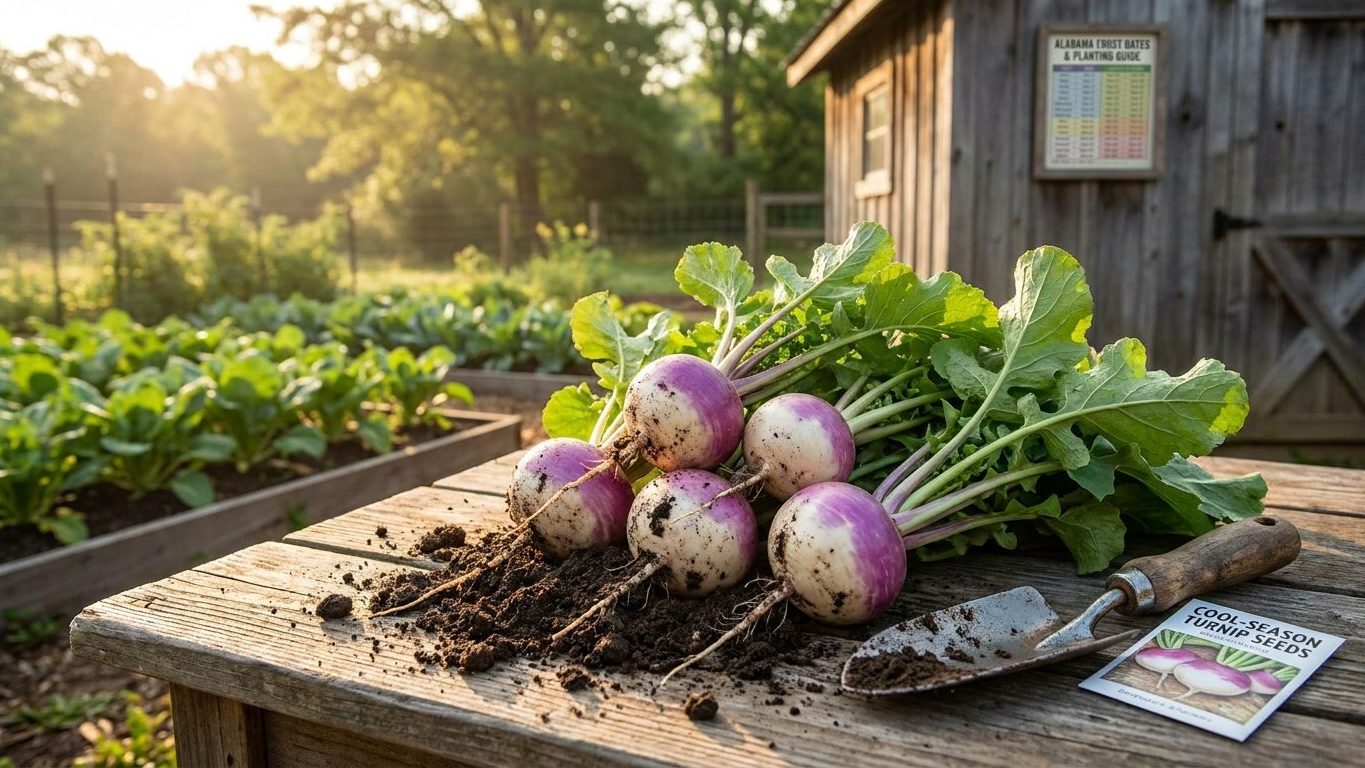

In South Carolina, sow turnips in fall first and in late winter second. Fall sowings ride the cool months ahead of the first freeze, which at the Charleston reference station falls between November 20 and December 5. Spring sowings get a short lane that closes once heat arrives. Every date here comes from Charleston and shifts as you move inland. For the whole crop, see Growing Turnips and Rutabaga in South Carolina.
The short answer for South Carolina
Sow a main turnip crop in fall, counting backward from the November 20 to December 5 first-fall-frost window, and a smaller one in late winter, starting around the February 28 to March 17 last-spring-frost window. Fall is the better bet in most years, because turnips are growing into cooling weather instead of racing a warming one.
Those two windows are probabilities, not deadlines. They come from NOAA’s 1991-2020 Climate Normals for the Charleston station (USW00013880), and they mark the band where the odds of a 32°F freeze run between 30 and 70 percent. Inside that band, a freeze is roughly a coin flip. Before it, a freeze is unlikely. After it, a freeze becomes the usual outcome in fall, or the exception in spring.
Fall sowing
Work backward from November 20, not forward from summer. Check the days to maturity on your seed packet, subtract that number from the start of the frost window, and add a cushion for slow growth as days shorten. Turnips shrug off light frost, so the frost date is not your enemy. It is simply the clock that tells you how much growing time is left. Greens can be cut sooner than roots can be pulled, so a late sowing still pays off as a leafy crop.
One number makes fall sowing forgiving along the coast. The mean daily minimum of the coldest month at the Charleston reference station is 38.9°F. On an average night, even January stays above freezing. Cold is rarely what ends a turnip planting there. Heat, at either end of the season, does that job.
Spring sowing
Spring is the narrower window. The last-frost band of February 28 to March 17 tells you when the ground is likely to stop freezing, and turnips can go in at about that time. But the crop has only so many cool weeks before South Carolina warms up, and roots that mature in warm weather turn woody and sharp. Treat spring as a quick, early planting, and don’t count on it to stretch into May.
What will not work here
The most common mistake is borrowing a calendar written for somewhere else. A northern chart that says “sow in late summer, harvest after the first frost” assumes a frost that arrives in October. At the Charleston reference station, the 30-70% band does not open until November 20. Follow a northern date here and you plant into weeks of lingering heat, with seedlings that bolt or stall.
Waiting for the last frost before sowing spring turnips fails for a related reason. The band runs from February 28 to March 17, and turnips do not need that wait. Gardeners who hold off until the danger is fully past often find the crop reaching sizing-up time just as warm weather arrives. The result is a row of tough roots and a lot of flowering stalks.
Rutabaga is the slowest crop in this family, and it takes the hardest hit. It wants a long stretch of cool weather to build a full root, and South Carolina’s cool season is mild but not long on either side. A rutabaga sown in spring has little hope. A fall sowing has a better chance, but only if it goes in early enough to finish before the cool season ends. If you want to compare the types, The Best Turnips and Rutabaga for South Carolina sorts them by season length.
Humidity is the third trap. South Carolina summers and shoulder seasons are damp, and turnips crowded into a tight row hold moisture on their leaves and stay wet after rain. Thin to the spacing on the packet, and make sure air can move between plants. A bed that looks efficient in March can turn leaf-spotted by April.
The last failure is overwatering after a warm spell. Because the coldest-month minimum sits at 38.9°F, many gardeners assume winter will do the thinning for them and plant too densely. It will not. Mild winters mean pests and fungal trouble stay active longer, so thin early and keep the planting open.
What changes across South Carolina
South Carolina is not one garden. The USDA Plant Hardiness Zone Map (2023, built on 1991-2020 normals) places the state across zones 7a to 9a, which is a three-zone spread. That map rests on one variable, the average annual extreme minimum temperature. So there is no single sowing date for the state, only a range that depends on where you live.
| Area | What the data says | What to shift |
|---|---|---|
| Charleston airport station (reference) | Last frost band February 28 to March 17; first fall frost band November 20 to December 5 | Use the dates in this article as written |
| Peninsular Charleston | Milder than the airport station | Expect a little more room at both ends of the season |
| Upstate | Runs several weeks tighter at both ends | Start fall sowing earlier and expect a shorter spring window |
A reader in the Upstate or at higher elevation should shift in two directions. Fall sowing moves earlier, because the first freeze arrives earlier and the growing time left is shorter. Spring sowing moves later, because the ground stays cold longer. The coastal calendar is the loosest, and the further you go from it, the less it applies.
Do not guess your zone from a neighbor or from a plant tag. Look up your own location on the USDA Plant Hardiness Zone Map. Keep in mind that zone numbers describe winter extremes, which matter less for turnips than the dates of the first and last freeze.
Where to check this for your own county
Your county extension office knows what this page cannot. Start with Clemson Cooperative Extension, the state’s land-grant extension service, and look for two things: a local planting calendar for fall and spring vegetables, and the turnip or rutabaga varieties that have been trialed in your county. A variety that performs in the Lowcountry may not suit a cooler Upstate bed, and the trial results will say so.
A county recommendation beats a state one. This page is the state one, built from a single Charleston reference station and written to be useful across a wide area. It will get you into the right season, but it cannot see your soil, your elevation, or the cold pocket at the bottom of your yard.
One caution about what this page has. The Clemson calendars it was able to verify are lawn calendars, published one per grass species (bermudagrass, zoysiagrass, centipedegrass and St. Augustinegrass), because a cool-season and a warm-season lawn are worked in opposite halves of the year. This page does not have a Clemson turnip calendar in hand. Ask your county office whether one exists for vegetables, and treat what they give you as the more local answer.
Checking this against your own garden
Your own observations outrank every date above. Three of them cost nothing and need no equipment.
- Soil warmth by feel. Push your hand a few inches into the bed in the morning. Soil that feels clearly cool is still fine for turnips. Soil that feels warm like a bathwater edge means fall sowing is too early, or spring sowing is too late. Compare a sunny bed with a shaded one, and you will learn how much your microclimate shifts the calendar.
- First true leaves. Sow a short test row and watch for the first true leaves, the ones after the seed leaves. Fast, sturdy growth says your timing is right. Slow or leggy seedlings say conditions are off, usually too warm.
- The first cold damage on tender plants. Note when basil or tomato leaves first blacken. That is your yard’s real first frost, and it often lands earlier in low spots than the nearest station says.
Keep notes for a season or two. Your own dates will beat any regional band.
If you follow the almanac, here is when to plant turnips by the moon. It is a tradition, not a proven method.
Common questions
Can I sow turnips in summer in South Carolina?
Summer heat works against them. Seedlings struggle and mature roots turn woody and sharp. Wait for the cooler weeks and count backward from the November 20 to December 5 frost window.
Do turnips survive a South Carolina winter?
Generally yes, at the coast. The mean daily minimum of the coldest month at the Charleston reference station is 38.9°F. Upstate gardens run colder, so check local conditions.
Is the last frost date a hard cutoff for spring sowing?
No. The February 28 to March 17 band is a probability of a 32°F freeze, not a deadline. Turnips tolerate light frost, so you can sow near the start of that band if the soil is workable.
Should I use the same dates in Greenville as in Charleston?
No. The Upstate runs several weeks tighter at both ends than the Charleston airport station, so fall sowing should start earlier and spring sowing later. Your county extension office can give you dates for your area.