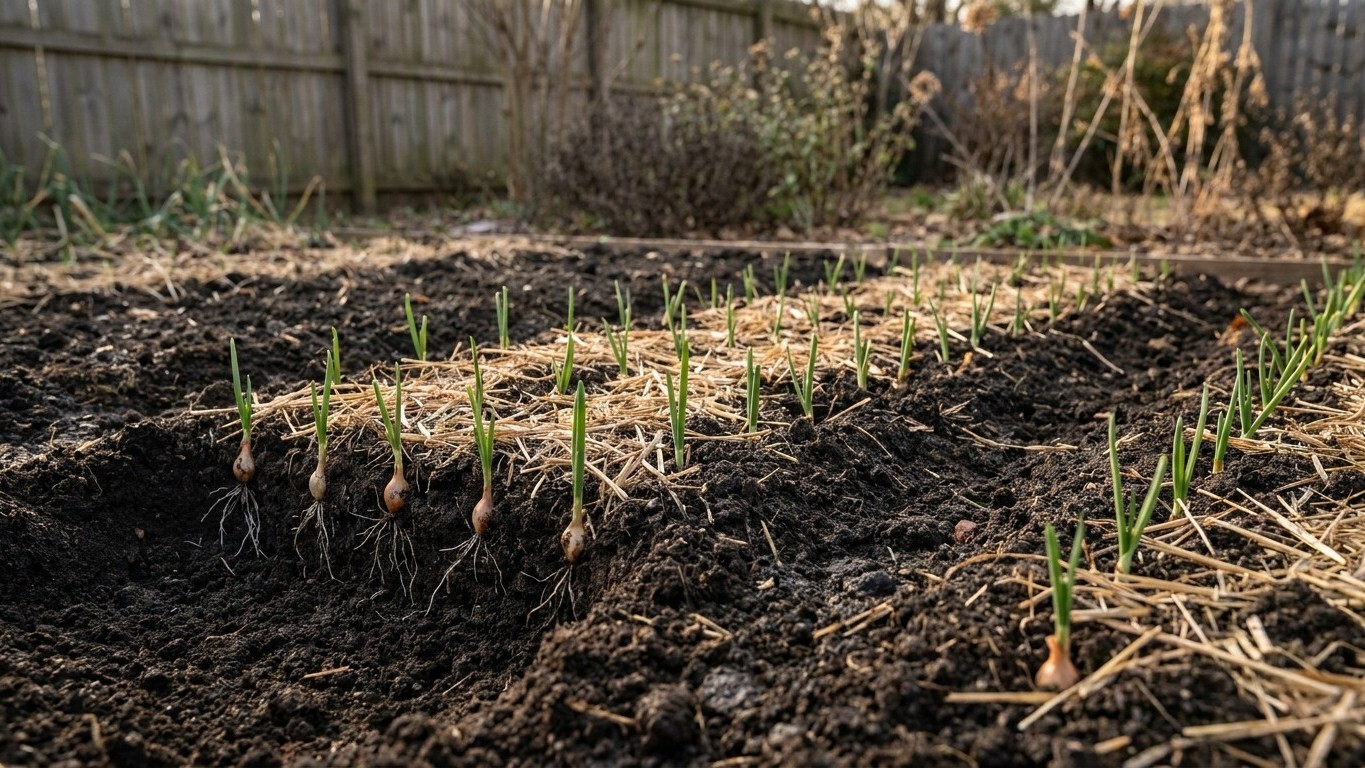

Slugs, wireworms and voles do most of the damage to garlic in Washington, and the calendar decides which one you meet. Slugs and soil pests work on cloves in fall and again in a wet spring. Rodents move in once the cold arrives. Bulb and stem nematodes ride in on infected seed, and onion maggots lay eggs in spring. Because garlic goes in during autumn and comes out the following summer, it sits through a full wet winter.
The short answer for Washington
In western Washington, the first 32°F freeze arrives between November 13 and November 30, based on the NOAA NCEI 1991-2020 Climate Normals for the Seattle-Tacoma station (the 30-70% probability band). That window is the clock for pest control, because every garlic pest either finishes its work before it or carries on straight through it.
Treat those dates as a midpoint, never a safe date. In one year out of two the frost falls later, so a mild November can keep slugs feeding and soil pests active well into the stretch when you would expect the ground to have shut down. Maritime soil rarely locks up. It cools slowly and stays wet.
That matters for the order of events. Between planting and the first freeze, slugs and wireworms find the freshly disturbed bed, and cloves are most exposed because they have not rooted. Through winter, voles and mice are the main threat, especially under heavy mulch. In spring, as growth picks up, onion maggot adults look for onion-family plants to lay eggs on, and nematode damage shows as swollen, twisted, stunted shoots. By early summer, thrips and aphids can stress the leaves as the crop heads toward lifting.
A mild frost date does not mean an early planting date here. Cold wet soil and low light hold spring crops back well past the last freeze, and the same slow soil delays root growth after fall planting. A clove that roots slowly spends longer as an easy target, which is why timing the planting matters as much as any trap or barrier. The When to Plant Garlic in Washington: Counting Back From the First Frost page works through that count in detail.
Working it out for your own garden
A state is not one climate, and a frost band measured at one airport station is a starting point, not your answer. The pest calendar follows the same arithmetic as the planting calendar, so you can rebuild it for your own district in a few steps.
- Start with November 13 to November 30 as the Seattle-Tacoma first-freeze band, then shift it for your site. Higher ground and inland valleys usually freeze earlier than the shoreline.
- Count back from that adjusted date to your planting date, using the planting calendar page.
- Mark the planting date as day one of slug and wireworm exposure. Check beds at dusk or after rain for slugs.
- Mark the first hard freeze, when it comes, as the point where slug activity drops and rodent pressure rises.
- Mark early spring as the window to cover beds against onion maggot egg-laying and to scout for twisted, swollen shoots.
The adjustment is where gardeners go wrong. Elevation is the biggest lever: every step up into the Cascade foothills brings colder nights and an earlier freeze, which pulls the whole sequence forward. Large bodies of water work the other way. Puget Sound and the Pacific coast hold heat, so shoreline gardens freeze later and stay soft and slug-friendly longer. A bed beside the water and a bed a few miles inland can run on schedules that differ by weeks, and I would trust a cheap soil thermometer and your own first frost over any regional figure.
Keep a note each year of the date of your first freeze and the date you first saw slug damage. Two or three seasons of those numbers will tell you more about your own plot than the normals do, because the normals are an average over thirty years and no garden lives through an average.
What changes across Washington
The Seattle window cannot be applied statewide. Western Washington is mild and maritime, while eastern Washington beyond the Cascades is high desert with a far shorter season. NOAA’s figure here belongs to the west side only, and no comparable eastern figure is published in this page’s data, so the table below describes tendencies rather than dates.
| Area | What drives the climate | Pests to expect |
|---|---|---|
| Puget Sound lowlands | Maritime air, late freezes, wet soil | Slugs through fall and spring, wireworms in beds cut from lawn, voles in mulch |
| Pacific coast and Olympic Peninsula | Very wet, slow-draining soils, mild winters | Slugs are the dominant problem for much of the year |
| Cascade foothills and mountain valleys | Elevation brings colder nights and earlier freeze | Voles and mice under snow cover, slug pressure shortened by cold |
| Eastern Washington (Columbia Basin, Yakima Valley, Spokane area) | High desert, dry air, hard winters | Fewer slugs outside irrigated beds, with nematodes, thrips and onion maggot the bigger concerns |
Eastern gardeners face a different problem. The season is shorter, so a clove planted late may not root before the ground freezes, and a weak plant is more exposed to whatever finds it. Irrigated ground can also carry nematodes and onion-family pests year after year if beds are not rotated. Dryness limits slugs but does not remove the other threats.
For comparison, a gardener who also grows in the Appalachians will find a different clock on the When to Plant Garlic in West Virginia: Counting Back From the First Frost page, where the pest sequence is set by a colder, more continental winter. The Growing Garlic in Washington hub puts the state’s regions side by side.
The mistakes this climate punishes
The expensive errors here come from treating a wet, mild winter like a dry, cold one. The first is thick straw mulch laid right after planting. Mulch keeps soil moist and sheltered, which is exactly what slugs and voles want, and in western Washington it can shelter them all winter. A thinner layer, or a heavier one applied only after the ground has chilled, gives the cloves insulation without a hotel for pests.
The second is planting too early because the frost date looks far away. The first freeze may be weeks off, but warm, wet soil in fall hands slugs and wireworms a longer feeding period on unrooted cloves. Tops that emerge before winter are also a target for slugs. The third is trusting the frost date as a deadline. Since frost comes later in half of all years, a planting date chosen to land just before the average first freeze can slip into a wet stretch where cloves rot or get eaten before they root.
In colder parts of the state, the opposite error costs a crop: planting too shallow or too late to root. A clove with little soil over it and no root system by the time the ground freezes is vulnerable to frost heaving and to rodents digging it up. Eastern and higher-elevation gardeners should plant with the cold in mind and not copy a coastal date.
Two mistakes cut across the whole state. One is replanting garlic or onions in the same bed, which lets nematodes and soil-borne problems build up. The other is saving seed cloves from a crop that showed swollen, distorted or stunted growth, because nematodes travel inside the clove. Buy clean seed, rotate beds, and choose a variety suited to your side of the Cascades. The Garlic Varieties That Suit Washington Winters page covers that choice.
Checking this against your county
Pest pressure varies by county, soil type and even by neighborhood, so local confirmation is worth the trouble. Washington State University Extension runs county offices that can identify damage from a photo or sample, tell you which pests are active locally and confirm county-level frost figures. Take your own first-freeze dates along when you ask.
Common questions
What is the most common garlic pest in western Washington?
Slugs. The mild, wet climate keeps them active in fall and spring, and they feed on emerging shoots and on cloves that have not rooted. Wireworms and voles follow behind, depending on whether the bed was lawn and whether it is mulched.
Can I use the November 13 to November 30 date everywhere in Washington?
No. That band is the first-freeze window at the Seattle-Tacoma station, which represents mild, maritime western Washington. Eastern Washington is high desert with a much shorter season, and higher ground on the west side freezes sooner.
How do I know if nematodes are in my garlic?
Look for swollen, twisted or stunted shoots in spring, then bulbs that are soft or discolored at lifting. There is no cure for a home garden. The remedy is clean seed, long breaks before planting onion-family crops in that bed again, and no saving of cloves from affected plants.
When do I protect garlic from onion maggot?
Early spring, when adult flies lay eggs near the base of onion-family plants. Floating row cover applied before egg-laying keeps them off, but it only works if the bed was not already infested, so rotating where you plant also helps.