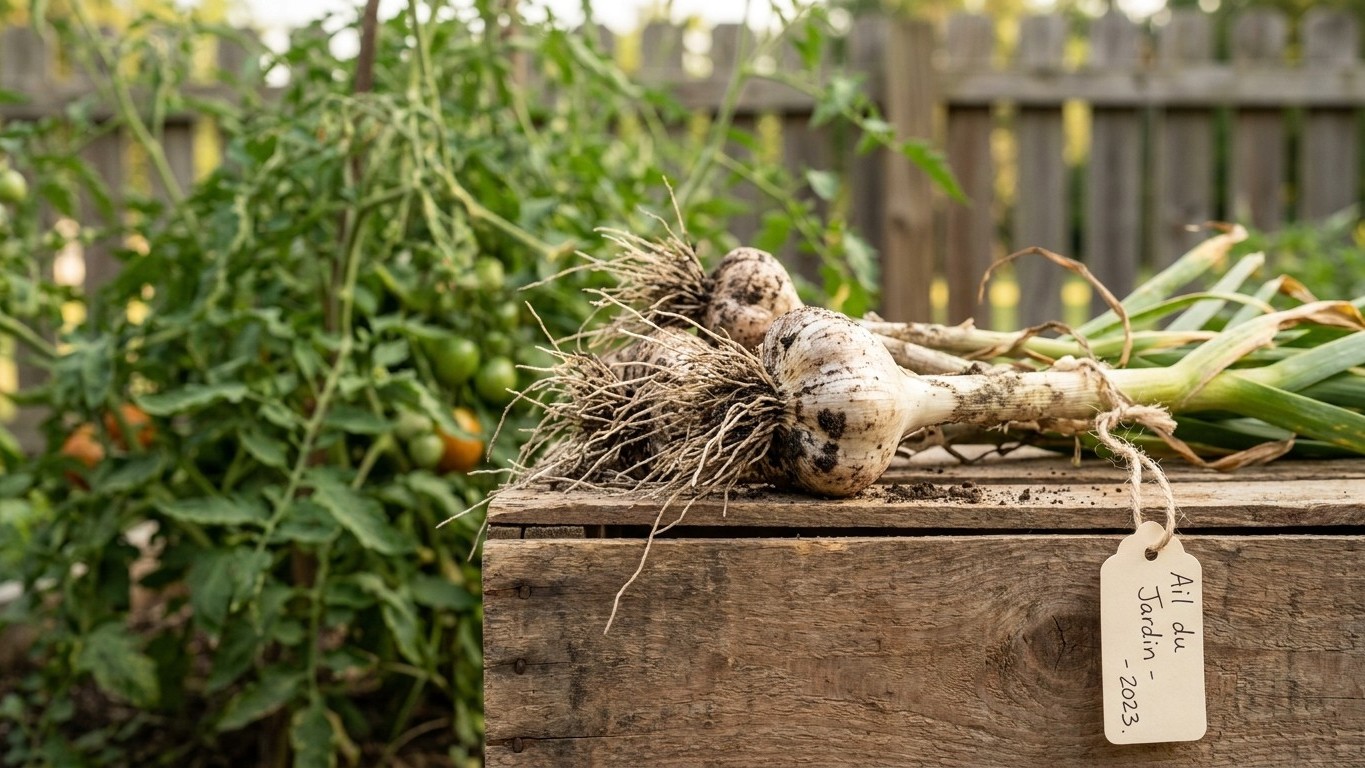

Plant Garlic in West Virginia from late September to mid-October, timed so the cloves root before the ground freezes ahead of the state’s first fall frost. NOAA’s 1991-2020 climate normals put that frost at Charleston, station USW00013866, somewhere between October 18 and November 1, and it can land later than that in roughly half of all years. Get cloves in the ground by early October if you garden at any real elevation, and pick a cultivar such as Chesnok Red or Inchelium Red before you dig.
The short answer for West Virginia

Garlic goes into West Virginia soil from late September through mid-October, and that window holds for all fourteen cultivars listed below, hardneck or softneck. It isn’t an arbitrary rule of thumb. It’s built backward from the state’s first fall frost, so the cloves get several weeks of cool, moist soil to push roots before winter shuts things down.
NOAA’s 1991-2020 climate normals, measured at the Charleston station (USW00013866), put the first fall freeze in a range of October 18 to November 1. That figure comes from a 30 to 70 percent freeze-probability band, which makes it a midpoint, not a guarantee. In roughly half the years on record, the true first frost at that station falls later than the window states, and in the rest it falls inside it or a little earlier.
Planting ahead of that frost, rather than up against it, is the whole point of the exercise. Garlic roots in cool soil and keeps growing slowly even after a light frost nips any green shoots that have emerged. What it can’t do is start a root system once the soil has gone hard. That’s why the planting window sits weeks ahead of the frost window instead of butting right up against it.
If you haven’t settled on a variety yet, Garlic Varieties That Suit West Virginia Winters walks through how hardneck and softneck types differ through a mountain winter. Here’s the full list with type and set-out window.
Varieties and their planting window
| Variety | Type | Set out |
|---|---|---|
| Early Red Italian | Softneck | Late Sept to mid Oct |
| Inchelium Red | Softneck | Late Sept to mid Oct |
| Italian Late | Softneck | Late Sept to mid Oct |
| Lorz Italian | Softneck | Late Sept to mid Oct |
| Bavarian Purple | Hardneck | Late Sept to mid Oct |
| Blue Music | Hardneck | Late Sept to mid Oct |
| Chesnok Red | Hardneck | Late Sept to mid Oct |
| Duganski | Hardneck | Late Sept to mid Oct |
| Fall Festival | Hardneck | Late Sept to mid Oct |
| Georgian Crystal | Hardneck | Late Sept to mid Oct |
| Georgian Fire | Hardneck | Late Sept to mid Oct |
| German Red | Hardneck | Late Sept to mid Oct |
| German White | Hardneck | Late Sept to mid Oct |
| Ivan | Hardneck | Late Sept to mid Oct |
Whichever type you plant, West Virginia’s winters supply plenty of the cold garlic needs to split a single clove into a full head of new ones. University of Georgia Extension, publication C854, puts that chilling requirement at six to eight weeks below 40°F after planting. West Virginia’s winters run cold for roughly 21.8 weeks below that mark, so the cold half of the job takes care of itself once the cloves are in by mid-October.
Working it out for your own garden
The arithmetic behind that late-September-to-mid-October window is simple once you lay the two ranges side by side. NOAA’s Charleston-area normal puts the first frost between October 18 and November 1. The catalogue set-out window for every variety above runs from late September to roughly the middle of October. Subtract one range from the other and you get a gap of roughly three to five weeks between planting and that first frost, more if you plant early in the window, less if you wait until the middle of it.
That gap is the buffer garlic needs to root before the ground goes hard. It isn’t a hard number backed by a single published threshold for this state, so treat it as a planning target rather than a countdown clock. If you plant on the early side of the window, you buy yourself extra margin against a frost that shows up ahead of schedule. If you plant on the late side, you’re betting that the frost lands on the later end of the NOAA range, which happens in some years and not others.
Redoing the math for your own district
The Charleston figure is one station’s normal, not a state-wide law. If you know your own area’s typical first frost date, whether from a longer memory of your own garden or from a source specific to your county, run the same subtraction: count back three to five weeks from that date and aim to have cloves in the ground by then. A garden that reliably frosts in early October needs its garlic in by early to mid-September, not late September.
Elevation is the biggest variable in West Virginia, more than in flatter states. A garden a few hundred feet higher than the valley floor a few miles away can see frost arrive noticeably earlier, simply because cold air sinks and pools, and because thinner air at altitude loses heat faster after sundown. If you haven’t worked out your bed prep and planting depth yet, the full walkthrough in Growing Garlic in West Virginia covers that groundwork.
What changes across West Virginia
West Virginia is a mountain state, and elevation does more to move a frost date here than latitude does. The Allegheny Highlands in the eastern counties, where towns sit hundreds to thousands of feet above the river valleys, typically see their first frost well ahead of the Charleston normal. A grower in that high country should treat the early end of the late-September planting window as the safer target, not the fallback.
River valleys run the other direction. Charleston itself sits low in the Kanawha Valley, and NOAA’s own note on this station flags that setting: valley air holds heat longer into fall than the surrounding ridges do, which is part of why the Charleston normal sits where it does. Other low-lying valley towns along the state’s rivers likely see a similar lag behind the ridgetop communities nearby, though without a station-specific normal for each one, that’s a pattern to expect rather than a number to plant by.
The Eastern Panhandle, tucked closer to the mid-Atlantic than the rest of the state, tends to run on the milder side of West Virginia’s climate overall, but a grower there still needs to check local frost expectations rather than assume the Charleston window applies unchanged. The single reference station behind these normals cannot describe a whole state shaped like this one, and that gap matters more in West Virginia than in a flatter, more uniform state.
The mistakes this climate punishes
Two mistakes cost a garlic crop in West Virginia more often than any variety choice does, and both come down to timing rather than technique.
Planting too late
Waiting into the back half of October, or slipping into November, cuts into the three-to-five-week rooting window before frost. A clove planted the week a hard freeze arrives often winters over with almost no root system built up, which shows the following spring as a weak, late plant or a bulb that never sizes up properly. Planting on the early side of the catalogue window costs nothing and buys real insurance against a frost that beats the NOAA midpoint.
Planting too shallow, or skipping the mulch
Ground that cycles through repeated freezing and thawing, which describes most of West Virginia’s winter, works shallow-set cloves loose and pushes them partway out of the soil. A generous layer of straw mulch, put down once the ground starts to cool, keeps that freeze-thaw action from heaving cloves before they’ve had a chance to anchor.
Bringing disease in with the seed stock
Garlic’s autumn planting window overlaps with conditions that favor white rot, caused by the fungus Sclerotium cepivorum. According to UC IPM’s Pest Management Guidelines for onion and garlic (UC ANR Publication 3453), white rot’s published range is 50 to 75°F, measured in soil. West Virginia’s average air temperatures fall inside that band across five months of the growing season, including September and October, right when garlic goes into the ground. That’s an air-temperature count set against a soil-temperature threshold, and soil lags air by weeks and swings less than a monthly average implies, so treat it as a general risk pattern, not a forecast. A month falling outside the range doesn’t mean the disease is absent either. The sclerotia that cause white rot survive in soil for years regardless of season, and the surest way to bring them into a clean bed is with infected seed stock.
- Buy seed garlic from a supplier who guarantees it disease-free.
- Never replant cloves from a bulb that showed soft rot or fungal growth at the base.
- Rotate garlic beds rather than planting the same ground every fall.
Fusarium basal rot, caused by Fusarium oxysporum f. sp. cepae, shows a similar seasonal overlap in September and again from May through July, per the same UC IPM guidelines. It’s less about the calendar and more about avoiding wounded or waterlogged cloves at planting time and again at harvest the following summer.
Checking this against your county
The Charleston figures above are a starting point, not a county-by-county answer. West Virginia’s terrain shifts frost timing enough, county to county and even farm to farm, that the state-wide normal is a rough anchor at best. WVU Extension keeps county-level agents who can speak to local frost history and soil conditions in a way one river-valley climate station can’t. Find your county’s office through the WVU Extension directory before you lock in a planting date, especially if your garden sits well above or below the Kanawha Valley floor.
Common questions
Can I still Plant Garlic in November if I missed the window?
You can, but expect weaker roots going into winter and a smaller bulb the following summer. A late-planted clove that missed most of its rooting window before frost will still often survive and grow, since West Virginia’s long cold winter provides plenty of chilling once it does start growing, but sizing tends to suffer.
What if I don’t know my local first frost date?
Use the Charleston-area NOAA range of October 18 to November 1 as a rough starting point, then adjust earlier if you’re at meaningfully higher elevation than the Kanawha Valley, and check with your county WVU Extension office for anything more specific to your area.
Does it matter if I plant hardneck or softneck for this timing?
No. Every cultivar on the list above, hardneck or softneck, uses the same late-September-to-mid-October set-out window, because the timing is driven by frost and root establishment, not by neck type.
Should I plant earlier in a year that’s shaping up cold?
Yes, lean toward the early end of the window whenever a fall is running cold or wet, since that shortens the practical planting season without moving the catalogue dates themselves. A clove in the ground in late September has weeks of margin a mid-October planting doesn’t.
If you follow the almanac, here is when to plant garlic by the moon. It is a tradition, not a proven method.