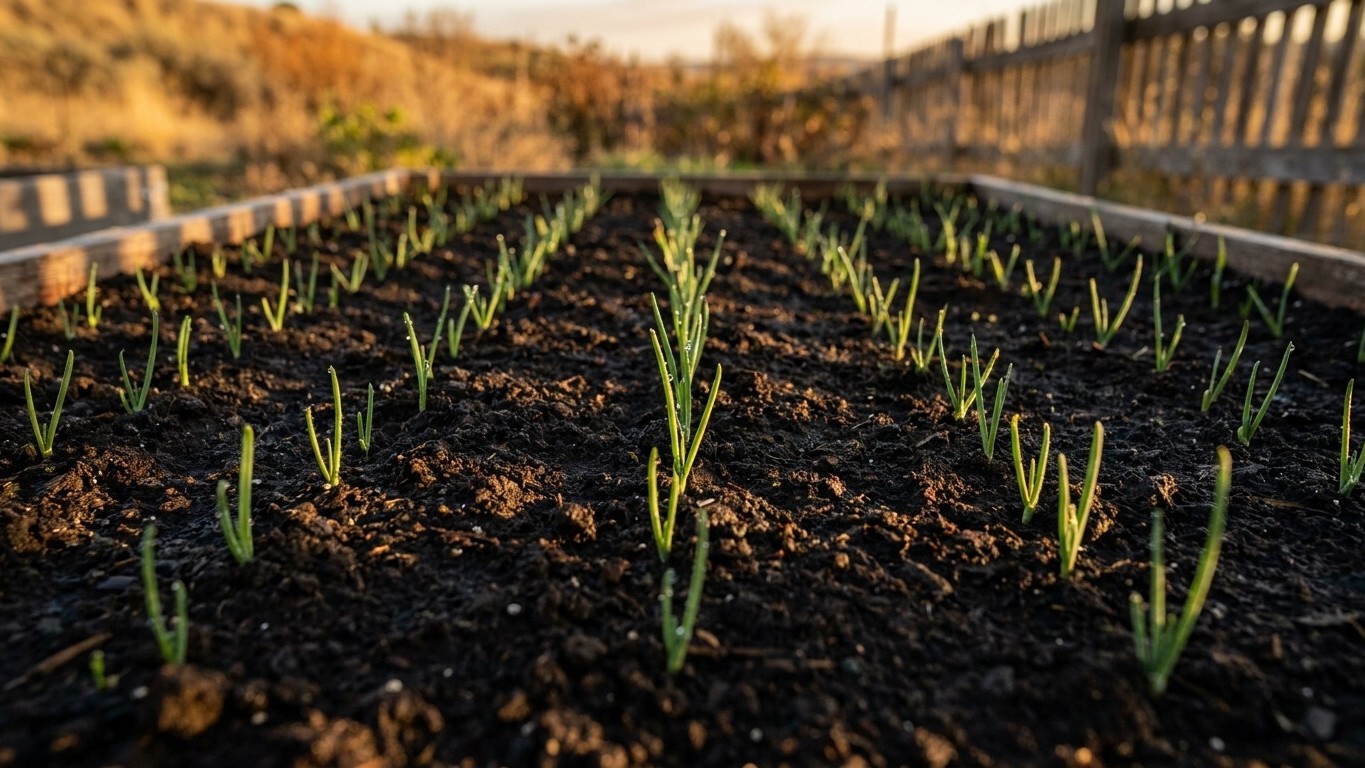

Garlic in West Virginia gets eaten in two shifts. From planting through winter, the trouble lives underground: voles, mice, wireworms and soil-borne rot. From spring until the bulbs come out of the ground the following summer, the damage moves up into the leaves and stalks, courtesy of thrips, leaf miners and onion maggots. One pest ignores that calendar entirely. The bulb and stem nematode rides in on the cloves you plant. Tying each defense to the first fall frost keeps the whole season manageable.
The short answer for West Virginia
At Charleston, first fall frost lands between October 18 and November 1, according to the NOAA NCEI 1991-2020 Climate Normals (32°F freeze probabilities, 30-70% band, station USW00013866). That window is where the garlic year begins, and it sets the clock for nearly every pest decision that follows.
A frost date is a midpoint, never a safe date. In one year out of two, the first freeze arrives later than the date you are counting on. Treat the window as the center of a bell curve, not a deadline you can plan a whole fall around. A warm autumn that pushes the freeze into mid-November is not unusual, and it changes which pests get a head start.
Charleston also sits in a river valley, and that matters. Higher elevations across the state freeze noticeably earlier in fall, so a garden on a ridge is working from a different calendar than the one at the airport station.
Why does the frost anchor pest control? Because garlic is planted in autumn, wintered in the ground and lifted the following summer, which gives pests close to nine months of access. Cloves set near the frost date put down roots in cooling soil and hold their tops low. Cloves set weeks early in warm soil can push green growth that exposes them to a mild fall and a hungry winter. Mulch laid too soon turns into rodent housing. Even the nematode problem is a timing question, since the decision to buy clean seed garlic has to be made before the planting window opens, not after.
For the planting side of this arithmetic, the companion piece on When to Plant Garlic in West Virginia: Counting Back From the First Frost walks through the dates. The overview of Growing Garlic in West Virginia covers the rest of the season.
Working it out for your own garden
A state is not one climate, and West Virginia proves it better than most. Within a single county, a hilltop and a creek bottom can differ by weeks.
The arithmetic
Start with the Charleston window, October 18 to November 1. The midpoint is October 25. Now adjust for where you actually garden. Elevation, and in other states a large lake or the coast, can move these dates by two weeks either way. Apply that to Charleston and you get a rough range: a cold ridge garden might see its first freeze around October 4 to October 18, while a sheltered low-lying site could run from November 1 to November 15. Those two ranges are my arithmetic on the brief’s two-week rule of thumb, not published station figures. Your own garden’s first killing frost is the number to track, and a few seasons of notes beat any table.
Once you have your midpoint, plant around it and then hang the pest chores off the same date.
Pest timing on that clock
The table below lays the main garlic pests against the season. Dates are described relative to your frost date and the harvest, because the brief does not carry published emergence dates for West Virginia and I will not invent them.
| Pest | When it hits | What it does | Your move |
|---|---|---|---|
| Voles and mice | Winter, under mulch | Eat cloves and young roots | Mulch after the ground starts to freeze, not before |
| Wireworms, white grubs | Fall and spring | Tunnel into cloves and bulbs | Avoid beds freshly cleared of sod |
| Bulb and stem nematode | All season, worst in cool, wet soil | Twisted, swollen shoots; soft bulbs | Buy clean seed garlic; rotate beds |
| Allium leaf miner | Spring, as shoots resume growth | Rows of puncture marks; larvae in the bulb | Cover with row cover in spring |
| Onion maggot | Spring | Larvae feed on bulbs and stems | Row cover; clean up debris |
| Onion thrips | Late spring into early summer | Silvery streaks, stunted leaves | Keep plants watered; scout leaf bases |
Read it as a rhythm: rodents and wireworms first, nematodes lurking all along, then the flying insects once the weather turns. The varieties you choose also matter, since some handle damp springs better; the page on Garlic Varieties That Suit West Virginia Winters covers that.
What changes across West Virginia
The Wisconsin gardener counting back from an earlier frost, as in When to Plant Garlic in Wisconsin: Counting Back From the First Frost, faces the same logic. West Virginia just stretches it over far more terrain. A look at Garlic Varieties That Suit Wisconsin Winters shows how differently a colder state approaches the same plant.
Valleys and the Ohio River
The Kanawha Valley around Charleston is the reference point for the figures above, and the Ohio River corridor from Parkersburg to Huntington behaves in a similar way: river valleys hold heat, so frost comes later. A later freeze means a longer window in which wireworms and slugs stay active and cloves sit in warm, damp ground. In these low sites, drainage is the pest-control tool. Waterlogged clay invites nematodes and rot, so a raised bed earns its keep.
Mountains and the Panhandle
The Allegheny Highlands, including places like Pocahontas, Randolph and Tucker counties, freeze earlier than Charleston, and cold air pools in the narrow hollows of the southern coalfields so that frost can arrive weeks before it reaches a nearby ridgetop. Gardeners there plant earlier. Deep, lingering snow also insulates the soil, which protects garlic but gives voles a quiet runway through winter. In the Eastern Panhandle around Martinsburg, the lower elevation runs warmer than the mountains. It also borders the Mid-Atlantic states where the allium leaf miner has been spreading since it turned up in Pennsylvania, so Panhandle growers have more reason than most to cover shoots in spring. Whether it has been reported in your county is a question for your extension office.
The mistakes this climate punishes
West Virginia winters swing. A stretch of 60-degree days in January followed by a hard freeze is a normal pattern, and that swing shapes which errors cost a crop.
Mulching too early, and too thick
Pile straw over a bed in early October and you have built vole housing while the ground is still warm. Rodents move in, and by midwinter they are eating cloves. Wait until the ground has started to freeze, then mulch. Keep it loose, and pull it back from the shoots as spring warms. In years when the freeze arrives in mid-November rather than late October, that wait is longer than you expect, and it is the right call.
Planting stock you did not vet
Saving cloves from a bulb that looked fine is the quickest way to spread nematodes. The pest lives inside the clove and in the soil, so replanting it into the same bed year after year compounds the problem. Buy certified clean seed garlic, discard any bulbs with soft or twisted tissue, and rotate beds. Grocery store garlic is a gamble for the same reason.
Planting too early, or too shallow
A mild fall invites early planting, and early cloves put up green tops that get hit before winter. Plant too shallow, though, and the freeze-thaw cycles typical of this state heave cloves toward the surface, leaving them exposed to rodents and cold. Time the planting around your own frost midpoint, then set cloves deep enough that frost heave cannot push them up.
Ignoring spring cover
Leaf miners and onion maggots are attacking just as the garlic is growing fastest, and by the time damage shows, the larvae are already inside. Row cover goes on before the pests do, not after. Pull it when the plants are well established or summer heat builds underneath.
Checking this against your county
County-level frost figures and current pest reports come from West Virginia University Extension. Your county agent can tell you whether leaf miner or nematode problems have been reported nearby, and which seed sources they trust. Bring a photo of any damaged leaves; diagnosis beats guessing.
Common questions
What is the biggest garlic pest in West Virginia?
The bulb and stem nematode is the most damaging because it comes in the cloves and persists in the soil. Voles and onion thrips are far more common to see, but a nematode-infested bed can force you to stop growing garlic there for years.
When should I put mulch on my garlic?
After the ground begins to freeze, which at Charleston follows a first fall frost falling between October 18 and November 1 (NOAA NCEI 1991-2020 Climate Normals). Because frost is a midpoint and comes later in one year out of two, watch the soil rather than the calendar.
Do deer eat garlic?
Rarely. The strong smell tends to put deer off, which is one reason garlic is a popular border crop. Voles and insects do the real damage.
Can I replant garlic in the same bed every year?
You can, but you should not. Nematodes and soil diseases build up when alliums follow alliums. Rotating to a new bed each fall is the simplest defense and costs nothing.