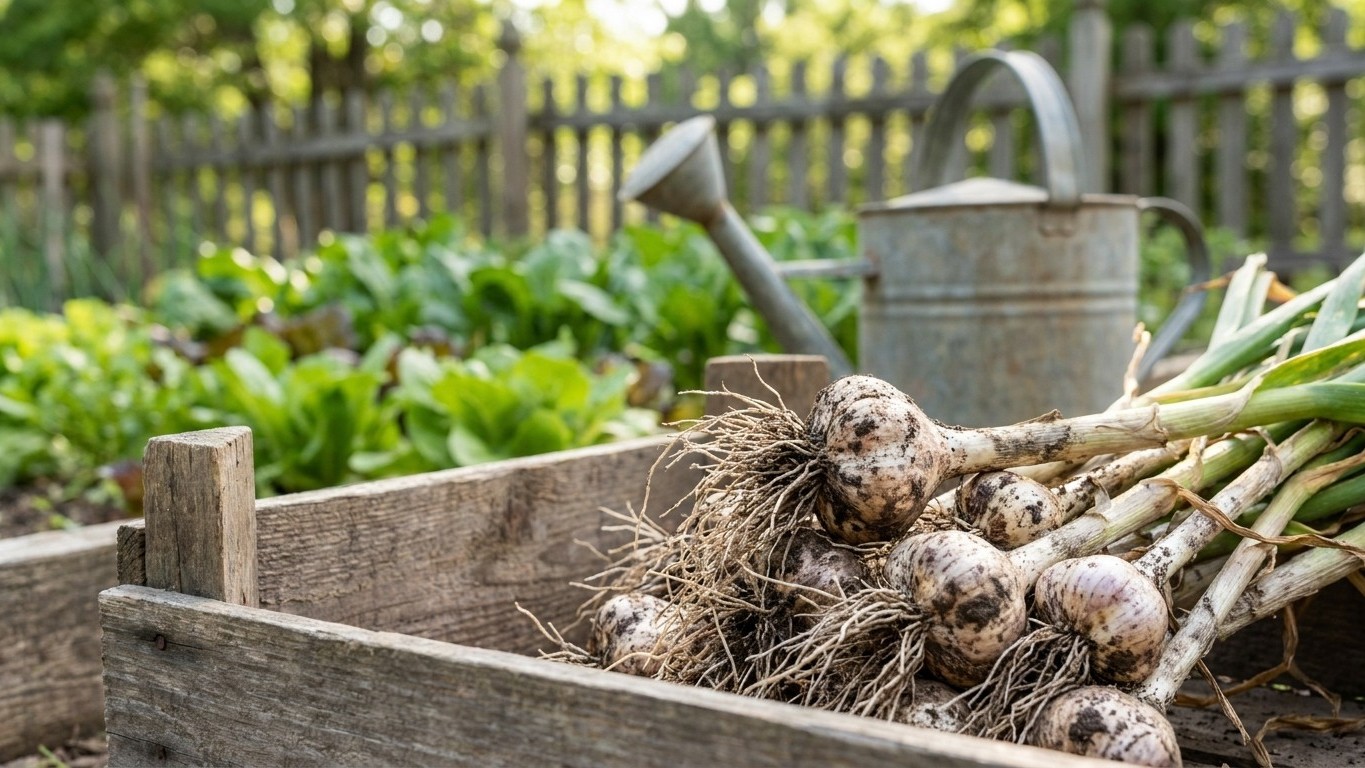

Your yard gets more than enough winter cold to turn a single clove into a full head of garlic — that part isn’t in question. What decides whether your harvest works out is timing: getting hardneck cloves into the ground in late September to mid October, ahead of your area’s first hard frost, so roots take hold before the soil locks up. Start there. Check when frost typically hits your part of the state, then work backward from that date to pick your planting week.
Will garlic get the cold it needs in West Virginia

Garlic does not split into cloves on its own. A clove planted in warm soil, or one that never sees a real cold spell, grows into a single round bulb the following summer, not a head. The plant needs a sustained stretch of cold, working through the winter while the clove is in the ground, to trigger that division. University of Georgia Extension publication C854 puts the requirement at six to eight weeks below 40°F, and that figure is what every planting decision in this state should be checked against.
NOAA’s NCEI 1991-2020 climate normals, measured at the Charleston station (USW00013866), show this territory averaging 21.8 weeks below 40°F across the season. That is nearly three times the minimum garlic asks for. Even accounting for a mild winter or a late start to cold weather, a clove planted here is not going to run short of chilling hours the way a grower in the Gulf states might. West Virginia’s winter cold is, if anything, the least of a grower’s worries here, and that puts this state in a different category from places where growers have to think hard about hardneck versus softneck purely on cold-hours grounds, the way a grower comparing a state like Wisconsin’s much longer, harder winter would.
The one caution worth carrying forward is that the Charleston station sits in a river valley. Higher elevations across the state see colder air and an earlier freeze, which means those growers clear the cold requirement even sooner in the season and need to plan their planting date accordingly, a point that matters more for section two than for this one. Because the state’s cold surplus is so large, there is no scenario in West Virginia where a grower needs to refrigerate cloves before planting to manufacture a cold spell, the workaround used in warm-winter states. That decision is already made by the climate. What is left to the grower is choosing a variety that makes use of that cold, a choice made easier by consulting Garlic Varieties That Suit West Virginia Winters, and timing the planting so the clove is in the ground long enough to receive it before growth starts in spring.
When to put the cloves in
Garlic planting date in West Virginia should be set against the first fall frost, not a fixed calendar date. For the specific windows to target, see When to Plant Garlic in West Virginia. NOAA’s NCEI 1991-2020 normals put that frost, at the Charleston station, in the range of October 18 to November 1. That is a range, not a single day, and other parts of the state will see it earlier or later depending on elevation and local terrain. A grower at higher elevation, on a ridge, or away from the moderating effect of a river valley should expect frost noticeably earlier than the Charleston window and should plant on the early side of the recommended window as a result.
Cloves need enough time in the ground to grow roots before the soil freezes solid, but not so much time that they push a lot of top growth before winter sets in. Top growth that gets caught by a hard freeze can set the plant back, though it rarely kills it outright once the clove itself is established. Working back from the Charleston frost window, planting in late September to mid October gives roughly three to five weeks of root establishment before that frost arrives, which is the standard target for this crop across the cooler half of the country.
If you are gardening well above the river valleys, at a ridge-top elevation, or in a spot known locally for early frost, shift your planting toward the earlier end of that late-September-to-mid-October window rather than the later end. If you are in one of the warmer valley bottoms, the later end works fine. Either way, resist the urge to plant by a fixed date every year. Watch the soil and the weather instead, and use the Charleston frost window as your reference point, adjusting for your own elevation.
Which types suit West Virginia
Hardneck and softneck garlic are not interchangeable, and the choice is not a matter of preference here. Hardneck varieties need a real winter cold season to perform well and produce a scape, the curling flower stalk that gets cut before it fully forms. Softneck varieties tolerate a mild winter without the same cold demand and store considerably longer in the pantry, which is why they dominate warm-climate commercial production.
Given that NOAA’s NCEI normals put this state’s winter cold at 21.8 weeks below 40°F at the Charleston station, far beyond garlic’s six-to-eight-week requirement, hardneck garlic performs well across West Virginia, and growers here are not limited to softneck the way a grower in a warm-winter state further south would be. Hardneck varieties worth planting include Bavarian Purple, Blue Music, Chesnok Red, Duganski, Fall Festival, Georgian Crystal, Georgian Fire, German Red, German White, and Ivan, all of which are set out in the same late September to mid October window as the softnecks below.
Softneck varieties are not out of place here either, especially for a grower who wants a garlic that keeps in storage past midwinter. Early Red Italian, Inchelium Red, Italian Late, and Lorz Italian all handle a West Virginia winter without trouble and store noticeably longer than most hardnecks once cured. A grower deciding between the two types here is really deciding between flavor and scapes on one side and storage life on the other, not between what will and won’t survive the winter, which is a different calculation than the one facing a grower in a state like Missouri, where the milder winter tilts the decision more firmly toward softneck.
Soil and bed preparation
Garlic sits in the same bed for eight to nine months, through freezing, thawing, and the wettest part of the year for most gardens. Drainage matters more than any other single factor in bed prep. A clove sitting in saturated soil over winter rots before disease pressure or cold ever becomes the issue. If your planting site holds water after a rain, raise the bed, even by just a few inches, before you plant rather than after you find out the hard way in spring.
Steps to take in the weeks before planting
- Work several inches of finished compost into the top of the bed to loosen heavy clay and improve drainage
- Test soil pH and adjust ahead of planting rather than after, since amendments take time to shift pH
- Clear the bed of the current season’s weeds and roots so garlic isn’t competing all winter
- Avoid fresh manure at planting time, since it favors soft rot and delays curing later
- Choose a full-sun spot, since garlic bulbs size up poorly in shade
Raised beds or ridged rows are worth the extra effort anywhere the water table sits high or the soil leans toward clay, which describes a fair amount of West Virginia’s bottomland. A loose, well-drained bed also makes it much easier to lift the crop cleanly at harvest without breaking wrappers on the bulbs, which matters for how well they cure and store afterward.
What the climate here favours, and what it does not
UC IPM’s Pest Management Guidelines for onion and garlic (UC ANR Publication 3453) publish temperature ranges for the main garlic diseases, and those ranges can be checked against the months this state’s air temperature spends inside them. One limit applies to everything that follows: the published thresholds are soil temperatures, while the figures below are monthly average air temperatures. Soil lags air and swings less, so a month’s average air temperature landing inside a disease’s range is a tendency toward risk, not a measured infection event, and it is never a guarantee the disease is present or absent.
Where the growing season crosses each disease’s range
| Disease | Months in range (Charleston-area air temperature) | Note |
|---|---|---|
| White rot (Sclerotium cepivorum) | 5 months: September, October, April, May, June | Includes one month at the published optimum. Marked critical by UC IPM. |
| Fusarium basal rot (Fusarium oxysporum f. sp. cepae) | 4 months: September, May, June, July | Marked critical by UC IPM. |
| Pink root (Setophoma terrestris) | 1 month: July | At the published optimum that month. |
| Southern blight (Sclerotium rolfsii) | 0 months at optimum | Less active outside its 86-95°F optimum, not absent. |
White rot and Fusarium basal rot are the two to watch here, since the growing season’s air temperature spends the most months inside their published ranges. Neither one is something this climate makes impossible. Infected planting stock introduces both pathogens regardless of what the weather does, so buying clean seed garlic from a reputable source matters as much as anything about the local climate. Southern blight, by contrast, never reaches its published optimum here in a typical growing season, and pink root only brushes its optimum in July, which is reassuring but not a guarantee against either one showing up in an infected planting.
Getting it through the winter
Mulch is what turns West Virginia’s genuinely useful winter cold from a benefit into a hazard-free one. A shallow-planted clove, or one left bare over an open winter, is vulnerable to frost heaving, the freeze-thaw cycling that pushes a clove partway out of the ground and exposes it to cold air and drying wind. Once heaved, a clove often survives but produces a smaller, weaker plant, and the visible tilt in the row by late winter is usually the first sign a bed wasn’t mulched heavily enough going into the cold months.
Lay mulch, straw is the standard choice, once the ground has cooled but before it freezes hard, covering the bed deeply enough that the soil surface is no longer visible. That timing matters. Mulch put down too early traps warmth and can encourage the clove to push top growth before winter, the opposite of what you want in a state with a cold season as long as this one’s. Mulch put down after the ground is already frozen solid does little for that year’s crop since the freeze-thaw damage happens right at freeze-up, not partway through winter.
In spring, pull the mulch back gradually rather than stripping the bed all at once, as soon as new green shoots are visible pushing through. Leaving it too thick too long shades the emerging shoots and slows them down, while removing it too early exposes new growth to a late cold snap. A partial pull-back, leaving a thinner layer in place, splits the difference well in a climate where a warm week in March can still be followed by a hard freeze.
Harvest and curing here
Garlic tells you when it’s ready better than any date on a calendar does. Watch the leaves, not the month: when roughly the bottom half of the leaves have browned and dried back while the top leaves are still green, the bulb below has usually finished sizing and wrapping. Pull one test bulb and check that the cloves have separated and the wrappers are intact before digging the whole bed.
Curing is where a humid West Virginia summer works against a grower who isn’t paying attention. Bulbs need to dry out of direct sun, in a spot with real air movement, for several weeks before the roots and stems are trimmed and the crop goes into storage. In a stretch of humid, still weather, a fan running in the curing space makes a real difference, since garlic left curing in stagnant humid air is prone to mold and rot at the neck even after a clean, disease-free harvest. A bulb that looks perfect at digging can still be lost in curing if the airflow isn’t there, which is the single most common way growers lose a crop that survived everything else the season threw at it.
Local help
Frost dates, soil conditions, and disease pressure all shift from one county to the next across a state with as much elevation change as West Virginia has. For county-specific planting windows and soil testing, contact WVU Extension directly rather than relying on a statewide average, since the figures in this article are drawn from a single reference station near Charleston and your county may run meaningfully earlier or colder.
Common questions
Can I plant garlic in spring in West Virginia instead?
You can, but expect a much smaller bulb. Garlic planted in spring misses the long cold period it needs to divide into cloves, and it also loses months of root growth compared to a fall-planted clove. Fall planting, in the late September to mid October window discussed above, is what this climate is built for.
Do I need to refrigerate my garlic cloves before planting here?
No. That trick is used by growers in warm-winter states trying to manufacture a cold period the climate doesn’t provide naturally. NOAA’s NCEI normals put this state’s winter cold at 21.8 weeks below 40°F at the Charleston station, several times over what garlic needs, so refrigeration before planting isn’t necessary anywhere in West Virginia.
Why did my garlic come up as one big clove instead of a full head?
That’s usually a sign the clove didn’t get enough cold, was planted too late to establish roots, or was actually an elephant garlic clove, which is a leek relative that naturally forms a single round bulb some years. Given how much cold this state gets, a true hardneck or softneck garlic clove failing to split here more often points to planting timing than to a lack of winter chill.
Should I cut the scapes off my hardneck garlic?
Yes, most growers cut the scape once it curls, since leaving it on diverts energy from bulb growth into the scape itself. The scape itself is edible and worth cutting for the kitchen anyway, so there’s little reason to leave it.
How early is too early to Plant Garlic in the fall here?
Planting much before late September risks the clove pushing noticeable top growth before winter sets in, which can weaken the plant when a hard freeze arrives. If you’re at a high elevation with an earlier frost than the Charleston-area window, lean toward the earlier end of the recommended window rather than pushing planting into late September regardless of your local conditions.