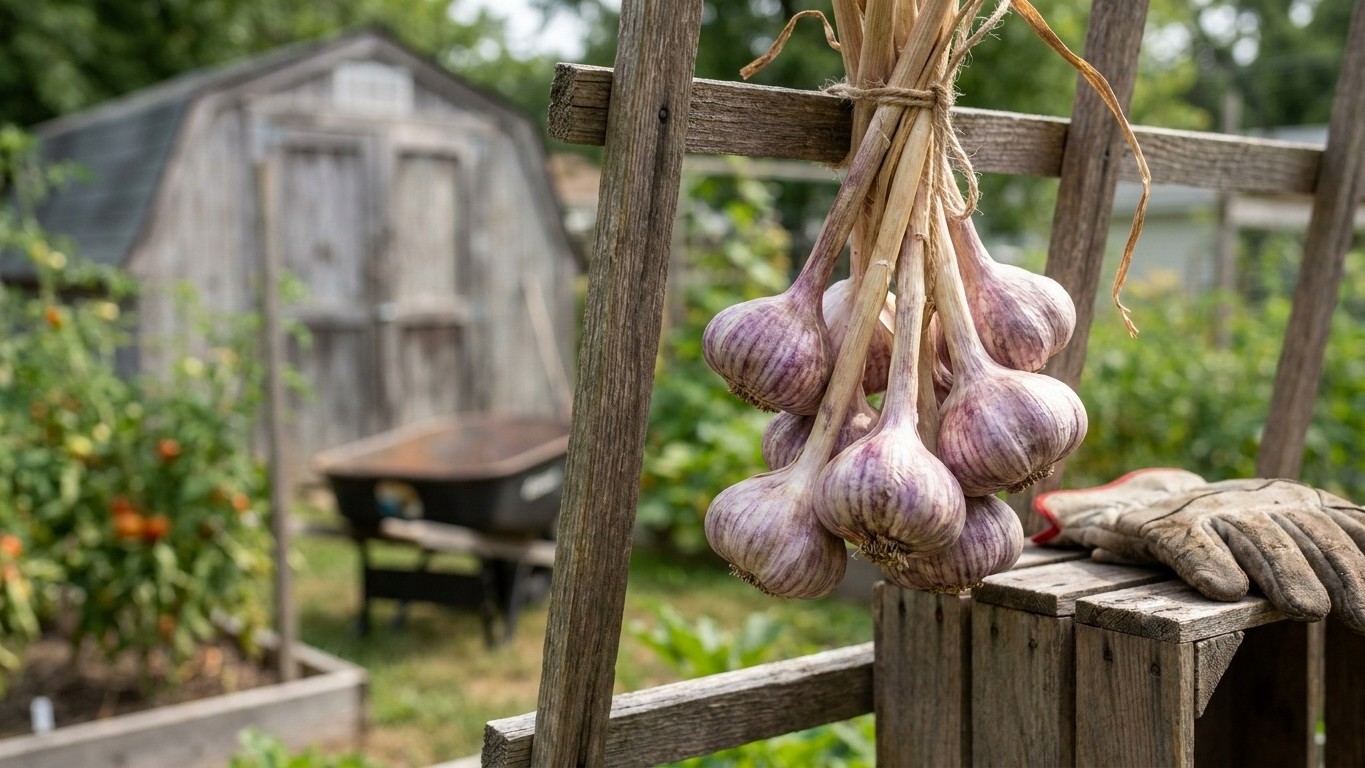

Most garlic varieties suit Wisconsin winters just fine, because the state’s cold season runs far longer than garlic needs to split into cloves. Near Milwaukee, NOAA’s 1991-2020 climate normals put the average first fall freeze between October 17 and October 29, and the ground stays below 40°F for roughly 26.1 weeks each winter, well past the six to eight weeks garlic needs to vernalize. Set cloves out from late September to early October, well ahead of that freeze window.
The short answer for Wisconsin

Milwaukee’s first fall frost lands somewhere between October 17 and October 29, and that’s the number this whole list bends around — not because garlic minces at the sight of frost, it doesn’t, but because roots need weeks in unfrozen soil before winter locks it down. So the planting window here runs late September to early October, earlier than the “wait for the first freeze” advice you’ll hear everywhere else. The varieties below are the ones built for what comes after.
Every variety on the closed list below goes into the ground on the same schedule: late September to early October. That window is anchored on NOAA’s first fall frost date for the Milwaukee station, October 17 to October 29. Garlic tolerates light frost without damage, so the target isn’t to beat the frost itself. It’s to get roots established before the ground begins to freeze in earnest.
- Inchelium Red (softneck)
- Early Red Italian (softneck)
- Italian Late (softneck)
- Lorz Italian (softneck)
- Bavarian Purple (hardneck)
- Blue Music (hardneck)
- Chesnok Red (hardneck)
- Duganski (hardneck)
- Fall Festival (hardneck)
- Georgian Crystal (hardneck)
- Georgian Fire (hardneck)
- German Red (hardneck)
- German White (hardneck)
- Ivan (hardneck)
None of these fourteen is a poor fit for Wisconsin cold on paper. The choice between them comes down to flavor, storage life and clove size, not winter survival, since the state’s cold season clears the vernalization bar for any of them with room to spare.
Working it out for your own garden
The late-September-to-early-October window is set to give cloves several weeks of root growth before the soil surface starts to freeze hard, using NOAA’s Milwaukee-area first fall frost range of October 17 to October 29 as the anchor point. That frost date is a midpoint, not a guarantee. In one year out of two, the first freeze arrives later than the range shown, and in the other year it arrives earlier, so treat early October as the safer edge of the planting window rather than the latest one you can get away with.
Redo the count for your own district
To rework this for your own garden, start with the same two numbers. First, find your local first-fall-frost range, which will differ from Milwaukee’s, especially the farther you get from Lake Michigan. Our planting calendar for Wisconsin walks through counting backward from that date in more detail. Then treat late September through early October as your starting point and shift it earlier if your local frost range runs earlier than Milwaukee’s, or later if it runs later.
Elevation and the lake both move that arithmetic. A garden at higher elevation, away from the moderating effect of Lake Michigan, trends toward the earlier end of any regional frost range. A garden within a few miles of the shoreline trends later, sometimes by two weeks or more, because the lake holds summer heat into the fall and slows the first freeze.
The 26.1-week figure for time spent below 40°F works the same way. It describes conditions measured at one station near Milwaukee, not the whole state. A garden in the far north will likely log more cold weeks than that figure, which isn’t a problem: garlic’s six-to-eight week vernalization requirement is a floor, not a ceiling, and extra cold beyond what’s needed doesn’t hurt the crop, provided the bed is mulched against frost heave.
What changes across Wisconsin
NOAA’s frost figures above are measured at or near Milwaukee, and the same caution that applies to the frost date applies to everything downstream of it. Lake Michigan delays the first fall freeze along the shoreline, sometimes by two weeks compared with places just a short drive inland. Inland southern Wisconsin typically freezes in early October, ahead of the shoreline. The north freezes far earlier than either, often weeks before the Milwaukee range even begins.
| Region | Frost timing tendency | Effect on the planting window |
|---|---|---|
| Lake Michigan shoreline | Later than inland areas, since the lake holds summer heat into fall | Can often lean toward the later half of late September to early October |
| Inland southern Wisconsin | Typically freezes in early October | Plant toward the earlier half of the window to be safe |
| Northern Wisconsin | Freezes far earlier than the south | Shift the whole window earlier; confirm timing with a county extension office |
None of this changes which varieties will vernalize. It changes how much margin you have if a planting gets delayed. A gardener on the shoreline who plants in early October still has weeks of root-growing weather ahead. A gardener in the far north planting on the same calendar date may already be racing a freeze, which is exactly why the same closed list of fourteen varieties works everywhere in the state, but the calendar around it does not.
The mistakes this climate punishes
Two mistakes cost a Wisconsin garlic crop more than any others, and both are timing errors rather than variety errors, since every cultivar on the list above can handle the state’s cold.
Planting too late or too shallow
- Planting after the local window closes leaves cloves without enough root growth before the ground freezes, which weakens or kills them over winter.
- Planting too shallow, or skipping a mulch layer, exposes cloves to freeze-thaw heaving that can push them partway out of the soil during winter thaws.
- Buying seed stock without asking about its disease history introduces problems no amount of correct timing can fix.
That third point deserves detail. UC IPM’s Pest Management Guidelines for onion and garlic, UC ANR Publication 3453, list white rot, caused by the fungus Sclerotium cepivorum, as active in a published soil temperature range of 50 to 75°F. Near Milwaukee, mean air temperature falls inside that range in five months of the growing season, September, October, May, June and July, with one of those months at the pathogen’s published optimum. Fusarium basal rot, caused by Fusarium oxysporum f. sp. cepae, has a published range of 59 to 90°F that Milwaukee’s mean air temperature matches in three months: September, June and July.
Three things temper those counts. The published thresholds are soil temperatures, and soil lags air temperature by weeks and swings less than air does. A monthly average is not a month spent inside the danger zone. A month that averages 65°F still holds days near 50 and days near 80. And one weather station near Milwaukee does not describe conditions in Green Bay, La Crosse or the Northwoods. None of this means white rot or fusarium basal rot are guaranteed here, and it doesn’t mean they’re absent either. Infected planting stock carries both pathogens into any garden, regardless of climate, and white rot’s resting bodies persist in soil for years once introduced. Buying certified, disease-free seed garlic and rotating away from any bed with a history of onion or garlic disease matters more in Wisconsin’s climate than picking one variety over another.
Checking this against your county
Every figure above comes from one station near Milwaukee, and Wisconsin covers a lot of ground between the Illinois line and Lake Superior. Before you lock in a planting date, check WISC Extension for county-level frost and soil data closer to your own garden. County offices often keep records that reflect local elevation and lake effects better than a single statewide figure ever could, and that’s the number worth building your calendar around.
Common questions
Can I Plant Garlic in spring instead of fall in Wisconsin?
Spring planting generally produces small, undivided bulbs called rounds instead of properly cloved heads, because the crop misses the sustained cold period it needs to split. Fall planting, in the late-September-to-early-October window, is the reliable path for any of the fourteen varieties named above.
Is a hardneck a safer bet than a softneck for northern Wisconsin?
Not based on cold tolerance alone. Both hardnecks like German White and Duganski and softnecks like Inchelium Red and Early Red Italian will complete their vernalization requirement given Wisconsin’s long winter, wherever in the state you garden. Hardnecks are more commonly grown in harsh-winter regions historically, but that’s a matter of tradition and storage habits, not a documented survival difference in this climate.
What happens if I miss the late September to early October window?
Plant as soon as you can after that, as long as the ground isn’t frozen and is still workable. The cloves will have less time to root before winter sets in, so mulch heavily and immediately to buy back some of that lost establishment time.
Do I need to mulch garlic over a Wisconsin winter?
Yes, and it matters more here than in milder states. A mulch layer of straw, applied once the ground starts to cool, buffers the freeze-thaw cycles that otherwise heave shallow-planted cloves up and out of the soil during winter thaws.