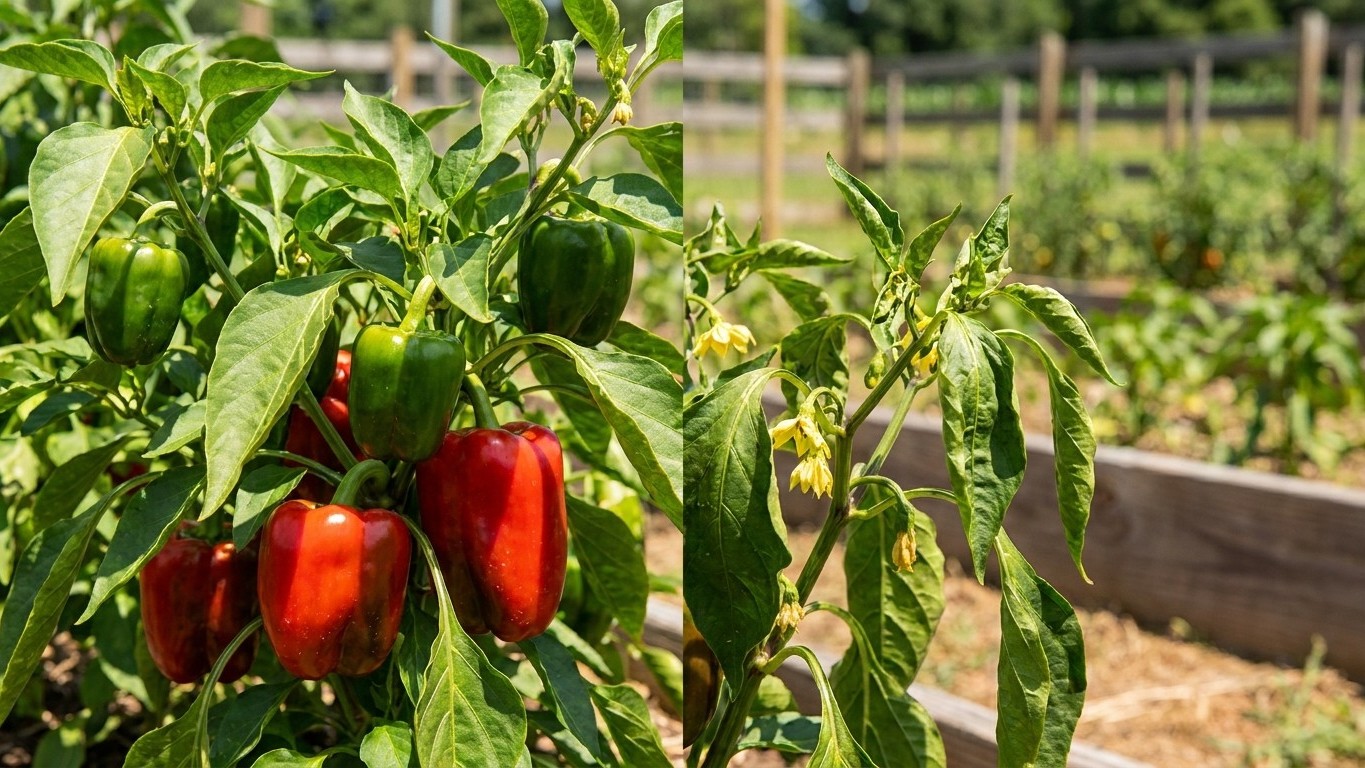

Most Missouri peppers are ready about 70 to 85 days after transplanting, according to Clemson Cooperative Extension. They keep best at 45 to 50 °F, which is warmer than a kitchen refrigerator. Below about 45 °F they pit and go soft. So pick when the fruit reaches full size, then store it on a cool shelf, not in the crisper. The rest of this page covers the timing, the heat and cold limits, and the failures that wreck a crop first. For the wider picture, see Growing Peppers in Missouri.
The short answer
The hot end
The Kansas City reference station averages 32.7 days a year at 90 F or more, based on NOAA NCEI climate normals. That is nearly five weeks of days, spread across the warm season, when pepper flowers are at risk. Utah State University Extension says pepper fruit set fails when days climb above 90 F. The number counts hot days. It is not the average summer temperature, and it says nothing about when the hot days arrive. A flower that opens during a scorching stretch can drop, while one that opens a week later sets normally. That is why a healthy plant can seem to pause in midsummer and then pick up again.
The count comes from one reference station, and your own county may run hotter or cooler. If you want the full picture of what a failed bloom looks like and what to do about it, Why Peppers Fail to Set Fruit in Missouri goes deeper.
The cool end
Fruit set also fails at the other extreme. Nights below 55 F are enough to stall it, the same Utah State source says, even when the days feel pleasant. This site does not carry summer night minimum temperatures, so that half of the picture is yours to track. A cheap min/max thermometer placed near the plants will tell you more than any guess. Don’t estimate your nights from latitude, and don’t assume a cold winter means cool summer nights. The two have no reliable link, and a pepper plant only responds to what actually happens at its leaves.
Picking and storing
Clemson puts harvest at about 70 to 85 days after transplanting. Treat that as a window, not a deadline. The fruit itself ripens on a clock that starts at flowering, not at sowing, so a plant that stalled during a hot spell or a cool week will run late. Cut peppers with pruners and leave a short stub of stem. Green fruit is edible at full size, and fruit left on the plant to color simply needs more time.
Then comes the mistake nearly everyone makes. Clemson’s storage conditions are 45 to 50 °F with 80 to 90 percent relative humidity, good for two to three weeks. That is a ceiling under ideal conditions, not a promise. A domestic refrigerator is colder than that range, and below about 45 °F peppers suffer chilling injury, which shows up as pitting and softening. Keep whole peppers on a cool counter for a few days, or in a cool spot that holds the range. Freeze or dry anything beyond what you will eat soon.
When to start seed here
You can’t pick a start date from the calendar alone. Work backward from the day transplants go outside, and that day depends on two things: frost and soil temperature. The arithmetic is short enough to redo for any county.
- Find your last spring frost. For the Kansas City International station (MCI), NOAA NCEI puts the date at which a 32 F freeze falls into the 30 to 70 percent probability band at April 6 to April 20. MCI sits well north of the city. The downtown station runs about five days earlier in spring, and southern Missouri is milder still. Your own county’s date is the one that counts, so use a local source.
- Wait for the soil to reach 60 F. Utah State University Extension says to transplant when the soil hits that mark, after frost. Soil usually lags behind the air, so this date often lands well after the last frost date. A soil thermometer in the bed settles it. This site does not publish a county soil-temperature date.
- Subtract 8 to 10 weeks. That is the time transplants need indoors before they go out. Eight weeks is 56 days, and ten weeks is 70 days.
- Seed on the resulting dates. As a worked example only, not a published date for any county, say your soil reaches 60 F on May 10. Count back 56 days and you reach March 15. Count back 70 days and you reach March 1. Seed between those two dates.
- Add the harvest window. Using the same example, 70 to 85 days after a May 10 transplant runs from July 19 to August 3, the span in which Clemson says peppers should be ready for harvest.
Reading the result
The two-week spread in step four is useful. Seeding at the early end gives you larger transplants, but they sit indoors longer and can get leggy if light is poor. Seeding at the late end gives you smaller, tidier plants with less margin if spring drags on. If the soil is slow to warm, hold the transplants back rather than forcing them into cold ground. A seedling that sits at 60 F soil with a few extra days of hardening off usually beats one planted early into a cold snap.
The same logic works in reverse in a hot year. If your forecast shows a run of days at or above 90 F arriving just as the first flowers open, expect the first wave of blossoms to drop and plan on a later first harvest.
What goes wrong here
Missouri’s heat load and its swings make three problems common. Each one has a recognizable look and a practical fix.
- Blossom drop. Flowers fall off without forming fruit during a hot spell (days above 90 F) or after a cool night (below 55 F). Both ends of the range cause it. Use light shade cloth on the hottest afternoons, water evenly, and cover plants on nights you expect to run cool. Skip heavy nitrogen, which pushes leaves instead of flowers. Don’t pull the plant. Flowers that open once conditions settle will set. More detail is in Why Peppers Fail to Set Fruit in Missouri.
- Sunscald. Pale, papery, sunken patches show up on the sun-facing side of the fruit. It usually follows a loss of leaf cover, whether from pests, disease, or heavy pruning, so protecting the foliage is the remedy. Leave leaves on, use shade cloth in the strongest sun, and check whether insects are stripping the plant. What Eats Pepper in Missouri, and When covers the usual culprits. A scalded spot can be cut away, and the rest of the pepper is fine to eat.
- Blossom-end rot. A dark, leathery, sunken patch forms on the bottom of the fruit, often on the first peppers of the season. It is tied to calcium not reaching the fruit, and the usual cause is uneven watering rather than missing calcium in the soil. Keep moisture steady with mulch or drip irrigation, and run a soil test before adding any calcium. Pick off affected fruit so the plant puts its energy into healthy ones.
Telling them apart
Location on the fruit is the quickest clue. Sunscald sits on the shoulder facing the sun, and blossom-end rot sits at the base. Chilling injury looks different again: small pits scattered across the skin of a pepper that went into the fridge. If you see that after a week in the crisper, the damage came from storage, not the garden, and the fix is simply a warmer shelf next time.
Common questions
Should I pick peppers green or wait for color?
Either works. Green fruit at full size is ready to eat, and Clemson’s 70 to 85 days after transplanting marks the harvest window. Fruit left on the plant to color needs more time, and the plant keeps spending energy on it, which can slow new flowers. If a cool snap or frost is coming, pick everything that has reached size.
Is a day or two in the refrigerator really a problem?
Clemson’s range for whole peppers is 45 to 50 °F, and a home refrigerator is colder than that. Below about 45 °F, peppers pit and soften from chilling injury. How fast that happens depends on how cold and how long, and this page has no figure for it. The safe habit is a cool counter for whole peppers. Once a pepper is cut or cooked, the refrigerator is fine, since you will use it within days.
How long will picked peppers keep?
Clemson says two to three weeks at 45 to 50 °F and 80 to 90 percent relative humidity. That is the best case under optimal conditions, not a guarantee. Most kitchens cannot hold that range, so plan on less. Slice and freeze or dry what you can’t use within a few days.
Does 32.7 days at 90 F mean Missouri is too hot for peppers?
No. It means there are roughly a month and a half’s worth of risk days in a typical year, scattered through the season, and peppers set fruit again when conditions ease. The figure is a mean at the Kansas City reference station, so your county may differ. It also covers only the hot end. The cool end, nights under 55 F, is not carried here, so a min/max thermometer in your own garden is the only way to know whether it is hurting your crop.