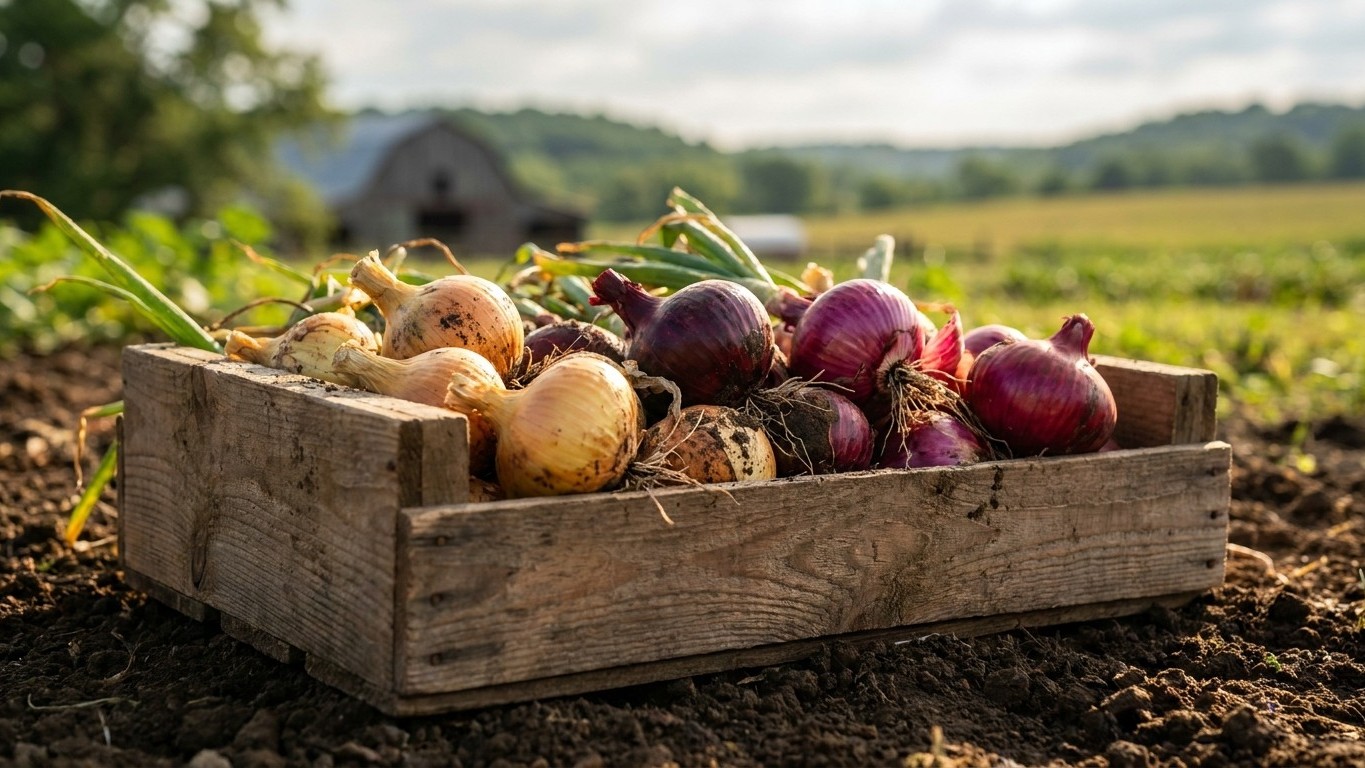

Three things eat onions on Prince Edward Island, and they arrive in a predictable order. Onion maggots chew seedlings and young bulbs in the cool, damp spring. Thrips rasp the leaves during warm, dry spells in summer. Rot organisms take over in storage when bulbs go in uncured or damp. Day length drives none of them. It drives the onion, and the onion’s stage decides which pest can hurt it. Exact emergence dates for the island are not published here, so this page gives the sequence and the checks.
The short answer for Prince Edward Island
Charlottetown sits at 46.29 degrees north, and on the longest day of the year it gets 15 h 36 of daylight. That number is the reason pest timing on the island looks the way it does. Onions switch from making leaves to making a bulb based on day length, not warmth. Short-day varieties start bulbing at about 12 hours, according to Clemson Cooperative Extension. Long-day varieties wait for 14 to 16 hours, and Charlottetown’s summer days clear that bar. The island is long-day territory (the best onion varieties for Prince Edward Island are covered on their own page).
Here is what that means for pests. Once day length triggers bulbing, the plant stops adding leaves. The leaf area it has at that moment sets the size of the bulb. Anything that eats leaves or kills small plants before that point, whether maggot or thrips, takes bulb weight with it. The same pests arriving after bulbing costs far less. So the question “when do they attack” is really “how much of the plant’s growing window is left.”
The three culprits in order
The onion maggot is the early one. The adult fly lays eggs at the base of young plants, and the larvae tunnel into stems and bulbs. Cool, moist weather suits it, and that describes a Maritime spring well. Thrips are tiny insects that hide in the leaf folds and scrape the surface, leaving silvery patches. They prefer heat and dry air, so they show up in summer spells rather than in spring. The third problem is not an insect at all. Neck rot and other storage rots start at the cut or open neck and spread when bulbs sit damp.
| Pest | Crop stage at risk | Weather that favors it | What you see |
|---|---|---|---|
| Onion maggot | Seedlings and young plants, before bulbing | Cool and damp | Wilting, yellowing plants; hollowed stems; soft bulbs |
| Thrips | Leafy growth, up to and during bulbing | Warm and dry | Silvery streaks, tips browning, leaves collapsing early |
| Storage rots | Harvested bulbs | Damp, warm storage | Soft necks, mold at the top, bulbs going slimy |
Timing the planting itself also matters, and the planting calendar for onions in Prince Edward Island sets out when the crop should go in. For the full picture of growing them here, start from the main page on onions in Prince Edward Island.
What will not work here
Planting late to dodge the maggot does not delay the harvest. It shrinks it. Whatever size the plant has reached when day length triggers bulbing is the size of the bulb, so a seedling set out late gets less time to build leaves and ends up with a smaller onion. A plant that loses half its leaves to thrips or its roots to maggots before that trigger ends up the same way. Smaller plants, smaller bulbs, no second chance. Several common moves fail for this reason or a related one:
- Short-day varieties: they begin bulbing at about 12 hours of daylight, and Charlottetown’s days pass that long before midsummer. They bulb early on small plants and stay small, which leaves little leaf area to absorb any pest damage.
- Planting late to escape the maggot: the fly’s timing is not worth the lost bulb size. You trade a possible pest problem for a certain smaller crop.
- Onions in the same bed every year: maggot pupae overwinter in the soil and in leftover plant debris, so a repeat planting hands the next generation its food.
- Spraying before you know the culprit: a wilting seedling could be maggot, and silvery leaves could be thrips. A treatment aimed at one does nothing for the other.
- Storing bulbs straight from the ground: curing comes first. Necks must be tight and skins papery before bulbs go into storage, or rot enters through the open neck.
- Sharing the root cellar with carrots: carrots want damp air, but onions want it dry. Clemson Extension puts the ideal at “between 45 °F and 55 °F, and 50 to 60 percent humidity,” and a single cellar cannot hold both crops well.
That last point is where a lot of the island’s garden losses happen, quietly, in January. A bulb that survived maggot and thrips all summer can still be written off by a damp cellar corner. The storage guidance comes from the Clemson Cooperative Extension fact sheet on onions, leeks, shallots and garlic.
What changes across Prince Edward Island
Every figure on this page belongs to Charlottetown, not to the whole province. The island is long and narrow, and a garden at either end is still near Charlottetown’s latitude, so day length there differs by minutes rather than hours. The bulbing trigger is not going to move much between North Cape and the eastern shore. If your garden is well away from Charlottetown, check your own latitude rather than assuming 46.29 degrees north. Exact latitude spans for the island are not published here, which is why there is no north-south table on this page.
What does shift from place to place is the local weather, and pests follow weather. A garden near open water tends to run cooler and damper through spring, conditions the onion maggot favors. A sheltered, inland bed with lighter soil warms and dries faster, which is the kind of spot where thrips get a foothold in a warm summer. Neither pattern is a rule, and the island’s soils vary from sandy to heavy, so treat these as tendencies to watch for rather than predictions. The point is that two gardens on the same island can face different first pests.
The practical move is to scout by crop stage rather than by calendar date. Look at the base of seedlings in spring, then at the leaves once the plants are growing hard, then at the necks at harvest. A gardener who watches the plant sees the problem on whatever date it actually arrives, which beats any date a guide could print for a province-wide average.
Checking this against your own garden
Province-wide numbers are a starting point, and no figure here replaces what your own plot is doing. Several checks are worth doing this week, none of which needs equipment beyond a phone and a thermometer:
- Look up your latitude. Any mapping app will give it. Compare it with 46.29 degrees north, the Charlottetown figure, and note how far apart you are.
- Find your local frost dates. Ask the extension or agriculture advisory office that serves your part of the island for the last spring frost and first fall frost typical for your area. This page does not carry frost dates, so do not borrow one from elsewhere.
- Name your pest before treating it. Pull a wilting seedling and check the base for tunneling, and look at leaf surfaces for silvery streaks. If you cannot tell, bring a sample to the extension office for identification.
- Review where onions grew last year. If the same bed is in line for them again, plan a different spot.
- Test your storage space. A cheap thermometer and humidity gauge will tell you whether the cellar sits at 45 °F to 55 °F and 50 to 60 percent humidity, or whether it is carrot weather.
- Judge your cure. Necks should be tight and skins papery before any bulb goes into storage.
The extension office is also the right place to ask what is active locally in a given season, since pest pressure changes from year to year in ways no printed guide can follow.
Common questions
When do onion maggots attack on Prince Edward Island?
In spring, when plants are small and the weather is cool and damp. The exact dates for the island are not published here, so scout seedlings at the base weekly and ask your local extension contact what is flying that season.
Does planting later avoid pests?
It trades one problem for another. A late planting does not push the harvest back. It shrinks it, because the plant has fewer leaves built when day length triggers bulbing, and the bulb ends up that much smaller.
Does day length affect the pests themselves?
Day length acts on the onion, not on the insects. At 15 h 36 of daylight on the longest day in Charlottetown, long-day onions bulb on schedule, and the pests respond to weather and to the crop’s stage.
Can I store onions in the same cellar as carrots?
Not well. Onions keep best at 45 °F to 55 °F and 50 to 60 percent humidity, according to Clemson Extension, and carrots want damper air. Cure the onions first, then store them somewhere drier.