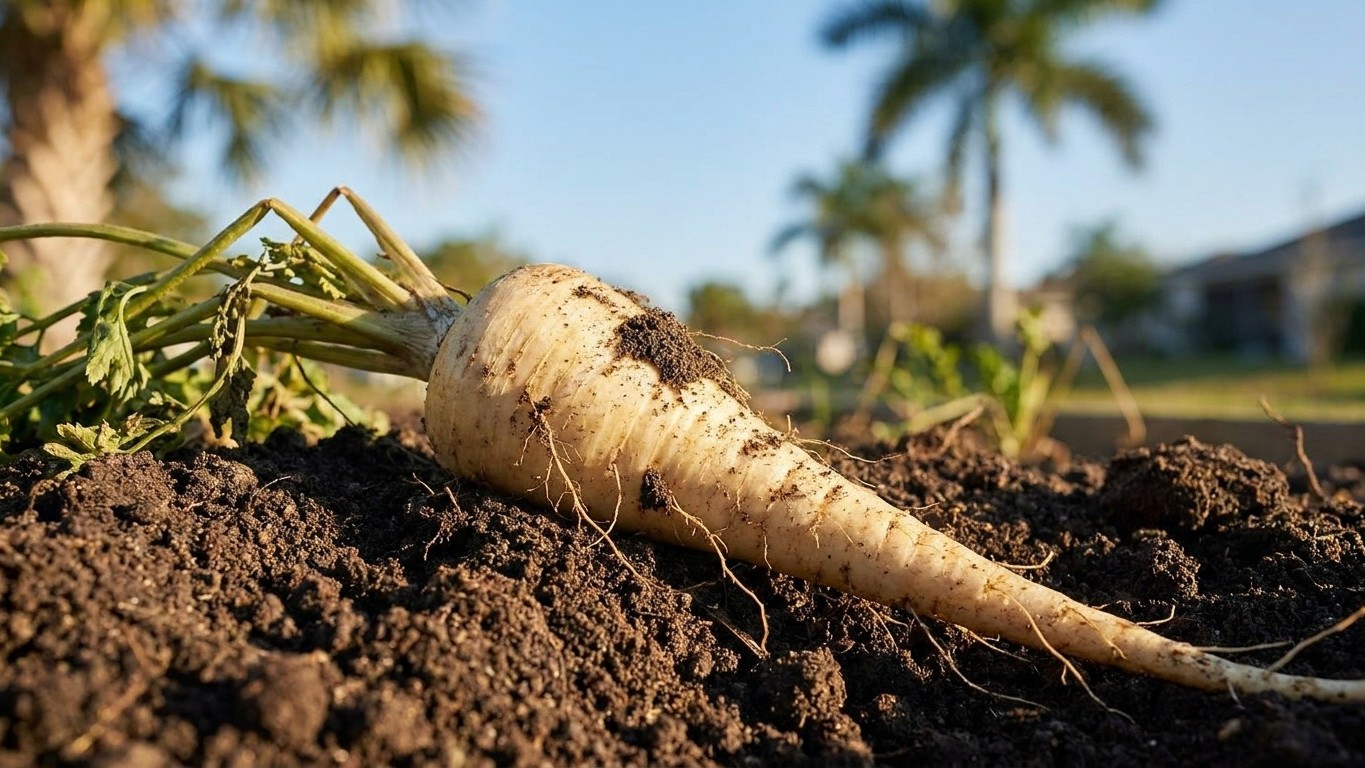

Lift parsnips after several weeks of frosty weather, not before. At Burlington the first fall frost arrives October 3 to October 13, so the first digging belongs in late October or November. A sowing made in April finishes growing by late summer, which leaves the roots weeks to sweeten. Once they’re out, a parsnip can keep four to six months, but only at 32 to 34°F and only away from apples.
The short answer
Does Vermont deliver several frosty weeks? It does. The mean daily minimum of the coldest month at Burlington is 12.9°F, according to NOAA NCEI Climate Normals. That is the average overnight low, not the record low and not the monthly average, and it describes the mildest corner of the state. Burlington sits on Lake Champlain, which softens winter. Inland valleys, the Green Mountains and the Northeast Kingdom run colder and have shorter seasons. A parsnip grown here will sweeten, not merely grow.
The mechanism comes from Utah State University Extension. Parsnips taste best after several weeks of cool, frosty weather, which converts stored starch to sugar. The trigger is exposure to frost, not the hardiness zone printed on a seed packet. A comfortable zone number says the plant will live through winter, and a parsnip would live through a mild one. It would just stay bland. The root needs cold nights in the ground, week after week. Vermont has them. For the longer version of that chemistry, see Will Parsnips Sweeten in Vermont?
When the digging starts
The source gives a duration, “several weeks,” and no calendar date. So count from the first fall frost. With that frost landing October 3 to October 13 at Burlington, a first lifting in late October or early November gives the roots their several weeks. Colder towns see frost earlier, so their clock starts earlier too. Pull one root and taste it before committing the row. If it’s mild and starchy, give it another week of cold.
Parsnips can also stay where they grew and be dug as needed while the ground is workable. A thick mulch of leaves or straw keeps the soil from locking up solid. Dig them all before the soil thaws and warms, because a root left to wake up in spring is spent.
Storage is where the second mistake happens. USDA Agricultural Handbook 66 says parsnip roots can be stored 4 to 6 months at 32 to 34°F with 98 percent relative humidity. That is a long keeper by any standard, and the figure assumes those conditions are held steady. Almost no house does that. A refrigerator crisper in a sealed or perforated bag comes closest, and a cold root cellar can work too. Parsnips are not chilling sensitive, so cold is not the danger. The danger is ethylene. Parsnips make very little of it themselves, but the handbook reports that exposure to low levels in cold storage causes bitterness, likely from a compound called xanthotoxin. Put them next to apples or any ripening fruit and they turn bitter, even at the right temperature. Keep them in a separate drawer or a separate room. Top the greens after harvest, but do not cut into the crown. The full text is in the USDA handbook.
Does the season fit?
A parsnip needs 100 to 120 days from seeding, and it is sown in place, so the count starts the day the seed goes in the ground. Sow 2 to 3 weeks before the last spring frost. Here is the arithmetic for Burlington, in words.
- Find the sowing window. The last spring frost falls April 30 to May 10. Two to three weeks earlier puts sowing between April 9 and April 26.
- Wait for germination. Seed takes 14 to 21 days to come up. An April sowing means no green until early to mid May. Don’t dig up bare soil and re-sow. Slow seed is normal for this crop.
- Count to maturity. From April 9, 100 to 120 days lands between July 18 and August 7. From April 26, it lands between August 4 and August 24.
- Compare with the fall frost. The first fall frost arrives October 3 to October 13. The earliest sowing has about 177 days before the earliest frost, and the latest sowing has about 160. Against a need of 100 to 120 days, that is a margin of 40 to 77 days.
- Read the margin correctly. The roots are full size by late summer and then sit, getting no bigger, until the cold arrives. Those weeks are not wasted. They are the wait before sweetening starts.
The season fits comfortably at Burlington. The frost-free stretch itself runs roughly 146 to 166 days, depending on which ends of the two date ranges you pair, and a parsnip asks for 100 to 120 of them.
Where the arithmetic tightens
Those dates come from the lakeside station. The Green Mountains and the Northeast Kingdom run substantially shorter, with later last frosts and earlier first frosts. Frost dates for those areas are not published here, so check a station near your own garden before assuming the margin holds. If your last frost is a few weeks later and your first frost a few weeks earlier, that 40 to 77 day margin can shrink toward nothing, and a late sowing becomes a gamble. Sow as early as the ground can be worked. Cold, sodden soil in early April can rot seed, so a sowing delayed to the first workable day is better than one forced into mud.
What goes wrong here
Most Vermont parsnip trouble comes from the soil, the calendar or the kitchen shelf, rarely from winter itself. Utah State University Extension recommends deep sandy soil and says heavy soil must be double dug. A map of the state’s soils is only a starting point, not a diagnosis of your bed. Push a spade down a foot and see what you actually have.
- Forked roots in heavy or stony ground. A root that meets clay or a rock splits around it. Double dig the bed deeper than the root will grow, and pull out stones as you go. Vermont gardens often hold both clay and glacial stone, sometimes in the same row.
- Forked roots from overwatering. This is a separate cause, and it can happen in good soil. Constantly wet ground can fork roots even when the bed is loose. Water deeply and less often rather than a little every day, and let the top inch dry between soakings.
- A season that runs out. In the Green Mountains and the Northeast Kingdom the frost-free stretch is shorter than at Burlington, and the exact dates are not published here. Sow on the first workable day, and don’t count the days from the calendar. Count them from when the seed goes in.
- Bare soil in May. Germination takes 14 to 21 days, and gardeners who dig up the row at day ten conclude the seed failed. Mark the row and wait three weeks before judging it.
- Lifting too soon. Roots dug in September, before cold nights have done their work, are fine to eat but not sweet. Wait for the frost, and taste one first.
- Bitter roots from ethylene. Parsnips stored beside apples turn bitter even in a cold fridge. Give them their own drawer or room, and top them without cutting into the crown.
- A winter too mild to sweeten. This is the classic failure in warm states, and it is not a real risk at Burlington, where the coldest month averages 12.9°F at night. A zone number would not have told you that. Frost exposure does.
Pests are the other half of the story. Carrot rust fly and similar insects attack roots in the ground, and the timing matters. What Eats Parsnip in Vermont, and When covers it. For the full crop from seed packet to table, start at Growing Parsnips in Vermont.
Common questions
When should I harvest parsnips in Vermont?
Begin after several weeks of frosty weather. The first fall frost at Burlington falls October 3 to October 13, so late October into November is the usual start. Taste one root first. Colder parts of the state get frost earlier, so their harvest can start earlier.
Can parsnips stay in the ground over winter?
They can stay until you need them, provided the ground is still diggable, and mulch helps with that. Dig the rest before the soil warms in spring, since a root left to wake up goes downhill.
How long do harvested parsnips keep?
USDA Handbook 66 gives 4 to 6 months at 32 to 34°F with 98 percent humidity. A home refrigerator drifts from those numbers, so expect the low end, and don’t count on the full six months without a cold, humid cellar.
Why did my stored parsnips taste bitter?
The likeliest cause is ethylene from nearby fruit. Apples and other ripening fruit give off the gas, and the handbook links even low exposure in cold storage to bitterness. Store parsnips alone, and keep the crown intact when you top them.