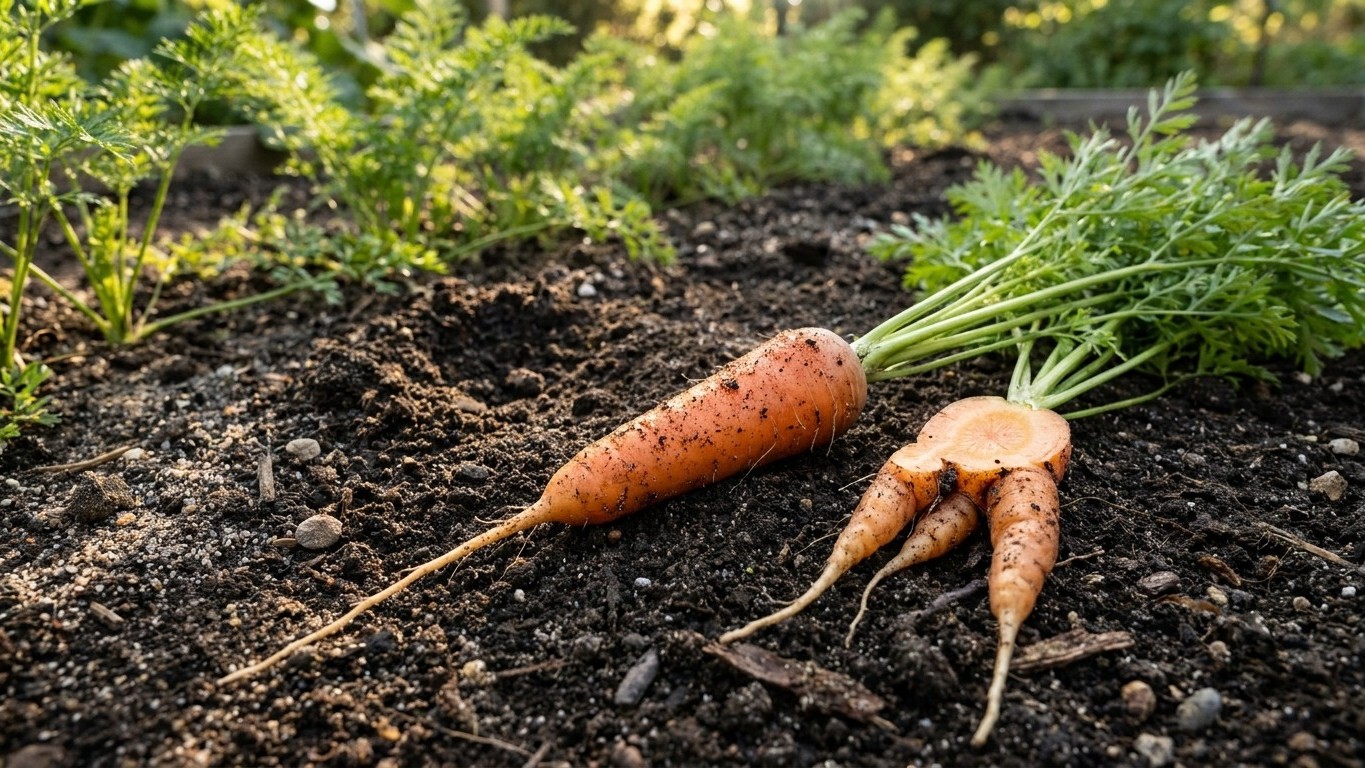

Pull carrots about 65 to 75 days after planting, per Clemson Cooperative Extension. Seed packets for slower types often run 70 to 100 days, and both counts start the day the seed goes in the ground. Once the roots are out, twist off the tops and chill them at 33 °F with high humidity, and they can keep for months at best. Leave the leaves on and that drops to 10 to 14 days. The details below decide which end of that range you get.
Keeping them, and for how long
Clemson Cooperative Extension’s Home & Garden Information Center states the storage rule in one line: store carrots at 33 °F and high humidity to prevent wilting. That is barely above freezing, and it is the number most gardeners get wrong. A carrot is a living root, still breathing and still spending its sugars, and cold slows all of that. Humidity matters for a different reason. A root is mostly water, and dry air pulls it out through the skin until the carrot goes limp and rubbery.
The same Clemson source gives the shortest figure on the list. Bunched carrots, meaning plants with the tops still on, can be stored for about 10 to 14 days. Treat that as the ceiling, reached only when the cold and the humidity are both right. A bunch on a warm counter will not get there.
Why the tops come off first
The leaves are the catch. They keep drawing moisture out of the root long after harvest, the way a cut bouquet drinks from its vase, except here the root is the vase and it has no way to refill. Within days the carrot shrivels while the greens still look decent. That is why bunched carrots last 10 to 14 days and trimmed ones last months.
So cut the tops off the day you pull the roots, leaving just a short stub of stem at the crown. Nothing is lost, since the greens are the part that spoils first. Trimmed carrots held at 33 °F in high humidity can last for months. That is the best case, with cold, humidity and sound roots all working together, so check the bin now and then rather than trusting the calendar.
Temperature drift costs time quickly. A reader who stores carrots at 50 °F will lose them to sprouting and softening in a fraction of the time. Warmth wakes the root up, and a root that wakes up starts feeding a new flush of growth from its own stored sugars.
Counting the days to the pull
Carrots are sown where they will grow. There is no transplant, so the 65 to 75 days Clemson gives, and the 70 to 100 on many packets, run from seeding. A packet that says 75 days means 75 days from the day the seed was pressed into the row, not from the day the first feathery leaves showed. For sowing windows and spacing, see Growing Carrots in Illinois.
The calendar only gets you to the right week. The test is the root itself. Pull one carrot, check that the shoulder at the soil line is as wide as the packet describes and the color is deep, and taste it. If it is thin and pale, give the row another week and test again. Roots left in cool soil hold their quality for a while, and many gardeners find the flavor improves as the weather cools. The limit is ground that freezes hard enough to lock them in, so mulch the row heavily if you plan to leave some in place and dig the rest before a deep freeze.
Soil texture changes how the pull goes. The state soil of Illinois, the Drummer series, is a deep, dark prairie Mollisol, but its mapped surface is 31 percent clay and 61 percent silt, with only 8 percent sand, and it is poorly drained. Carrots yanked from wet, heavy ground like that tend to snap at the neck. Loosen the soil beside the row with a garden fork first, then lift. Utah State University Extension notes that heavy or rocky soil makes carrots fork, which is worth remembering when you see crooked roots at harvest. Will Carrots Fork in Illinois Soil? covers the fix.
Where in the house that actually is
The 33 °F figure is easy to write down and hard to find in an ordinary house. Most rooms miss it by a wide margin, and some appliances overshoot it in the other direction.
The refrigerator comes closest. It is the only space in a typical home that stays cold on purpose, and the crisper drawer, with its slightly higher humidity, is the best spot in it. The cold that bruises tomatoes and basil suits carrots well. Fridges are not uniform, though. Air near the back wall or the cooling vent often runs colder than air near the door, so a carrot wedged against the back can freeze while one on the door shelf sits too warm.
Heated rooms fail for the opposite reason. A kitchen cabinet, a pantry off the kitchen, or a mudroom with a radiator all hover far above 33 °F, and the 50 °F outcome described above is where carrots end up. An unheated basement is better, and in a cold corner it can come near the target in late fall and winter. In early autumn, when the first big harvest arrives, a basement is often still warm from summer, and the carrots start to soften before the room cools.
The garage is the least reliable choice. It follows the weather. A garage that stays above freezing on a mild November night can drop below it during the first hard cold snap, and a frozen carrot thaws into a limp, watery mess. In a warm spell the same garage climbs well past the safe range. A bin there needs checking daily.
Whichever spot you choose, put a thermometer in it for a full day before you commit the harvest, and read it morning and evening. Skipping that step costs a bin of soft, sprouting roots a few weeks later, and by then the cause is hard to trace. Humidity is easier to judge by eye. Carrots that go limp need a damper environment, and a loosely closed plastic bag with a few holes keeps moisture in without trapping it. Carrots that turn slimy are sitting too wet.
A realistic plan splits the crop. The fridge holds what you will eat over the next few weeks, since a bumper row will not fit in a crisper drawer. The rest can stay in the garden under mulch until the ground starts to freeze, and then you dig them and decide where the thermometer says they can go.
Common questions
How do I know carrots are ready if the packet date has passed?
Pull one and look. The count of 65 to 75 days from Clemson, and the 70 to 100 days on many packets, is a guide from sowing, and weather can push it either way. Check that the shoulder at the soil line has reached the width the packet describes and that the color is deep. If the carrot is thin or pale, wait a week and test another.
Can I leave carrots in the ground instead of storing them?
For a while, yes. Cool soil holds them well, and a thick layer of mulch over the row delays freezing. The limit is ground that freezes hard, which traps the roots and makes digging a chore. Poorly drained clay stays wet and heavy, so dig earlier there. Your county extension office can tell you what the local freeze pattern looks like.
Is my soil likely to fork my carrots, and how do I check?
The Drummer series is only a starting point. A state spans hundreds of soil series, and your garden may be nothing like it. The Drummer surface runs about 6.7 pH, 5.5 percent organic matter, and is poorly drained and clayey, which tends to cause forking, according to Utah State University Extension’s rule about heavy ground. Carrots do better in deep, sandy, well-drained soil rich in organic matter. To check yours, fill a jar a third of the way with garden soil, top it off with water, shake it, and let it settle: sand drops first, silt next, clay last. The thicker the clay layer, the more forking you can expect. For an actual pH number, send a sample through your county extension office. Heavy soil calls for compost and double digging, or a raised bed, rather than a different variety.
Should I store carrots with damage on them?
Eat those first. Roots with tunnels or gnaw marks open the door to rot, and one bad carrot can spoil a bin. Sort them as you trim the tops, and keep only the sound ones for the long haul. What Eats Carrot in Illinois, and When explains who causes the damage and when to expect it.