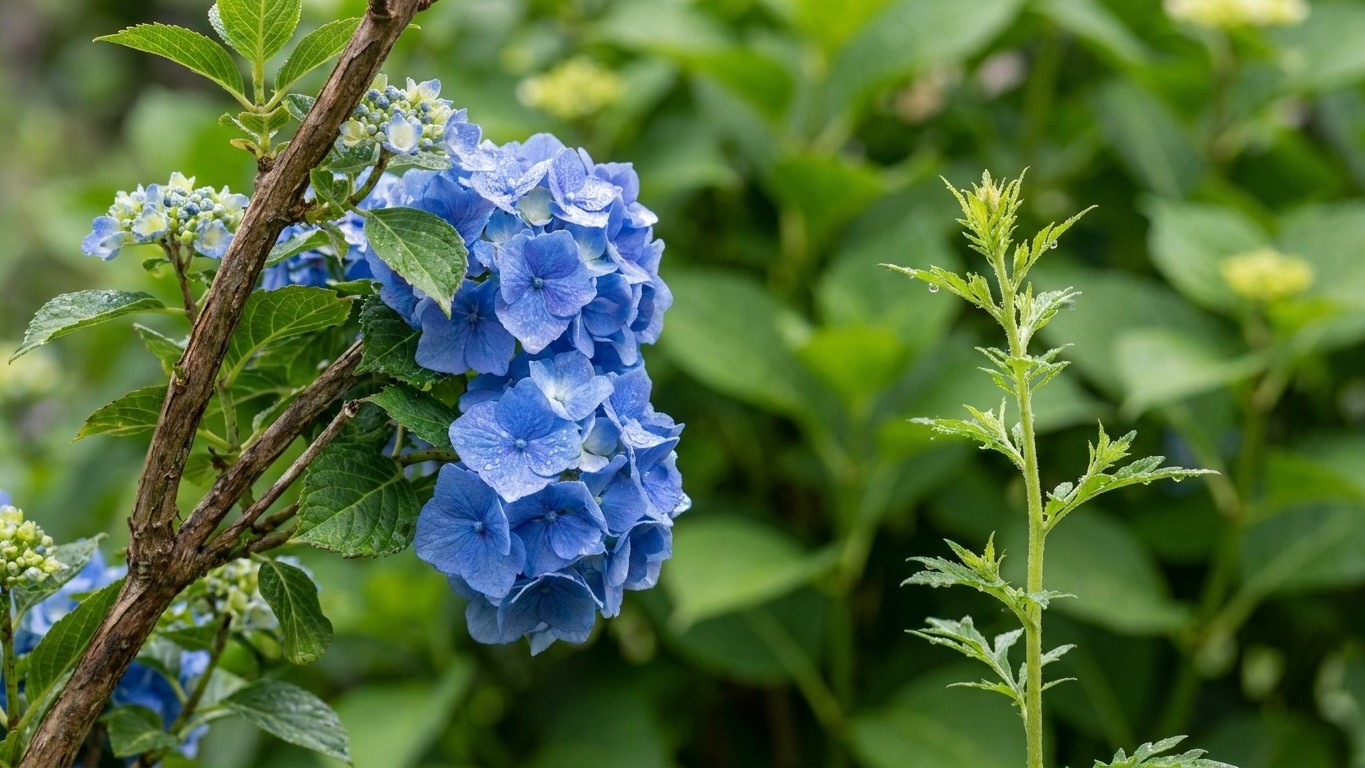

Plant container-grown Hydrangeas in Pennsylvania from mid-April, once the last spring freeze has passed, or from late September into early October so the roots settle in before winter. Panicle and smooth types handle the cold northern tier best. Bigleaf types bloom more reliably in the southeast or in a sheltered spot. Soil pH, not fertilizer brand, decides whether a bigleaf blooms blue or pink.
When to plant Hydrangeas in Pennsylvania

The reference point here is Philadelphia, where NOAA’s 1991-2020 Climate Normals put the last spring freeze between March 29 and April 6. Philadelphia is also the mildest corner of the state. The northern tier and the Alleghenies run two to four weeks later, which stretches that window to roughly April 12 through May 4. Use the date for your own county, not the Philadelphia one.
Spring planting and the count-back
Growing hydrangeas from seed is a poor bet. Named varieties don’t come true from seed, and seedlings can take years to flower. Cuttings and nursery plants are the practical routes. Softwood cuttings taken in June root by late summer, then spend the winter in pots in a cold frame or unheated garage. In spring they need hardening off, and so does any plant bought from a heated greenhouse.
Count back from planting day. In the Philadelphia area, set shrubs out around April 15, about a week after the end of the freeze window. Hardening off takes about ten days: an hour or two of morning shade on day one, then longer stretches, with full sun and a night outdoors only near the end. That puts the first outing on April 5. In the northern tier, shift everything by the local offset, so planting lands in early to mid-May and hardening off starts in late April.
Waiting past the last freeze matters most for bigleaf and oakleaf types. A dormant shrub shrugs off cold, but once the buds swell and leaves open, one night near 32°F can blacken the new growth and the flower buds with it.
Fall planting
Fall is the better season for many gardeners. Philadelphia’s first fall freeze typically arrives between November 5 and November 16. Roots need about six weeks to anchor, so counting back from the earliest date puts the last good planting day around September 24. In colder parts of the state the freeze comes sooner, so the window moves up by a couple of weeks, to early or mid-September. Plant in July or August and you will spend the first summer hauling water.
Soil and site preparation
Light decides more than people expect. Bigleaf and smooth hydrangeas want morning sun and shade from the hot afternoon, which is what keeps leaves from scorching in July. Panicle types tolerate full sun if the soil stays moist. Oakleaf types do well in dry shade under tall trees, where little else thrives.
Texture and drainage come next. Hydrangeas like moisture but rot in standing water. Dig a hole about 12 inches deep, fill it with water, and let it drain. Fill it again the next day. If water is still sitting there the following morning, plant in a raised bed or a broad mound 6 to 8 inches high. Heavy clay is common around newer suburban homes, where the topsoil was often scraped off during construction, and it benefits from compost worked into a wide area, not just the planting hole.
Start the prep weeks ahead. If the spot is lawn, smother the sod with cardboard and a few inches of wood chips four to six weeks before planting, or cut and flip it. Spread 2 to 3 inches of compost over the bed and fork it into the top 8 inches. Fall prep for spring planting works well because the compost has all winter to settle.
Color is a soil question. Bigleaf hydrangeas turn blue where the soil is acidic, because aluminum becomes available to the roots, and pink where it is neutral to alkaline. Limestone-derived soils in parts of the southeast and south-central counties lean toward pink, but a soil test tells you far more than a guess. Your county extension office can point you to a lab. White varieties, including panicle, smooth and oakleaf types, don’t change with pH.
Spacing depends on the species. Allow 3 to 4 feet for compact bigleaf types, 3 to 5 feet for smooth hydrangeas, and 6 to 8 feet for panicle and oakleaf shrubs. Dig the hole twice as wide as the root ball and no deeper, with the top of the root ball level with the surrounding soil.
Varieties that suit Pennsylvania
Three traits matter more here than any catalog photo. The first is which wood carries the flower buds. Bigleaf and oakleaf types form buds on last year’s stems, so a hard winter or a April freeze can erase the season. Panicle and smooth types bloom on new growth and bloom regardless. The second is stem strength, because summer thunderstorms flatten heavy blooms. The third is sun tolerance, since a shrub that scorches in afternoon sun is hard to place in an open suburban yard.
| Variety | Type | Blooms on | Good for |
|---|---|---|---|
| Endless Summer series | Bigleaf | Old and new wood | Blue or pink color; still flowers if winter kills the old buds |
| Annabelle | Smooth | New wood | Cold-hardy white mopheads in part shade; stems flop in rain |
| Incrediball | Smooth | New wood | Annabelle’s look on sturdier stems |
| Limelight | Panicle | New wood | Full sun, big blooms, tough in the northern tier |
| Bobo | Panicle | New wood | Small yards and foundation beds |
| Quick Fire | Panicle | New wood | Earlier blooms that fade to pink |
| Snow Queen | Oakleaf | Old wood | Dry shade and bronze-red fall leaves |
A reasonable rule: in the Alleghenies and the northern tier, lean on panicle and smooth types and treat bigleaf as a bonus. In the southeast, bigleaf varieties get a longer, gentler season, though a warm February followed by a hard freeze can still ruin buds. Reblooming bigleaf types protect against that, and mopheads in a sheltered spot beside a house wall tend to survive better than ones in an open lawn.
Growers in other states face their own versions of these choices. The How to Grow Hydrangeas: The Complete Guide covers the species in depth, and the state pages for Growing Hydrangeas in Colorado: Types, Colour and Winter and Growing Hydrangeas in Illinois: Types, Colour and Winter show how the same traits play out in drier or colder winters.
What to plant alongside
The best neighbors fill the shade and soil under a hydrangea’s skirt. Hostas, ferns, astilbe and heuchera all like the same moist, partly shaded conditions, and their leaves cover bare ground when the shrub is young. Their canopy also keeps soil cooler and slows evaporation, which is a real benefit during July dry spells. Spring bulbs such as daffodils fill the gap before hydrangeas leaf out, and the foliage fades just as the shrub takes over.
Pollinators matter too. Lacecap and oakleaf types have small true flowers that bees visit, while big mophead types are mostly sterile showpieces. Planting a few perennials with open flowers nearby, such as coneflower on the sunny side, gives bees something to feed on.
Competition is the other side of the ledger. Shallow-rooted trees such as maples and birches pull water from the top foot of soil, exactly where hydrangea roots live, so a shrub planted at the base of one will sulk in August. Keep hydrangeas out of the root zone of black walnut, which releases a compound that harms a number of garden plants. And a rose bed beside the hydrangeas is a poor idea. Japanese beetles gather on favorite plants in groups, and a crowd that begins on roses will not stay there.
Some popular pairings have little evidence behind them. Garlic, chives or marigolds planted nearby are said to confuse aphids and beetles, but there is no solid trial showing they protect a hydrangea. Plant them if you like them. Don’t count on them to replace scouting. The same goes for burying coffee grounds or rusty nails to change flower color. Those add almost nothing that a pH adjustment would not do better.
Watering, feeding and support
The common mistake is giving a little water every day. Hydrangeas root deepest when watered slowly and thoroughly, about an inch a week from rain and hose combined, and more during hot spells or the first year after planting. A soaker hose laid under the mulch delivers it without wetting the leaves, which also lowers the risk of leaf spots. A wilting shrub at 3 p.m. may only be flagging in the heat. Check again at dusk. If the leaves are still limp, the soil is dry.
Mulch with 2 to 3 inches of shredded bark or leaf mold, pulled back a couple of inches from the stems so the crown stays dry. It holds moisture and cools the soil, and it adds a layer of insulation before winter.
Feeding is simple. One application of a slow-release, balanced fertilizer when growth starts in spring is enough for most established shrubs, and compost each year helps further. Skip feeding after midsummer, because late nitrogen pushes soft growth that freezes in fall. Heavy nitrogen at any time gives you big leaves and few flowers.
Staking matters for smooth and heavy panicle types. A peony ring set early in the spring, while the stems are short, lets them grow through it and hides the support. Incrediball-type varieties usually need less help.
Pruning follows the bloom wood. Prune bigleaf and oakleaf types right after flowering, no later than late July, or you cut off next year’s buds. Cut panicle and smooth types in late winter or early spring, since they flower on new growth. Smooth hydrangeas can be cut back to a few inches above the ground. For suckering, panicle types can be trained to a single trunk by removing shoots at the base, while smooth types do better when the sprouts are left in place to form a clump.
Common problems

No flowers is the top complaint, and the cause is usually one of three. Bigleaf buds were killed by winter or by a spring freeze after leaf-out. The shrub was pruned in fall or spring when it blooms on old wood. Or the site is too shady, or the fertilizer too rich in nitrogen. Check the stems in spring. If they are green and alive but leafless where buds should be, it was cold damage.
Afternoon wilt, with leaves drooping in midday heat and recovering by evening, is normal for the large leaves of a hydrangea. Wilt that persists into morning means the roots are either dry or waterlogged. Dig a few inches down to see which. Brown, crisp leaf edges, especially on plants in full sun, point to scorch from heat or from days when roots can’t keep pace with water loss.
Leaf spots show as small tan or purplish circles with darker borders, usually on lower leaves in humid summers. They look worse than they are. Pick off the affected leaves, water at the base, and give plants enough room for airflow. Powdery mildew appears as a gray-white dust on leaf surfaces, mostly in shade with poor air movement, and is managed the same way.
Yellow leaves with dark green veins on a plant in alkaline soil indicate iron chlorosis. The iron is in the soil but locked up by high pH. Lowering the pH with sulfur, which works slowly, or adding chelated iron for a quick fix, restores the color. Evenly pale yellow leaves across the whole shrub are more often a sign of overwatering or soggy roots.
Blooms that turn brown at the edges can mean sun damage, but also late freeze injury if the flowers were opening. Blooms that open green and stay muddy often reflect a hot spell or too little water at bud formation. And flower color that goes wrong, with pink where blue was expected, comes back to pH and the aluminum available in the soil. Sulfur or aluminum sulfate applied according to the label, in fall or early spring, steers the color toward blue. Garden lime moves it toward pink. Change it gradually, since an overdose burns roots.
Pests that actually show up in Pennsylvania
Penn State Extension’s home garden pest guidance highlights several insects that matter to Pennsylvania gardeners. Four of them do real damage to hydrangeas.
Japanese beetle. The first sign is leaves reduced to lace, with the veins left and the tissue between them eaten away, plus shiny copper-and-green beetles feeding in clusters. Adults feed in summer, so scout in the morning when they are slow. The control that works best is shaking or knocking them into a bucket of soapy water. Traps tend to draw more beetles into the yard than they catch.
Aphids. You see clusters of small soft-bodied insects on new shoots and the undersides of leaves, with curled leaf tips and sticky honeydew. They peak in spring and early summer on tender growth. A strong spray of water knocks them off, and a repeat treatment every few days clears most infestations. Insecticidal soap is the next step.
Spotted lanternfly. Look first for clusters of gray, black-spotted nymphs in late spring and early summer, then for winged adults with red hindwings later in the season. They feed on sap, and the honeydew they leave can grow black sooty mold on leaves and stems. Handling them early matters. Remove nymphs by hand or with a soapy water spray, and report sightings according to local guidance, since quarantine rules apply in many counties.
Fall webworm. Silky webs enclose branch tips in late summer into early fall, and the caterpillars inside strip the leaves. Because the damage comes late, it rarely threatens the shrub’s health, but the webs are unsightly. Clip off the affected branch tip and drop it into soapy water, or tear the web open so birds and wasps can reach the caterpillars.
Brown marmorated stink bugs are also on the extension list for gardens. They are more of a nuisance than a hydrangea threat. If you are unsure what is chewing your leaves, take a sample to your county extension office for identification.
Harvest and end of season
Hydrangeas are cut for the vase and for drying, and timing differs for each. For fresh arrangements, cut stems early in the morning once the flowers feel firm, and put them straight into water. For drying, wait until late summer or early fall, when the blooms shift to muted antique shades and the petals feel papery. Cut too early and they shrivel instead of drying.
Dried bloom ripens off the plant. Strip the leaves, stand the stems in an inch of water, and let the water evaporate so the flowers dry slowly and keep their color. Or hang stems upside down in a dark, dry room. Stored in a dry spot out of direct sun, they last through winter.
As the first fall freeze approaches (typically November 5 to 16 in Philadelphia, earlier in the northern tier and higher elevations), stop feeding and pull the mulch up to a depth of 3 to 4 inches. In colder parts of the state, protect bigleaf hydrangeas by circling them with a cage of chicken wire and filling it loosely with shredded leaves. Leave panicle and smooth types standing. The old flower heads add winter structure, and any pruning can wait until late winter.
Local help
County-level planting dates, soil tests and pest identification are available through Penn State Extension, which has an office serving every county. Bring a soil sample if you want to change flower color. Bring a leaf or insect if something is eating the shrub. More regional advice is gathered in our Pennsylvania guides.
Common questions
What is the best time of year to plant hydrangeas in Pennsylvania?
Mid-April after the last freeze in the southeast, early to mid-May in the northern tier and Alleghenies, or late September through early October for fall planting. Avoid midsummer, when heat stress is hardest on new roots.
Which hydrangeas are hardiest in the northern part of the state?
Panicle types such as Limelight and smooth types such as Annabelle and Incrediball bloom on new wood, so winter damage to stems doesn’t cost you the season’s flowers. Bigleaf types are riskier there unless you choose a reblooming series and protect the plant.
How do I get blue hydrangeas instead of pink?
Test the soil first. Acidic soil gives blue flowers on bigleaf hydrangeas and neutral to alkaline soil gives pink. Applying sulfur or aluminum sulfate according to label directions lowers pH over time. White varieties do not change color.
Why did my hydrangea leaf out but never flower?
Most often the flower buds were killed by winter cold or a late freeze, or the shrub was pruned after it set buds. Bigleaf and oakleaf types flower on old wood, so prune them only right after bloom. Too much shade and too much nitrogen are the other usual causes.
Should I cut hydrangeas back in fall?
Generally no. Cutting in fall removes the buds of old-wood bloomers, and leaving stems standing helps protect the crown. Prune panicle and smooth types in late winter, and prune bigleaf and oakleaf types after flowering.