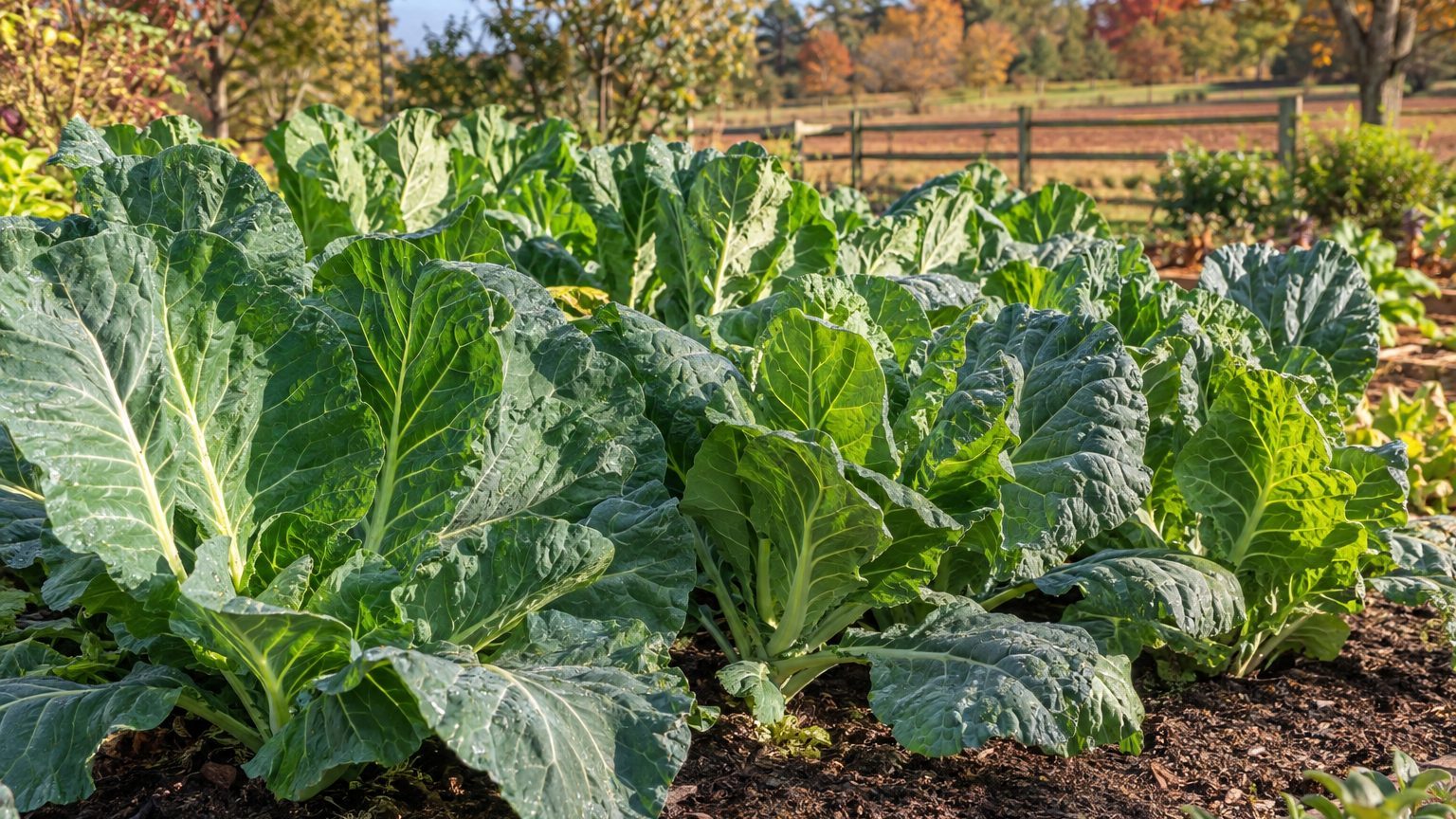

For most Massachusetts gardens, a standard open-leaf collard such as Vates or Georgia is the right pick, and the fall harvest is the one that counts. In the hills and the Berkshires, shift toward compact or early types, and consider kale alongside them. Both greens handle the cold, but they differ in how much season they need.
The short answer for Massachusetts
Choose by type rather than by seed catalog name: a standard open-leaf collard for the coast and the lowlands, a compact or early type where the frost-free season runs short, and a cold-hardy companion green (kale, or a mustard) to fill gaps. Collards are a cool-weather crop that tolerates warmth, and Massachusetts offers a long, cool shoulder on both ends of summer. That combination favors steady, upright varieties over fast-and-flimsy ones.
Reading the Boston frost dates
The best-documented dates come from NOAA’s 1991-2020 Climate Normals for Boston’s Logan Airport. The last spring frost falls between April 1 and April 8, and the first fall frost between November 3 and November 14. These are probabilities of a 32°F freeze, not promises. The dates mark the 30-70% band, the stretch in which the odds of a freeze shift from likely to unlikely in spring and from unlikely to likely in fall.
Logan sits on the water in a dense city, and it is the mildest spot in the state. Inland suburbs and the Berkshires frost noticeably later in spring and earlier in fall. Treat the Boston window as the best case, roughly seven months, and subtract from it as you move west and uphill.
Matching type to season
Collards are transplanted, and they keep growing through light frosts, so a long season is a bonus rather than a requirement. The leaves also taste sweeter after cold nights, which is why a fall crop beats a midsummer one. The table below sorts the types by what each asks of the season. For timing the transplants, see When to Plant Collards in Massachusetts.
| Type | Best fit in Massachusetts | Watch for |
|---|---|---|
| Standard open-leaf heirlooms (Georgia type) | Coastal and lowland gardens with a long season | Large plants that need room and time |
| Compact, cold-hardy standards (Vates type) | Most of the state, including cooler inland sites | Smaller yield per plant, so plant a few extra |
| Early hybrids (Flash type) | Short-season hill towns and the Berkshires | Less of the deep flavor of slow heirlooms |
| Kale and mustard greens | Fill-ins and late fall plantings anywhere | Different flavor and texture than collards |
What will not work here

The common failures in Massachusetts come from borrowing a calendar or a variety built for a different climate. Collards are a Southern staple, and much of the advice written for them assumes a winter mild enough to keep plants standing. That assumption breaks quickly here.
Overwintering and the slowest types
Boston’s coldest month has a mean daily minimum of 23.1°F. That is an average of the low, so the individual cold nights run well below it, and that is the reading that decides whether a plant lives through winter. Collards left in open ground are likely to be killed in most of the state. The state spans USDA hardiness zones 5a to 7b, so the hills and the Berkshires are colder still. Tree collards, the perennial type grown in mild-winter climates, are a poor bet outdoors in any part of Massachusetts.
A big, slow heirloom started late runs into the same wall from the other side. If it goes in the ground in midsummer at an inland or high-elevation garden, a freeze can arrive before the plant has built the leaf area you wanted. You will get small, tough leaves, not the broad ones the variety is known for. Early and compact types exist for this reason.
Cold soil, crowding, and the wrong frost date
Setting transplants out in the first mild week of April works only at the mildest coastal sites. Even there, a 30-70% band means a real chance of one more 32°F night after the window opens. Seedlings that have been hardened off will usually take a light frost, but waterlogged, cold soil slows root growth, and the plants sit stalled. Inland, a Boston date can be a month too early.
Crowding hurts too. Collards grow wide, and leaves packed together stay wet after rain and dew, which invites leaf disease and gives caterpillars and flea beetles cover. A planting that looks sparse in May fills out by August. Follow the spacing on the seed packet or plant tag, and thin or space generously so air moves through the rows.
Finally, a few gardeners treat spring and summer sowings as equal. The best-tasting collards come from the fall crop, and the strongest return per square foot comes from planning for it. A spring planting that stalls in heat often does worse than a summer-started one. For the full growing picture, Growing Collards in Massachusetts covers it in detail.
What changes across Massachusetts
A single answer for the whole state does not exist. The USDA Plant Hardiness Zone Map, built on the average annual extreme minimum temperature, places Massachusetts anywhere from zone 5a to 7b. That spread is large for a state this small. Cape Cod and the islands sit at the mild end, with the ocean moderating the cold. The Berkshires and the highest parts of the central hills sit at the cold end.
For a reader in the north or at altitude, the adjustments are practical. Choose the compact or early types first and treat the slow heirlooms as an experiment. Start transplants indoors a bit earlier so they are sturdy when the soil finally warms. Expect the first fall frost sooner than the Boston range of November 3 to November 14, which means the leaves sweeten earlier but the growing window ends earlier too. Cold sites also reward a mulch layer and a row cover, which extend the harvest by a few weeks rather than pushing it into winter.
For a reader on the coast or the Cape, the opposite applies. The longer season can carry a standard open-leaf variety all the way to a hard freeze, and a protected spot against a south-facing wall may keep a few plants usable deep into winter. Even so, the coldest-month minimum of 23.1°F in Boston means protection is optional only on the mildest nights.
Do not guess which band you fall into. Look up your own location on the USDA Plant Hardiness Zone Map and read the zone for your address. A garden a few miles inland or a few hundred feet higher can sit a full zone away from the nearest city, and microclimates inside a single yard add another layer.
Where to check this for your own county
The state-level picture is a starting point. The better source for a specific garden is the UMass Extension service, the land-grant university’s outreach arm, which works with growers across every county in Massachusetts. It publishes material written for local conditions rather than for the state as a whole.
Two things are worth looking for there. The first is a local planting calendar, which gives sowing and transplanting windows keyed to the frost pattern in your part of the state, not to Boston’s airport station. The second is the list of varieties trialed or recommended for your county. Trials tell you which collards and other greens actually produced under local cold, local soil, and local pests, and that is more useful than a catalog description.
A county recommendation beats a state one, and what you are reading is the state one. The Boston frost dates, the 23.1°F winter minimum, and the 5a to 7b hardiness range describe the state as a whole and its mildest reference point. A grower in Pittsfield and a grower in Plymouth are working with different seasons, even though both live in Massachusetts.
When you contact or search the extension, bring specifics: your town, the rough elevation, and whether your garden sits in a low spot or on a slope. Extension staff and master gardener volunteers can often say which frost pocket or wind exposure matters most in your area. That local knowledge is the piece no statewide guide can supply.
Checking this against your own garden
Your own observations outrank every date above. A frost date is a probability, and your yard has its own record. Three signs are worth watching, and none needs more than your hands and your eyes.
- Soil warmth by feel. Push your hand a few inches into the bed in the morning. If it feels cold and clammy, root growth will be slow, so hold back transplants. Soil that feels cool but loose and workable is ready for hardened-off collards. A bed that warms sooner than your neighbor’s tells you your site is a little ahead of the average.
- The first true leaves. On seedlings started indoors, the first leaves are the seed leaves. The next set, the true leaves, signals that the plant is making its own food. Seedlings with two or three true leaves are ready to harden off. Slow development suggests a cool, dim spot, and a stretched, leggy seedling suggests too little light.
- Where frost lands first. After the first frosty morning, walk the yard. White grass and stiff leaves mark the cold pockets, usually low ground where cold air settles. If your collard bed is in one, expect an earlier fall end and plan protection. If frost skips it, you have a milder microclimate than the area around you.
Keep a few notes from one season to the next: the date of the last frost you noticed, when the soil felt workable, and when the plants sweetened up. After two or three years, those notes will do more for your timing than any published window.
Common questions
Which collard variety is the best choice for Massachusetts?
A standard open-leaf type such as Vates or Georgia suits most of the state, and early or compact types such as Flash suit the cooler hills and the Berkshires. The right answer depends more on your site’s season length than on the variety name.
Can collards survive a Massachusetts winter?
Not reliably. Boston’s coldest month has a mean daily minimum of 23.1°F, and the state’s hardiness zones run from 5a to 7b. Plants left in open ground are likely to die, and only the mildest coastal sites with cover give them a chance.
Are collards or kale better for a short season?
Kale is the easier fit in the coldest parts of the state, and it handles late plantings well. Collards give you a broader, milder leaf and a sweeter flavor after frost, but they want an earlier start where the season is short.
When is the best time to harvest collards in Massachusetts?
Fall is the best harvest. Boston’s first fall frost falls between November 3 and November 14, and leaves picked after a few cold nights taste sweeter. Inland and higher sites will see frost earlier, so start picking when the leaves are full-sized and keep going as the weather cools.