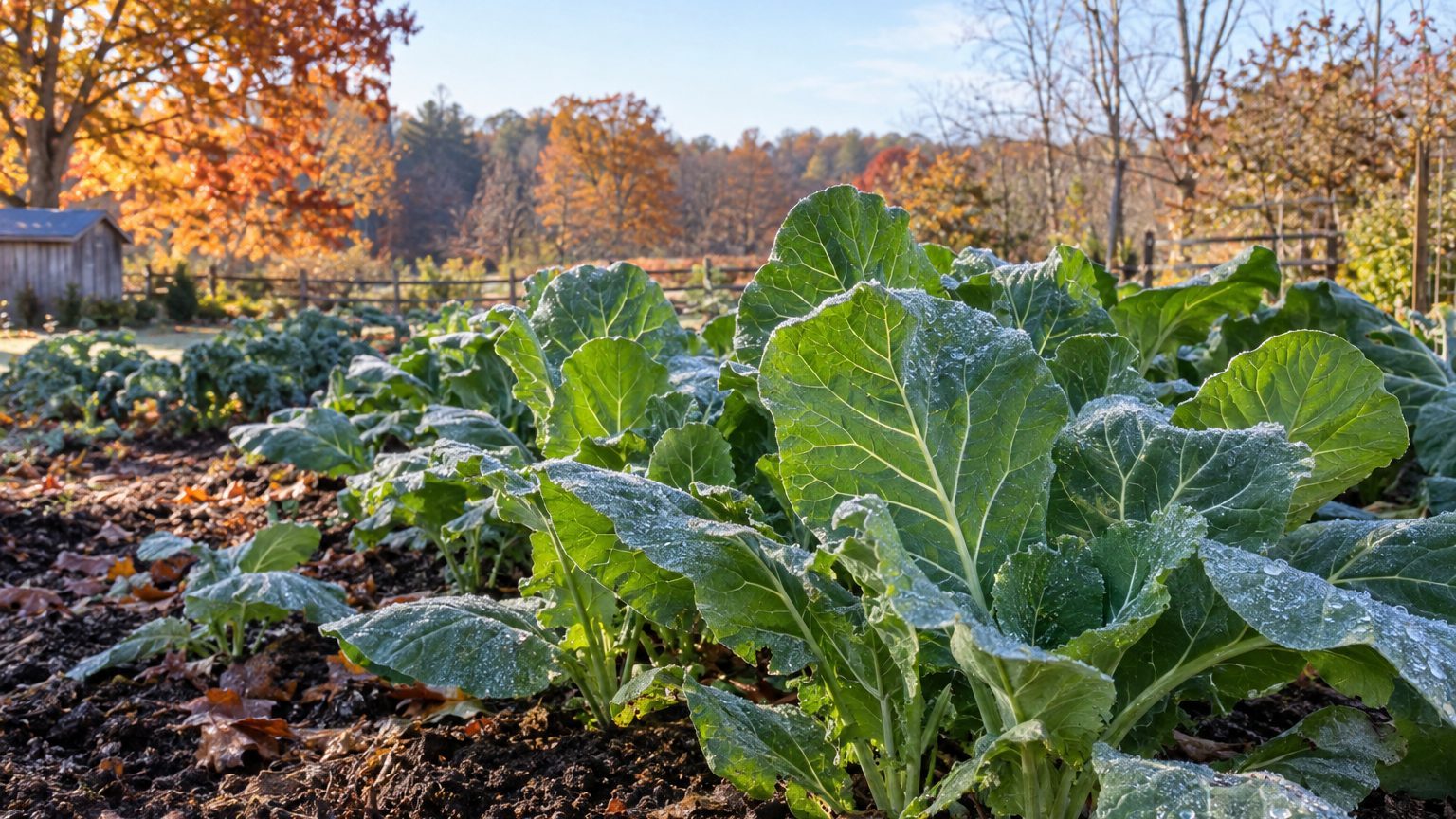

Plant collards in Massachusetts twice: transplants go out in early spring, around the last frost, and a second sowing goes in during early to mid summer for a fall harvest. Collards handle light frost, so the calendar has more give than it does for tomatoes. What the calendar cannot forgive is a late start or a sowing date borrowed from the South.
The short answer for Massachusetts
The last spring frost falls between April 1 and April 8, and the first fall frost between November 3 and November 14. Spring transplants can go out around that early-April window, and the fall crop should be sown in early to mid summer so it has size before the November frost window.
Those dates are a probability, not a deadline. NOAA’s 1991-2020 Climate Normals give the dates when the chance of a 32°F freeze sits in the 30 to 70 percent band. On April 8 the odds of one more freeze are lower than even but not zero. In November the same logic runs in reverse, and a killing frost can show up before the window or well after it.
The station behind these numbers is Boston’s Logan Airport, a waterfront spot and the mildest in the state. Inland suburbs and the Berkshires frost earlier in fall and later in spring, so treat early April and mid November as the best case.
Spring planting
Collards are a brassica, and the plants tolerate cool soil and light frost far better than most vegetable-garden crops. Start seeds indoors in late winter, harden the seedlings off, and set them out near the frost window at the coast. Inland, wait a couple of weeks past it. Getting plants in early matters because a spring crop has to size up before summer heat arrives and the cabbage worms with it.
Fall planting
Fall is where collards earn their place here. Sow seed or set transplants from early to mid summer, and the plants grow through the cooling weeks of September and October. Leaves taste sweeter after a few frosts, so the November window works in your favor if the plants are already big. The full story on timing and care sits in Growing Collards in Massachusetts.
What will not work here

A fall crop sown in August fails first. Frost can arrive in early November even at the mildest station, and earlier inland, so a plant started that late is still small when growth stops. Slow, large-framed varieties suffer most because they need a long run of mild weather to fill out. If a seed packet describes a long-season Southern heirloom, sow it early or pick a faster type, which the guide to The Best Collards and Greens for Massachusetts covers.
The traditional Southern plan also fails: sow in late summer, harvest all winter. That works where winters stay mild. In Massachusetts the mean daily minimum of the coldest month is 23.1°F at the Boston reference station, and that is an average of the lows, so many nights run colder and inland nights run colder still. Collards shrug off a light frost but not a prolonged deep freeze, and winter-over attempts usually end in brown, collapsed plants by midwinter. A cold frame or heavy mulch may carry a few plants through a mild stretch, but it is a gamble, not a calendar.
Waiting for warm soil also backfires. Gardeners trained on tomatoes and peppers hold off until late May, then wonder why their collards bolt, get chewed, or stall in July heat. Collards do not need warm soil. A late-May start throws away the best weeks of the cool season.
Dense spacing is the next problem. Massachusetts summers can be humid, and crowded leaves stay wet after rain and dew, which invites leaf spot and gives caterpillars cover. Give each plant elbow room so air moves through the canopy.
Finally, a hands-off watering habit fails during dry spells. Newly sown summer seed dries out fast in July and August, and a weekly soak does not keep the top inch of soil damp enough for germination. Fall sowings need light, frequent watering until seedlings are up.
What changes across Massachusetts
No single date fits the whole state. The USDA Plant Hardiness Zone Map (2023, built from 1991-2020 normals) places Massachusetts anywhere from zone 5a to 7b. That spans six half-zone steps, and the system rests on a single variable, the average annual extreme minimum temperature. It tells you about winter survival, not about when to sow, but it shows how much colder some gardens run than others. To find your own zone, enter your ZIP code on the USDA map and read it off there.
| Area | Spring transplanting | Fall sowing |
|---|---|---|
| Coast and waterfront (like the Logan reference) | Around April 1 to April 8 | Early to mid summer; frost holds off longest |
| Inland suburbs | Shift later by a couple of weeks | Start a little earlier |
| Berkshires and higher ground | Shift later again, often well into April | Sow early, favor quick varieties |
The pattern is simple: the colder the garden, the later the spring planting and the earlier the fall one. A reader in the Berkshires or on a hilltop should lean on fast-maturing types and consider a row cover to stretch the fall season. Cold air also pools in hollows and low spots, so a yard in a valley bottom behaves like a colder zone than the hilltop a mile away.
Near the coast, the milder stretch can let a fall crop hang on longer, but the winter-kill risk still applies.
Where to check this for your own county
The state calendar above is a starting point, and a county recommendation beats it every time. Massachusetts is small, but its gardens vary a lot, and the people who track those differences work for UMass Extension.
Look for two things on the extension site. The first is the local planting calendar for vegetables, which usually breaks the state into regions and lists transplant dates for cool-season crops like collards and other brassicas. The second is any information on varieties trialled nearby, which tells you what has actually grown well in your soil and season, not just what a seed company claims.
Extension offices also publish fact sheets on pests such as cabbage worms and flea beetles, and they can often tell you when those pests peak locally. Many offer soil testing, which helps with the fertility side. Collards are heavy feeders, and a test shows whether the bed needs lime or nitrogen before you plant.
If a county-level calendar and the statewide window disagree, trust the county. It is built from local frost records and local trials, and the statewide figures lean on a waterfront station that sits at the mild end of the range.
Checking this against your own garden
Your own observations outrank any date printed in a guide. Three things are worth watching, and none needs equipment.
- Soil warmth by feel. Push a hand into the bed in early spring. Soil that crumbles and feels cool but not icy is ready for collard transplants. Soil that stays cold, sticky, and waterlogged is not. A bed that thaws and drains first marks your warmest microclimate, often a south-facing spot near a wall.
- First true leaves. Seedlings first show two rounded seed leaves, then the first leaves with the real collard shape. Once a few true leaves are out, seedlings can start hardening off. If they take far longer than a packet suggests, your windowsill is too dim or too cool.
- Where frost lingers. Walk the yard at dawn after a clear, cold night. Frost that sits in one corner while the rest is clear shows you the cold pocket. Frost that arrives there first in fall tells you where the fall crop will stop growing first.
Keep a few notes from year to year, because one season of observation will correct a state calendar better than any guide.
If you follow the almanac, here is when to plant collard greens by the moon. It is a tradition, not a proven method.
Common questions
Can I sow collard seed directly in the garden?
Yes, especially for the fall crop. Sow into moist soil in early to mid summer and keep the top layer damp until seedlings emerge. For spring, starting indoors gives plants a head start before summer heat.
Will collards survive a Massachusetts winter?
Seldom. With a coldest-month average low of 23.1°F at the Boston reference station, and colder readings inland, a deep freeze usually finishes them. Mulch or a cold frame helps in a mild winter, but plan on harvesting before the hardest cold.
What if a frost hits after I transplant in spring?
Healthy, hardened-off collards generally tolerate a light frost. A floating row cover or an overturned bucket gives extra protection on the coldest nights, particularly inland where freezes can come after the April 1 to April 8 window.
Can I plant collards in both spring and fall?
Yes, and the fall planting is usually the better one. Cool autumn weather suits the plants, and frost sweetens the leaves, which is why many Massachusetts gardeners treat the first frost in the November 3 to November 14 window as a signal to start harvesting.