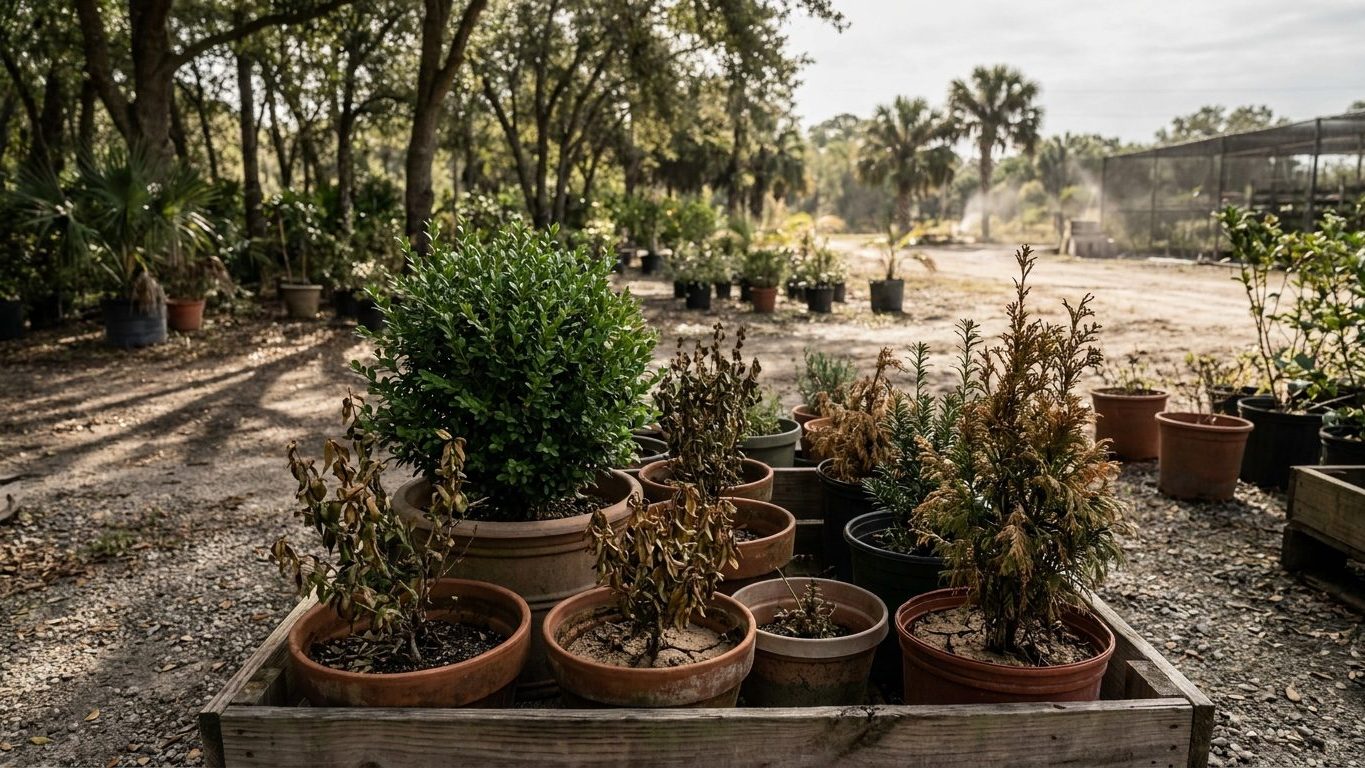

Georgia runs from USDA zone 6a to 9b, and that spread splits twelve widely planted hedge species into two groups. Five survive the whole range: American hornbeam, Leyland cypress, inkberry holly, winterberry holly and eastern red cedar. The other seven hold only in part of it: boxwood, privet, cherry laurel, yew, arborvitae, eastern hemlock and arrowwood viburnum. None of the twelve fails everywhere. Three of them can never be cut back once they outgrow the spot, which matters more than any zone number. More regions are covered in our Hedges section.
What actually holds in Georgia
A hardiness zone measures one thing: the average annual extreme minimum temperature, the coldest night in a typical year. The USDA Plant Hardiness Zone Map 2023, built on 1991-2020 normals, puts Georgia anywhere from 6a to 9b. A shrub fine in the mountains can fail near the coast, and the cause there is rarely cold. It is heat. The upper end of a plant’s listed range usually marks where long, humid summers stop being survivable, so “holds” here means survives, not thrives.
The seven that stop short
All seven start at 6a, so none is troubled by the coldest corners of north Georgia. The trouble is at the warm end. Boxwood, cherry laurel and arrowwood viburnum are listed for zones 6a through 8b, which leaves out 9a and 9b. Privet, yew, arborvitae and eastern hemlock stop at 7b, so zones 8a through 9b sit outside their range altogether.
| Plant | Holds in zones | Growth a year | Height as a hedge | Regrows from old wood |
|---|---|---|---|---|
| Boxwood (Buxus sempervirens) | 6a to 8b | 3 to 6 inches | 2 to 6 feet | Yes |
| Cherry laurel (Prunus laurocerasus) | 6a to 8b | 1 to 2 feet | 6 to 15 feet | Yes |
| Arrowwood viburnum (Viburnum dentatum) | 6a to 8b | 12 to 24 inches | 6 to 10 feet | Yes |
| Privet (Ligustrum vulgare) | 6a to 7b | 2 to 3 feet | 4 to 12 feet | Yes |
| Yew (Taxus x media) | 6a to 7b | 6 to 12 inches | 3 to 8 feet | Yes |
| Eastern hemlock (Tsuga canadensis) | 6a to 7b | 12 to 24 inches | 10 to 20 feet | Yes |
| Arborvitae (Thuja occidentalis) | 6a to 7b | 6 to 9 inches | 4 to 15 feet | No |
The five that cover every zone
These are the safe bets for a statewide recommendation, though “safe” only means they will live. Two of them, Leyland cypress and eastern red cedar, cannot be cut back hard.
| Plant | Growth a year | Height | Regrows from old wood |
|---|---|---|---|
| American hornbeam (Carpinus caroliniana) | 12 inches | 6 to 15 feet as a hedge | Yes |
| Inkberry holly (Ilex glabra), evergreen | 6 to 12 inches | 5 to 15 feet as a hedge | Yes |
| Winterberry holly (Ilex verticillata), loses its leaves in winter | 6 to 12 inches | 5 to 15 feet as a hedge | Yes |
| Leyland cypress (x Hesperotropsis leylandii) | 3 to 4 feet | 15 to 25 feet as a screen | No |
| Eastern red cedar (Juniperus virginiana) | 12 to 24 inches | 8 to 20 feet as a screen | No |
The hedges you can never cut back down
Three of the twelve do not regrow from old wood: arborvitae, Leyland cypress and eastern red cedar. Cut into the bare, brown interior of any of them and nothing sprouts. The hole stays a hole for good. The other nine will push new shoots from older stems, so a hard cut is a recovery plan rather than a mistake.
Why Leyland is the one to think hardest about
Leyland cypress adds 3 to 4 feet a year. Three growing seasons can mean 9 to 12 feet of new height, and a screen that reaches 15 to 25 feet will not stop at the fence line you had in mind. It holds in every Georgia zone, which is why it gets planted so freely, and the person who planted it cannot later saw it back to a manageable 8 feet. Space it for the size it will reach, not the size it arrives in the pot.
Eastern red cedar is the quieter version of the same problem, at 12 to 24 inches a year and up to 20 feet. Arborvitae is slower at 6 to 9 inches a year but is listed only for zones 6a to 7b, so it fails twice: it cannot be cut back, and it will not take the heat in the warmer parts of the state.
Pruning inside the green
With these three, shear only the soft, leafy growth and stay inside the line of living foliage. Timing differs by plant:
- Arborvitae: late winter before growth starts, or midsummer.
- Leyland cypress: late spring to midsummer.
- Eastern red cedar: late winter, light cuts only.
Dates need local context. NOAA NCEI 1991-2020 Climate Normals put Atlanta’s last spring freeze between March 11 and March 29 and its first fall freeze between November 13 and December 1 (the middle band of freeze probability). Atlanta is an urban heat island, so north Georgia and the mountains freeze several weeks earlier in fall, while the coastal plain runs milder. A late-winter cut means before the buds swell, not by the calendar.
The plants that do regrow still prefer specific windows. Boxwood wants late spring after the last frost, cherry laurel late spring after flowering, and arrowwood viburnum right after it flowers. Privet is the busiest, with two cuts a season, one in spring and one in midsummer.
Matching the plant to the job
The plant that screens a neighbor’s driveway is rarely the one that edges a front walk. Growth rate and mature height settle most of the choice.
Screening a property line
For a tall screen that holds in every zone, the options are Leyland cypress and eastern red cedar, with the no-cutback trade-off already described. Cherry laurel reaches 6 to 15 feet at 1 to 2 feet a year and does regrow from old wood, but it is listed only to 8b. Eastern hemlock gets to 10 to 20 feet and also regrows, though it is listed only to 7b and takes light cuts only. Hornbeam, at 6 to 15 feet and about 12 inches a year, holds across the whole state, with a midsummer cut after the first flush of growth. It is the deciduous answer for screening that mostly matters in the growing season.
Clipped hedges and informal borders
A low, formal edge points toward boxwood at 2 to 6 feet, growing a slow 3 to 6 inches a year, or yew at 3 to 8 feet and 6 to 12 inches a year. Boxwood is listed to 8b and yew to 7b. Slow growth means fewer trips with the shears, but a young plant takes years to fill in. Privet sits at the opposite extreme: 2 to 3 feet a year to a height of 4 to 12 feet, a hedge in a season or two but needing trims twice a year.
Between the two, the hollies are the statewide pick. Inkberry and winterberry share a genus, a size range of 5 to 15 feet and a late-winter pruning window while dormant, but inkberry keeps its leaves and winterberry drops them. If the hedge is supposed to block a view in January, that single difference decides it. Arrowwood viburnum at 6 to 10 feet suits a looser border in zones 6a to 8b.
Neighboring states reshuffle the same species, so Hedge Plants for Alabama: What Holds, and What Only Looks Hardy and Hedge Plants for Florida: What Holds, and What Only Looks Hardy are worth a look near a state line. For comparing climates, see Hedge Plants for Arizona: What Holds, and What Only Looks Hardy and Hedge Plants for Ohio: What Holds, and What Only Looks Hardy.
The ground you are planting into
The soil USDA lists as representative of Georgia is the Tifton series, an Ultisol: an old, heavily weathered, leached soil that is naturally acid and low in nutrients. The USDA NRCS Soil Data Access figures for its surface layer show a pH of about 5.5 (slightly acid), 84 percent sand, 6 percent clay and 9 percent silt, with organic matter around 0.8 percent. It drains well.
What that ground tends to do
Sand sheds water quickly and holds few nutrients, and with less than one percent organic matter there is little to buffer the swings. A new hedge here dries out between rains faster than the surface suggests. The first seasons call for deep, regular watering and a layer of mulch over the root zone, and watering matters more than fertilizer. Fall planting suits this ground: roots establish through the cool months before the first summer, and in Atlanta’s normals the first freeze does not arrive until November 13 to December 1. Mountain counties get theirs sooner, so plant earlier there.
Your yard is not the state’s representative soil
Those numbers describe a single mapped series, not the bed in your yard. Georgia spans hundreds of soil series, and river bottoms, hill country and any lot a builder has scraped or filled will behave nothing like a Tifton. The pH of 5.5 is the representative surface value for that series, not a reading you can assume for your own ground.
A soil test settles it. The county office of University of Georgia Extension can explain how to collect a sample and read the result, which tells you whether anything needs to be added before the hedge goes in. Do it before planting, because amending a row of established shrubs is much harder than amending an empty trench.
Common questions
Which hedge plants survive in every part of Georgia?
Five: American hornbeam, Leyland cypress, inkberry holly, winterberry holly and eastern red cedar. They cover zones 6a through 9b. Surviving is not the same as thriving, and Leyland cypress and eastern red cedar cannot be cut back hard.
Can I grow boxwood in south Georgia?
Boxwood is listed for zones 6a through 8b, which leaves out 9a and 9b. The upper limit reflects heat as much as cold, so a garden in the warmest zones should choose from the five statewide plants instead. Check your zone on the USDA map before buying.
Which hedges can I never cut back hard?
Arborvitae, Leyland cypress and eastern red cedar do not regrow from old wood. Every other plant covered here does, so a hard cut is survivable.
When should I prune a Georgia hedge?
It depends on the plant. Both hollies take late-winter cuts while dormant. Boxwood and cherry laurel go in late spring, boxwood after the last frost and laurel after flowering. Arrowwood viburnum is cut right after it flowers, and hornbeam in midsummer after the first flush of growth. Atlanta’s last freeze typically falls between March 11 and March 29, but north Georgia runs colder, so watch for new growth and local frost rather than the calendar.