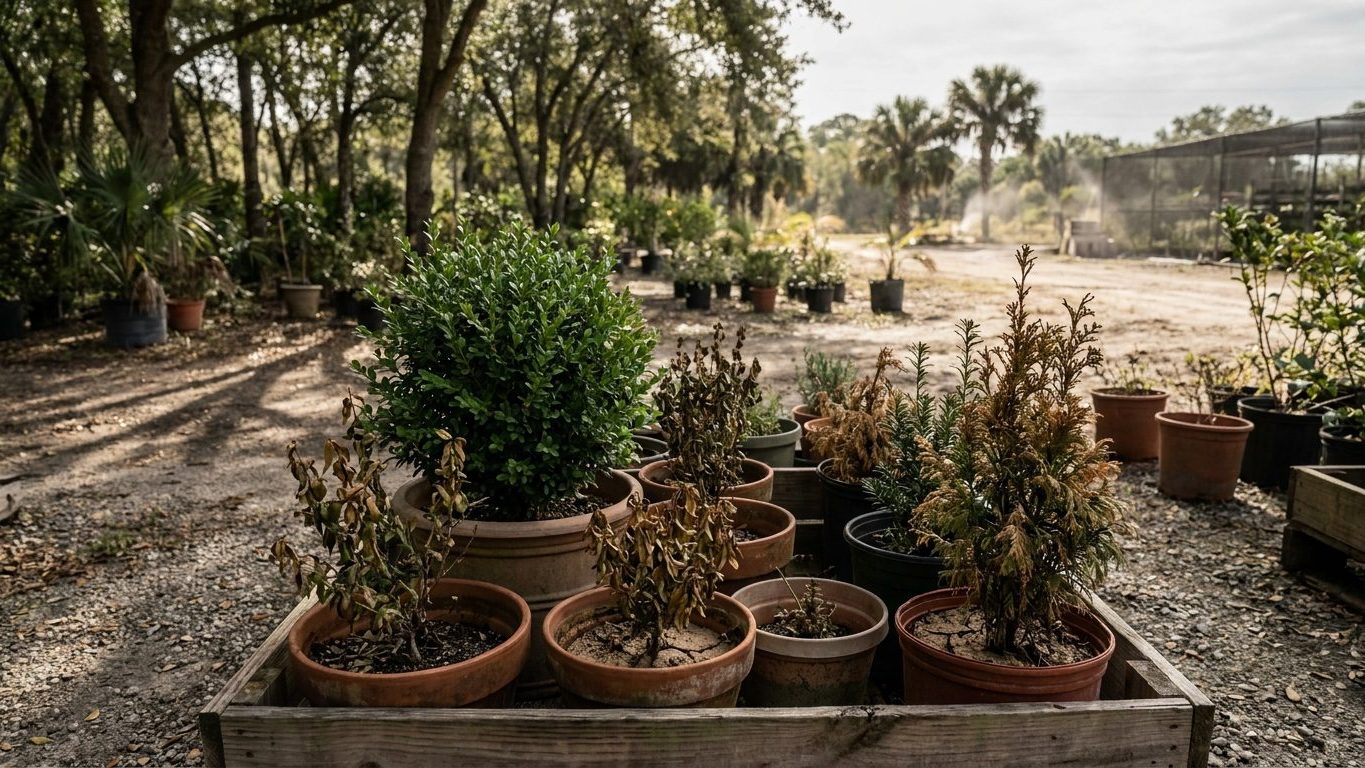

Ten of the twelve common hedge plants hold through winter anywhere in Pennsylvania, from the coldest zone 5a ground to the mildest 7b. Two do not. Leyland cypress and cherry laurel are dependable only in zones 6a through 7b. Survival is also only half the question, because Leyland cypress, arborvitae and Eastern red cedar never regrow from old wood, so their size has to be managed from the day they go in.
What actually holds in Pennsylvania
A hardiness zone rests on one number, the average annual extreme minimum temperature. The USDA Plant Hardiness Zone Map 2023 builds it from 1991-2020 normals, and Pennsylvania spans 5a through 7b. A tag reading “hardy to zone 6” therefore suits a yard near Philadelphia and can fail on a high Allegheny ridge or in the northern tier. Look up your own ZIP code before you buy anything.
The two that stop at zone 6a
Leyland cypress (x Hesperotropsis leylandii) and cherry laurel (Prunus laurocerasus) are listed only for zones 6a, 6b, 7a and 7b. In zone 5a or 5b, skip both. In 6a you are at the edge of the range, and the hard winter that tests it will come eventually.
Leyland is the one to be most careful with. It grows 3 to 4 feet a year and reaches 15 to 25 feet as a screen, and it does not regrow from old wood. Cherry laurel is slower, 1 to 2 feet a year to 6 to 15 feet, and it does regrow, so a mistake with it is easier to fix.
The ten that hold statewide
Four of them are conifers: arborvitae, Eastern hemlock, Eastern red cedar and yew. Boxwood and inkberry holly are the broadleaf evergreens. Winterberry holly loses its leaves in winter, as do arrowwood viburnum, American hornbeam and privet, which round out the list. All ten are documented for the whole 5a-7b span. Their details come up in the sections below.
Surviving is not thriving
A range on a plant tag describes where the plant survives, and the upper end of that range is often a heat limit rather than a cold one. A hedge can live through a zone 7 summer and still look tired every August. Leyland, usually planted in a tight row for speed, is especially prone to disease where summers are hot and humid. Treat “holds” as the minimum, and use the pruning and soil details below to decide what will look good.
Gardeners in neighboring states face the same split. The lists for Hedge Plants for New York: What Holds, and What Only Looks Hardy and Hedge Plants for New Jersey: What Holds, and What Only Looks Hardy run through the same cold-edge reasoning.
The hedges you can never cut back down
Some plants forgive a bad haircut and some never recover from one. Three of the hedge plants here will not sprout new growth from bare, old wood. Cut into the brown interior of one and the hole stays open for good.
Leyland cypress is the most dangerous of the three because it grows so fast. At 3 to 4 feet a year, a row planted as a 15 to 25 foot screen is a 6 foot wall within two seasons and a problem by year five. Prune it from late spring to midsummer, and never below the green growth.
Eastern red cedar grows 12 to 24 inches a year and reaches 8 to 20 feet as a screen. Its pruning rule is light cuts only, in late winter. Treat that as a hard limit, because there is no recovery if you take it too far.
Arborvitae is slower at 6 to 9 inches a year, and the usual size is 4 to 15 feet as a hedge. Prune in late winter before growth starts, or in midsummer. Because it grows slowly, people tend to plant it too close to a house or property line, and then discover it cannot be shortened later.
The practical rule is to choose the mature size you want before you buy, plant far enough from the wall, fence or driveway to allow it, and trim only the soft outer growth. A gardener who wants a 4 foot hedge should not plant something that wants to be 20.
Everything else on the list can be renovated, which makes them forgiving choices for a first hedge. Boxwood, yew, privet, American hornbeam, inkberry, winterberry, arrowwood viburnum and cherry laurel all regrow from old wood. Eastern hemlock regrows too, but its rule is still light cuts only, so do not count on a drastic reduction. If you inherit an overgrown hedge, find out which group it belongs to before you pick up the saw.
Matching the plant to the job
Start with the job. A privacy screen along a property line, a low formal edge and a loose wildlife hedge call for different plants, and heights and growth rates sort them out.
| Plant | Height as hedge or screen | Growth a year | Prune | Regrows from old wood |
|---|---|---|---|---|
| Boxwood | 2 to 6 feet | 3 to 6 inches | Late spring, after the last frost | Yes |
| Yew | 3 to 8 feet | 6 to 12 inches | Late spring, after new growth hardens | Yes |
| Privet | 4 to 12 feet | 2 to 3 feet | Spring and midsummer | Yes |
| Arborvitae | 4 to 15 feet | 6 to 9 inches | Late winter, or midsummer | No |
| Inkberry holly | 5 to 15 feet | 6 to 12 inches | Late winter, dormant | Yes |
| Winterberry holly | 5 to 15 feet | 6 to 12 inches | Late winter, dormant | Yes |
| American hornbeam | 6 to 15 feet | 12 inches | Midsummer, after first flush | Yes |
| Arrowwood viburnum | 6 to 10 feet | 12 to 24 inches | Right after flowering | Yes |
| Eastern red cedar | 8 to 20 feet | 12 to 24 inches | Late winter, light cuts | No |
| Eastern hemlock | 10 to 20 feet | 12 to 24 inches | Late spring, light cuts | Yes |
| Cherry laurel (zones 6a-7b only) | 6 to 15 feet | 1 to 2 feet | Late spring, after flowering | Yes |
| Leyland cypress (zones 6a-7b only) | 15 to 25 feet as a screen | 3 to 4 feet | Late spring to midsummer | No |
For a low formal edge, boxwood at 2 to 6 feet is the standard, with yew as a taller formal option. For a tall privacy screen, hemlock, red cedar and arborvitae reach the heights, and each has a limit: hemlock needs gentle trimming, and the other two cannot be cut back. For an informal hedge that feeds birds, winterberry, arrowwood and inkberry fit better. Winterberry needs a planting partner nearby to set berries. Privet grows fastest of the forgiving group but escapes into woods in some areas, so ask your extension office before planting it.
Pruning dates follow the same logic. The timing for boxwood is after the last frost, and Philadelphia’s last spring frost falls between March 29 and April 6, based on NOAA NCEI U.S. Climate Normals for 1991-2020. Philadelphia is the mildest corner of the state. The northern tier and the Alleghenies run two to four weeks later, so shift the dates in the table accordingly. Right now is a planting window for most of these, not a pruning window.
The ground you are planting into
The soil Pennsylvania uses as its state soil is the Hazleton series, an Inceptisol, which is a young soil without strong layers yet. USDA NRCS records its surface horizon as loam to silt, with 46 percent sand, 12 percent clay and 42 percent silt. Organic matter is about 3.0 percent, drainage is good, and the surface pH is about 4.6, strongly acid.
That describes what the state’s ground tends to do, not what your yard will do. Pennsylvania has hundreds of soil series, and river bottoms, hill country and any lot a builder has scraped or filled will behave differently. A new subdivision may have almost no topsoil at all. The only number that matters is your own, so get a soil test through Penn State Extension before you buy forty plants.
If your ground resembles Hazleton, the acidity favors some choices. Inkberry and winterberry hollies are acid-loving, and hemlock does well on acid soil too. Boxwood and privet generally want less acid ground, so if a test comes back strongly acid, ask extension about lime before planting them. Good drainage suits yew, which dislikes wet roots. A well-drained soil dries out fast around a new hedge, so plan on regular watering while it establishes.
Timing matters too. Philadelphia’s first fall frost arrives between November 5 and November 16, so a hedge planted this month has several weeks to root before the ground cools. In colder parts of the state the window closes sooner, so plant earlier or wait for spring. Every plant on the list is hardy across the state except the two that stop at zone 6a, and that makes the soil test the next thing to do.
Ground and climate differ a lot between states. The same plants face very different conditions on Illinois farmland or Colorado’s drier ground, and the pages for Hedge Plants for Illinois: What Holds, and What Only Looks Hardy and Hedge Plants for Colorado: What Holds, and What Only Looks Hardy show how the list changes. The wider Hedges section covers planting and care that applies anywhere.
Common questions
Which hedge plants are hardy across all of Pennsylvania?
Ten hold in every zone from 5a to 7b: boxwood, American hornbeam, inkberry holly, winterberry holly, Eastern red cedar, privet, yew, arborvitae, Eastern hemlock and arrowwood viburnum. Holding through winter does not guarantee a good-looking hedge, so match each one to your soil and sun.
Can I grow Leyland cypress or cherry laurel in zone 5?
No. Both are listed only for zones 6a through 7b. Check your zone on the USDA Plant Hardiness Zone Map 2023 by ZIP code. If you are in 6a, you are at the edge of what they tolerate.
When should I prune a hedge?
It depends on the plant. Inkberry, winterberry, Eastern red cedar and arborvitae take their main trim in late winter. Boxwood, yew and hemlock are trimmed in late spring, and arrowwood viburnum right after it flowers. Privet needs two cuts a season, and hornbeam is done in midsummer. Mid-October is for planting, not pruning.
Which hedge can I cut hard if it outgrows its space?
Choose one that regrows from old wood: boxwood, yew, privet, American hornbeam, inkberry, winterberry, arrowwood viburnum or cherry laurel. Avoid Leyland cypress, arborvitae and Eastern red cedar if you may want to shrink the hedge later. Eastern hemlock regrows too, but treat it as a light-cuts plant, since a stressed tree can be weakened.