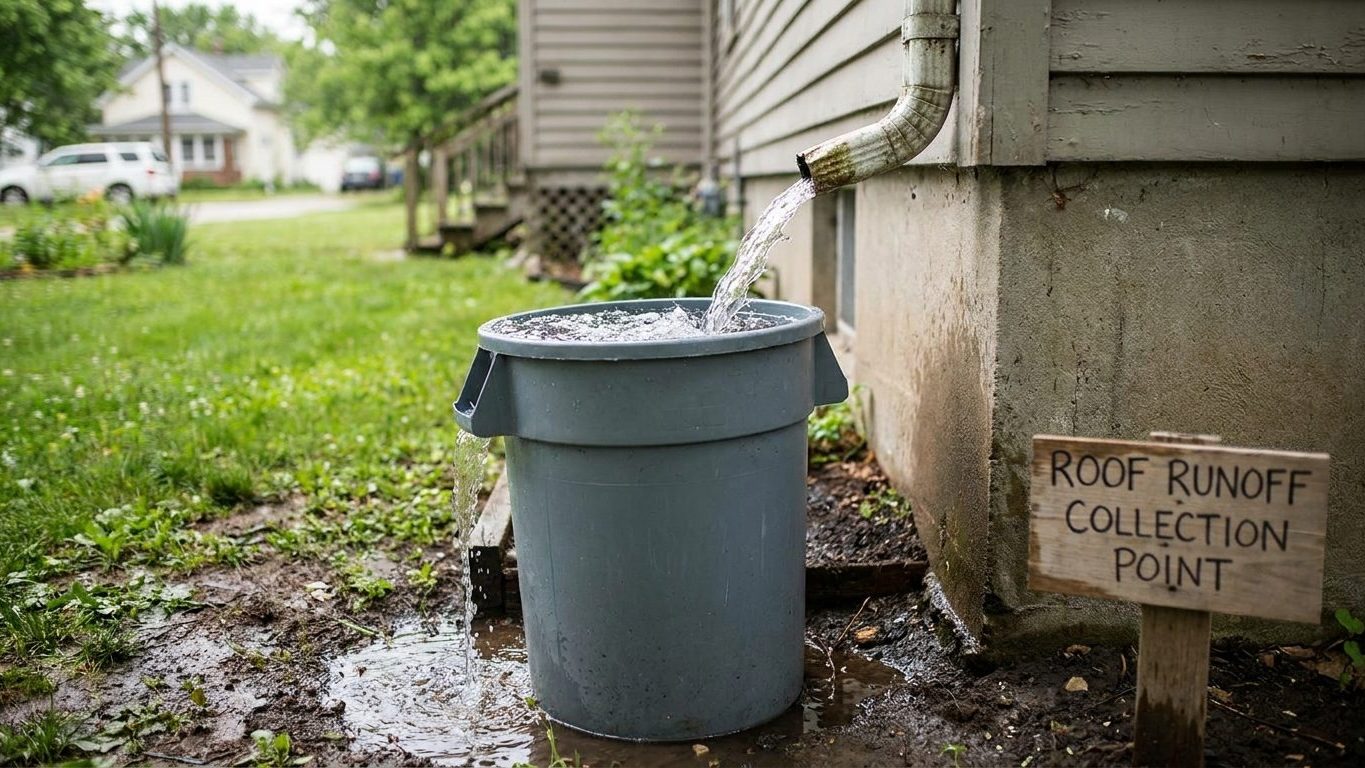

A roof does not spread rain evenly around a house. It gathers rain from every one of its square feet and drops nearly all of it at four or five points, the downspouts, so whichever one of those is aimed at the wall delivers a small river to the exact spot the foundation is weakest. Extend every downspout well away from the foundation before doing anything else.
What is actually going on

Why a few downspouts carry the whole roof’s water
The mechanism worth understanding is concentration. A roof does not leak water into the yard the way rain falls on open lawn, spread thin and mostly absorbed where it lands. It sheds water off sloped planes into a gutter system, and that gutter pours the whole collected volume back out through three or four downspouts. A roof of 1,500 square feet will shed something close to 900 gallons for every inch of rain that falls on it, using the standard conversion of roughly 623 gallons per 1,000 square feet of roof per inch of rainfall. A storm that drops several inches moves thousands of gallons, and all of it exits the system at a handful of points instead of spreading out the way it would on open ground.
Where those points sit matters more than how much rain fell that day. A downspout that ends at the base of the wall, or a splash block set flat against the siding, delivers its full share of that volume directly against the foundation, storm after storm, all year. The soil right next to a foundation is usually the loosest on the whole lot, because it was dug out and put back when the house was built. Loose backfill soaks up water fast and holds onto it, and saturated soil pressing against a wall creates hydrostatic pressure that the wall was never built to resist.
Grading works the same way as a misplaced downspout. A yard that slopes toward the house, even slightly, sends surface rain in the same direction a bad downspout does, straight at the wall. A downspout that is aimed correctly can still be undone by a low spot in the lawn a few feet off that channels water right back toward the house.
Why sealing the inside does not solve an outside problem
One habit worth breaking early is treating basement dampness as something to fix from the inside with a coating or a sealant on the interior face of the wall. Interior sealants manage humidity and hide staining, but they do nothing about water arriving from outside under pressure, and that water simply finds the next weak point, a different crack, a different joint, once the spot it used before is blocked. The order that actually works is drainage first, outside the house, and interior treatment second, only if it is still needed once the outside water has somewhere else to go. The full picture of how water moves through a foundation and into a basement is worth reading before deciding where to start, at Foundations and Basements: Almost Everything Here Is Water.
What to look at, and in what order
Working from cheapest to most involved
Work from the roof down and from the cheapest fix to the most involved one. Extending downspouts is the first move because it costs almost nothing, needs no tools beyond what most garages already have, and rules out one whole category of cause in an afternoon. If moving a discharge point stops the problem, everything further down this list can wait.
| Check | What to look for | What it rules out | What it points to |
|---|---|---|---|
| Downspout discharge point | Where the spout ends after a real rain, not a light drizzle | If moving it clears the problem, downspouts were the whole cause | If damp persists after moving them, the source is somewhere else |
| Grade around the foundation | Slope of soil, raised beds, settled walkways next to the wall | Ground already sloping away rules out grading as the driver | Ground sloping toward the house means water pools there no matter what the gutters do |
| Window wells and low openings | Working drain, intact cover, standing water level a day after rain | A well that drains fine rules out that opening as a path | A well that still holds water after downspouts and grading are fixed has its own problem |
| Pattern of interior staining | Location of damp patches relative to the outside features above | A stain lining up with an outside source confirms the diagnosis | A stain with no outside match, especially in dry weather, suggests groundwater rather than roof runoff |
A clogged or undersized gutter overshoots in exactly the spots that need the most protection, above doorways and low roof edges, so the walk-around after a real storm matters more than a look on a dry day. The sizing and layout of the gutter system itself, and what a guard system does and does not change, is its own subject covered in the roofing guides on gutters. Any window well, area way, or below-grade entry acts as its own small collection point the same way a downspout does, and a well that fills and overtops puts water right at basement level, often exactly where staining shows up first. It is worth ruling out window wells that fill with water as a separate source, distinct from the downspout question, before assuming gutters explain everything.
Once outside sources are addressed or ruled out, go back inside and map where dampness shows up relative to the outside features checked above. A match confirms the outside diagnosis. No match, particularly if the damp patch appears in dry stretches too, points toward a water table or groundwater issue rather than roof runoff, which calls for a different kind of fix entirely.
Watch it, or get someone in
Most of what shows up after heavy rain is something a homeowner can track without help. Note the date and how hard it rained, photograph any damp patch or stain, and check. A stain that stays the same size and color from one storm to the next is a monitoring problem, not an emergency. A crack, gap, or bulge that has visibly changed between two photos taken weeks apart is not.
What crosses the line into a professional call
Certain signs move past what a homeowner can safely judge alone. A wall that bows or leans, a crack that runs diagonally through poured concrete rather than following a mortar joint in block, a door or window frame gone noticeably out of square, or a floor that has tilted, all point at movement in the structure rather than simple dampness. Water that keeps arriving no matter what has been tried at the gutters, the grade, and the window wells also earns a call, because at that point the source may be groundwater rather than roof runoff.
Who to call depends on what is actually being asked. A structural engineer assesses the building and reports what is happening and how serious it is, without having anything to sell as the fix, which makes an engineer’s opinion the one to get first whenever the movement itself, not just the water, is in question. A drainage contractor is the right call once the diagnosis already points at moving surface water and groundwater away from the house rather than treating the wall directly. A waterproofing company representative is a salesperson for interior systems, coatings, drain tile, and sump systems, and a site visit from one is a sales estimate rather than an independent diagnosis, however knowledgeable that person may be. Getting an engineer’s read on a structural question before a waterproofing quote on the same wall keeps the two roles from blurring together, since one is paid to be right and the other is paid to close a job. Where the question is whether a crack or a lean is worth worrying about at all, that judgment belongs with an engineer, and when a foundation question needs an engineer covers the specific signs that justify the call in more detail.
What has to happen first
Where each next decision lives
Money gets wasted on this problem in a specific order: finish work happens before the water problem is solved, and then it happens again once the water comes back. Outside drainage comes before any interior treatment, because a sump pump, a dehumidifier, or a coated wall are all managing water that a fixed downspout or a corrected grade would have kept out in the first place. Fix the outside first and see what is left before spending anything on the inside.
Water problems come before finish work for the same reason. A finished basement wall, new flooring, or fresh insulation installed over a wall still taking on water from outside will show the same staining and the same failure within a season or two, and the finish materials themselves often have to come back out to fix the water source once it is finally traced. Diagnosis before repair sounds obvious until the actual order in most basements runs the other way: a sump pump goes in first because the water is visible and urgent, and only months later does someone trace it back to a downspout that was never moved in the first place.
Once the roof and grading side of the problem is under control, the remaining pieces each have their own considerations elsewhere on this site. A sump pump and the plumbing behind it, for basements where groundwater rather than roof runoff is doing the damage, belongs with the plumbing guides. Insulating a basement wall correctly, once it is actually dry, is its own set of decisions covered in the insulation guides for basement walls. Choosing what goes on top of a slab, whether that is tile, sealed concrete, or a floating floor, is a separate question covered in the flooring guides. None of those choices should get made before the water question is settled, because the answer to the water question can change which of them still makes sense.
Common questions
Do I need underground drain pipe on every downspout, or is a splash block enough?
A splash block is enough as long as it actually moves water well clear of the foundation and the ground beyond it slopes away. Underground pipe becomes worth it where the yard is flat, where a splash block would just create a puddle that soaks back toward the wall, or where the discharge point needs to cross a walkway or patio.
My basement only gets damp during heavy spring storms, not all year. Does that still count as a foundation problem worth fixing?
Yes, intermittent dampness tied to storms is still worth tracing, because it usually means the soil around the foundation is reaching saturation only under heavy load, not that the source is trivial. Dampness that shows up only in specific weather is often easier to diagnose than a constant leak, since the timing points fairly directly at surface water rather than a steady groundwater source.
Can I just seal the crack from inside and call it done?
Sealing a crack from inside stops that particular crack from letting water into the room, but it does not stop water from pressing on the wall from outside. That pressure usually finds a new path, a different crack or a joint nearby, so a sealed crack with no change to drainage outside is a delay rather than a fix.
How long should I watch a crack before calling an engineer?
There is no fixed waiting period, and a crack that is actively changing, widening, or accompanied by a door or window going out of square, deserves a call right away rather than a waiting game. A hairline crack that has looked identical across several sets of photos taken over weeks is reasonable to keep monitoring, but any doubt about whether a crack is structural is itself a reason to bring in an engineer rather than guess.