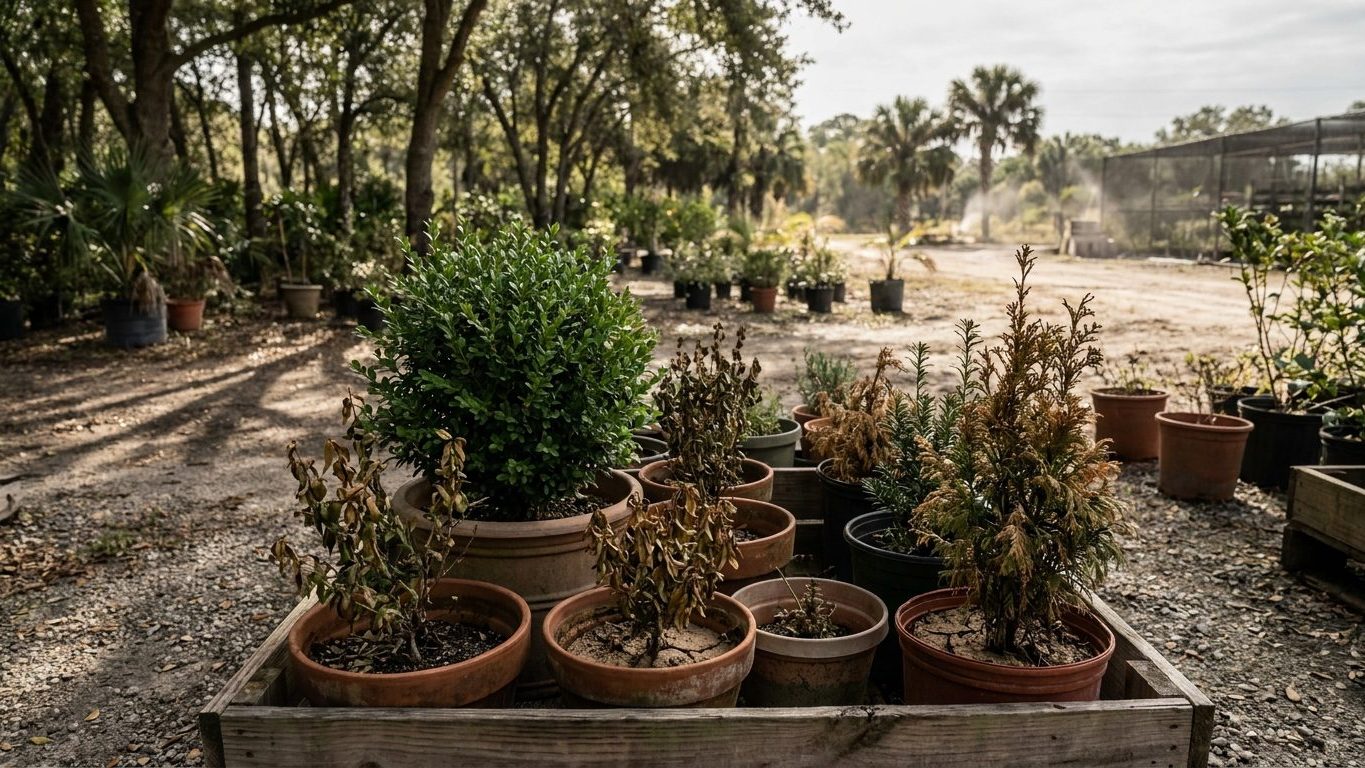

Six of 12 hedge plants commonly considered for northern yards survive everywhere in South Dakota. Four survive only in the warmer part of the state, and two do not survive anywhere in it. The two failures are Leyland cypress and cherry laurel, both popular in milder parts of the country. The four partial plants are boxwood, inkberry holly, privet and yew, and each needs your zone checked before you buy. The six dependable ones are arborvitae, eastern red cedar, hemlock, hornbeam, winterberry and arrowwood viburnum.
What actually holds in South Dakota
The USDA Plant Hardiness Zone Map (2023 edition, built on 1991-2020 normals) rests on a single number: the average annual extreme minimum temperature. South Dakota runs from zone 3b to zone 5b on that map. That is a wide spread for one state, and it explains why a plant that thrives in one town can be dead by March in another. A shrub rated to zone 4a is outside its range in 3b, and mulch does not make up for that over many winters.
“Holds” here means survives. The zone number speaks only to winter cold. Wind, dry spells and summer heat decide whether a plant looks good, but in South Dakota the cold end is the one that sorts the list.
Which hedge plants will not survive in South Dakota?
Leyland cypress (x Hesperotropsis leylandii) and cherry laurel (Prunus laurocerasus) fail across the whole state, including the warmest zone 5b ground. They are evergreen, fast and glossy in catalogs, which is exactly why people try them. Skip both. A hedge that browns out in its first hard winter costs you the plants, the digging and a year or two of growth.
Which hedge plants work only in part of South Dakota?
Four plants need the zone named, because the answer is neither yes nor no:
- Boxwood (Buxus sempervirens) holds only in zones 5a and 5b, the mildest corner of the state.
- Inkberry holly (Ilex glabra, evergreen) holds in zones 4a through 5b.
- Privet (Ligustrum vulgare) holds in zones 4a through 5b.
- Yew (Taxus x media) holds in zones 4a through 5b.
In zone 3b, all four are out. Zone 4a and above opens up inkberry, privet and yew, and only 5a and 5b allow boxwood. Look up your zone by ZIP code on the USDA map, then check it against your own low spots and wind exposure, since a yard on an open ridge can run colder than its zone suggests.
Neighboring states draw these lines in different places. See Hedge Plants for North Dakota: What Holds, and What Only Looks Hardy, Hedge Plants for Minnesota: What Holds, and What Only Looks Hardy and Hedge Plants for Kansas: What Holds, and What Only Looks Hardy.
Which hedge plants hold across the whole state?
Arborvitae, eastern red cedar, eastern hemlock, American hornbeam, winterberry holly and arrowwood viburnum are hardy from zone 3b through 5b. Choose from these six and you do not need to know your zone to the half step.
The hedges you can never cut back down
Two of the six dependable plants share a trait that matters more than their zone rating. Eastern red cedar and arborvitae do not regrow from old wood. Cut into the bare, leafless interior and the branch stays bare. No new green shoots appear, and the hole you made is permanent.
Which hedge plants never regrow from old wood?
Arborvitae (Thuja occidentalis) grows 6 to 9 inches a year and reaches 4 to 15 feet as a hedge. Prune in late winter before growth starts, or in midsummer. Eastern red cedar (Juniperus virginiana) is faster at 12 to 24 inches a year, and it is a screen rather than a trimmed hedge, running 8 to 20 feet. Prune in late winter and make light cuts only.
For both, size is set on the day you plant. Choose the spot for the height you want in ten years, and leave room for the plant to reach it. The only fix for an outgrown arborvitae or red cedar is to take it out and start over. Trim the green tips each year, never past the live foliage, and the hedge stays the size you chose.
Which hedge plants will regrow after hard pruning?
The rest of the viable list recovers from old wood. That group includes hemlock, hornbeam, winterberry, arrowwood viburnum, and in the warmer zones boxwood, inkberry, privet and yew. A neglected hedge of any of these can be cut hard and will leaf out again. Hemlock is the one to handle with care, because its pruning guidance is still light cuts only, even though it can regrow.
Privet shows the other side of this: it grows 2 to 3 feet a year and wants a trim in spring and again in midsummer, so it rewards the gardener who likes to prune and punishes the one who does not. Tight spaces, property lines and spots under power lines favor the plants that tolerate correction. Open acreage favors red cedar. More on hedge choice is in the Hedges section.
Matching the plant to the job
A hedge is a tool, and the right plant depends on what the hedge is for. The table below puts every plant that can work in South Dakota side by side.
| Plant | Where it holds | Height | Growth a year | Prune | Regrows from old wood |
|---|---|---|---|---|---|
| Arborvitae | Whole state | 4 to 15 ft | 6 to 9 in | Late winter, or midsummer | No |
| Eastern red cedar | Whole state | 8 to 20 ft (screen) | 12 to 24 in | Late winter, light cuts | No |
| Eastern hemlock | Whole state | 10 to 20 ft | 12 to 24 in | Late spring, light cuts | Yes |
| American hornbeam | Whole state | 6 to 15 ft | 12 in | Midsummer, after first flush | Yes |
| Winterberry holly | Whole state | 5 to 15 ft | 6 to 12 in | Late winter, dormant | Yes |
| Arrowwood viburnum | Whole state | 6 to 10 ft | 12 to 24 in | Right after flowering | Yes |
| Inkberry holly | Zones 4a to 5b | 5 to 15 ft | 6 to 12 in | Late winter, dormant | Yes |
| Yew | Zones 4a to 5b | 3 to 8 ft | 6 to 12 in | Late spring, after growth hardens | Yes |
| Privet | Zones 4a to 5b | 4 to 12 ft | 2 to 3 ft | Spring and midsummer | Yes |
| Boxwood | Zones 5a to 5b | 2 to 6 ft | 3 to 6 in | Late spring, after last frost | Yes |
For a tall evergreen privacy screen across the whole state, the choice runs between arborvitae, red cedar and hemlock. Red cedar and hemlock add 12 to 24 inches a year, so they fill in the fastest. Arborvitae is slower at 6 to 9 inches but easier to hold at a modest height.
For a clipped, formal edge, yew gives the most height range (3 to 8 feet) and is evergreen, but it needs zone 4a or warmer. Boxwood gives the lowest, tightest hedge, but grows only 3 to 6 inches a year, which makes it slow to establish and limited to zones 5a and 5b.
For a looser hedge that loses its leaves, winterberry, hornbeam and arrowwood viburnum hold in every zone. Winterberry screens less in January. Arrowwood is pruned right after it flowers, so shear it later and you cut off next year’s blooms. Hornbeam takes its trim in midsummer after the first flush of growth.
The ground you are planting into
South Dakota’s official state soil, named by state law in 1990, is the Houdek series, a Mollisol. USDA records for the surface layer of the Houdek components show a pH of about 6.7, near neutral, with 38 percent sand, 22 percent clay and 40 percent silt. That texture falls in the loam to silt range. Organic matter is about 3.0 percent and drainage is good.
Ground like that suits most of the plants above. But it describes the soil that represents the state, not the soil in your yard. River bottoms, hill country, and any lot a builder scraped or filled can be nothing like it. Treat the Houdek numbers as a hint, and measure your own.
A soil test gives your actual pH and organic matter, and South Dakota State University Extension and your county office can point you to testing and local advice. Dig a test hole where the hedge will go, fill it with water, and see how long it takes to drain. If water is still standing the next morning, a hedge row planted there is a risk. If it drains within a few hours, you are in good shape.
At the reference airport station, the last spring frost falls between April 29 and May 9, and the first fall frost between September 24 and October 4 (NOAA NCEI 1991-2020 normals). Suburban and rural yards typically get the last spring frost later and the first fall frost earlier, often by one to two weeks, so check your own county. Late spring pruning of yew, hemlock and boxwood should wait until after your last frost.
Common questions
What is the hardiest evergreen hedge in South Dakota?
Arborvitae, eastern red cedar and eastern hemlock are evergreen and hold from zone 3b through 5b, so they survive across the whole state. Arborvitae and red cedar cannot be cut back to size later.
Can I grow boxwood in South Dakota?
Only in zones 5a and 5b, the warmest parts of the state. In colder zones it is outside its hardiness range.
Can I plant Leyland cypress or cherry laurel?
No. Neither plant is hardy anywhere in South Dakota, including zone 5b. Arborvitae or hemlock fill the same evergreen role and survive.
When should I prune a hedge?
It depends on the plant. Inkberry, winterberry and red cedar are pruned in late winter. Arrowwood viburnum is pruned right after flowering. Yew, hemlock and boxwood are pruned in late spring, and hornbeam in midsummer. Privet needs two trims a season, one in spring and one in midsummer.