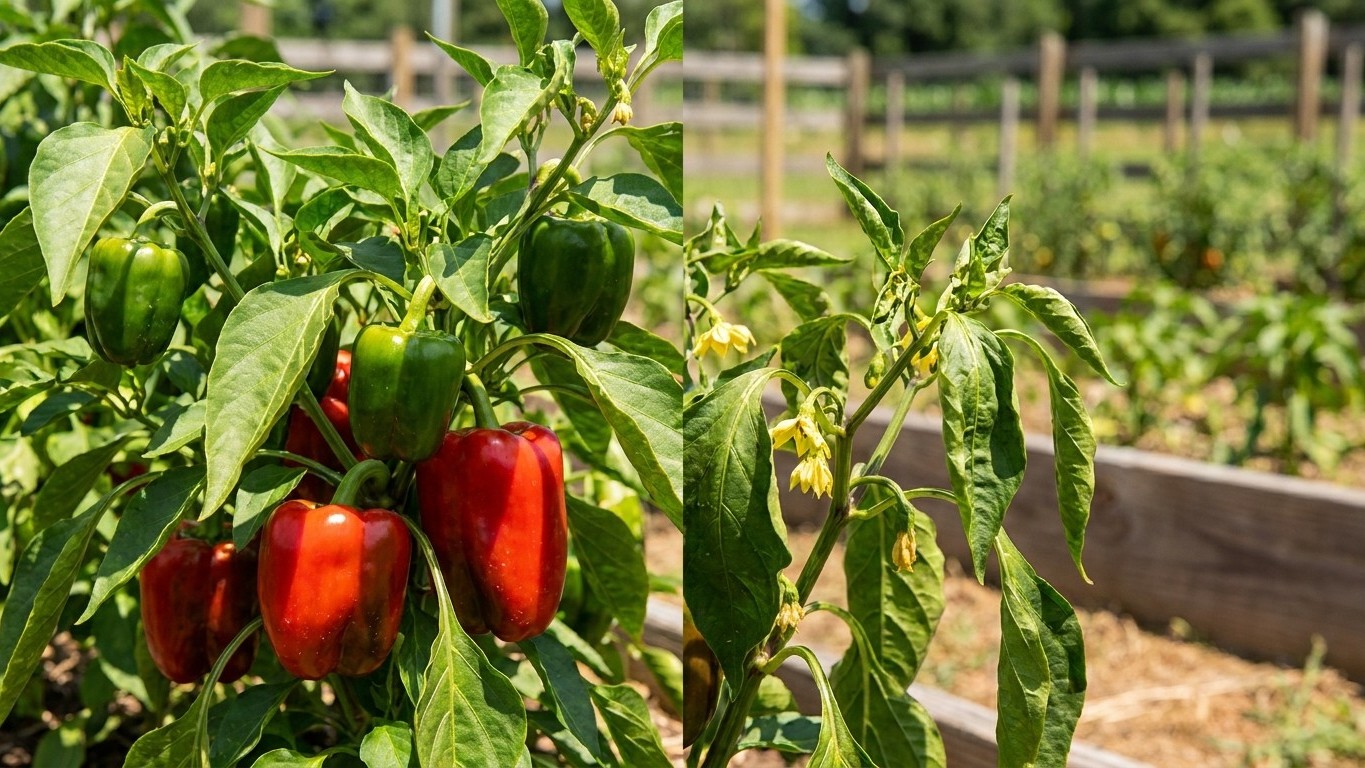

Four kinds of feeders go after pepper plants in Virginia gardens: cutters at the soil line, leaf chewers, sap feeders and fruit borers. Each one arrives at a different stage, from the first nights after transplanting to the weeks when pods swell. Timing follows your transplant date more than the calendar. The symptom you see first tells you which group to look for, and your local Virginia Cooperative Extension office can name the species active near you.
Which pests attack pepper in Virginia
Virginia Cooperative Extension is the service that documents garden insects across the state. For pepper, its pest lists sort into four working groups:
- Soil-level cutters, which sever young stems
- Leaf chewers, the beetles and caterpillars that make holes
- Sap feeders, small soft-bodied insects that cluster on new growth
- Fruit feeders, which bore into or puncture the pods
Extension lists also carry orchard, shade-tree and lawn insects. Set those aside. They feed on bark, wood or grass roots, and a pepper plant gives them nothing to eat. One sitting on a pepper leaf is resting there. It is not the cause of the damage you are looking at.
The timing of the first group depends on when the plants go out. At the coastal reference station (the mild end of the state), NOAA NCEI Climate Normals put the last spring freeze between March 20 and April 3, based on 32 F freeze probabilities at NAS Oceana. Utah State University Extension says to set transplants out after frost, once the soil reaches 60 F. Those transplants have usually spent 8 to 10 weeks indoors, so they go out soft and tender, and tender stems are what cutters go after first.
Summer heat adds a second pressure. NOAA NCEI counts 26.0 days a year at 90 F or more at the Virginia Beach reference station. Utah State University Extension notes that pepper fruit set fails at both ends: nights below 55 F or days above 90 F. A pepper that drops its flowers is not always under attack, and the next sections show how to tell.
Inland, the Blue Ridge and southwest Virginia run weeks later in spring and earlier in fall than the coast. A pest list that fits a Tidewater garden will not fit a mountain one.
When each one shows up, and what it does first
Count from the day transplants go in. Cutters come first. A seedling lies on its side, severed at the soil line, with the root still planted. A row can lose one plant after another over several nights. The damage happens overnight, so a missing or toppled seedling at the morning check is the first sign.
Leaf chewers follow once the plants establish and start to grow. Early on you see small round holes in young leaves. Later come ragged edges, then bare stems. Dark droppings on the leaves below are the giveaway. A large caterpillar can strip a plant in a warm stretch, and the damage often looks sudden because the insect matches the leaf color.
Sap feeders show up wherever new growth is pushing. Look for curled or crinkled leaf tips, a sticky shine on the foliage, and clusters on the undersides of leaves. Ants climbing a stem often point to sap feeders above them. This damage is slow, so it tends to be noticed later than it started.
Fruit feeders arrive from flowering onward. Look for a small entry hole, a pod that colors early, or one that drops and turns soft inside. Clemson Cooperative Extension’s Home & Garden Information Center says peppers are ready to harvest in about 70 to 85 days after transplanting, so the fruit-feeding window sits in the back half of that stretch. Harvesting on time shortens it.
Telling the damage apart from everything else
Several problems mimic insect injury, and the wrong diagnosis wastes a season. The table lists the common look-alikes and the sign that separates them.
| What you see | Possible causes | What settles it |
|---|---|---|
| Flowers or tiny pods dropping | Insect feeding, or heat and cool nights | No chewing, no insects and no sticky residue points away from pests. Check your own highs and nights against 90 F and 55 F. |
| Curled leaves | Sap feeders, or water stress | Sap feeders leave clusters and stickiness. Water stress curls leaves in the afternoon heat and they relax by morning. |
| Holes in leaves | Chewing insects, or wind and hail | Insects leave droppings and chewed margins. Weather damage hits all plants and leaves ragged tears. |
| Yellow leaves | Sap feeders, or a nutrient shortage | A nutrient problem spreads evenly across the plant. Insect damage clusters near where the feeders sit. |
| Sunken, soft spot on a pod | Fruit feeder, or a watering or storage problem | An entry hole or tunnel points to an insect. A smooth, collapsed patch does not. |
The pitted, soft spots on stored peppers deserve a special mention. A refrigerator is colder than peppers like. Clemson Cooperative Extension gives the best storage as 45 to 50 F with 80 to 90 percent relative humidity, good for two to three weeks at most. Below about 45 F peppers pit and soften from chilling injury, which people often blame on a bug that was never there.
When the cause is still unclear, take a leaf or pod and a photo of the whole plant to your county Extension office. For heat and cool-night drop specifically, read Why Peppers Fail to Set Fruit in Virginia.
What actually works here, and what is a waste of time
A physical barrier at the right moment beats any treatment, and the calendar does more than any product. Paper or plastic collars around stems at transplanting stop cutters, and they cost almost nothing. A lightweight row cover keeps leaf chewers off young plants. Take it off before the heat builds, because the coast alone logs 26.0 days at 90 F or more, and a cover that traps warmth can push flowers past the limit where fruit set fails.
Timing matters too. Transplants set out after the last frost, once the soil reaches 60 F, grow off quickly, and fast growth outpaces early feeding. Plants held indoors for the full 8 to 10 weeks go out soft and tender. Picking on schedule also helps, since ripe fruit left on the plant draws feeders. Choosing a variety that ripens inside your season, as covered in Pepper Varieties That Ripen in a Virginia Season, keeps the fruit on the plant a shorter time.
Hand-picking works for large leaf chewers, and the evening walk is when they are easiest to find. A hard stream of water from the hose knocks small sap feeders off tender growth, though they return if the cause is left alone.
What wastes time? Spraying at the first sign of damage without knowing the cause. It misses the real problem and can harm the beneficial insects that keep feeders in check. Treating heat-related flower drop as an insect problem is the same mistake. So is following a spray calendar from another state or climate, since the pest timeline shifts with the frost-free window.
Virginia Cooperative Extension is the only source that knows what is registered for home use in the state, and its advice changes as labels change.
Where to check this for your own county
Your county or city office of Virginia Cooperative Extension is the place to confirm what is feeding on your plants. Agents there know which species have been active locally this season, and they can identify a damaged leaf or pod faster than any guide.
Pest pressure varies inside the state. The coastal reference station sits at the mild end, while the Blue Ridge and southwest Virginia have a later spring and an earlier fall. A pest documented across the state may not be in your garden at all, and one that matters in your county may rarely appear elsewhere. For the overall growing plan, start with Growing Peppers in Virginia.
When you visit or send photos, bring the damaged leaf or pod, a photo of the whole plant, and your transplant date. Put the sample in a sealed bag so it stays intact. Next season, set up your collars before the first transplant goes in the ground.
Common questions
What eats pepper plants overnight?
A seedling that is toppled and cut at the soil line points to a soil-level cutter. Collars at transplanting prevent most of this, and a morning check catches the rest.
Why are my pepper flowers dropping when I see no insects?
Fruit set fails when nights fall below 55 F or days rise above 90 F, according to Utah State University Extension. The reference station averages 26.0 days a year at 90 F or more. Watch your own nights, since they vary by garden.
Can I store harvested peppers in the refrigerator?
Not for long. Peppers keep best at 45 to 50 F with 80 to 90 percent relative humidity, for two to three weeks at most. Below about 45 F they pit and soften.
When should I put transplants out to avoid early feeders?
Wait until after frost and until the soil reaches 60 F. At the coastal reference station, the last spring freeze falls between March 20 and April 3. Inland gardens run weeks later.