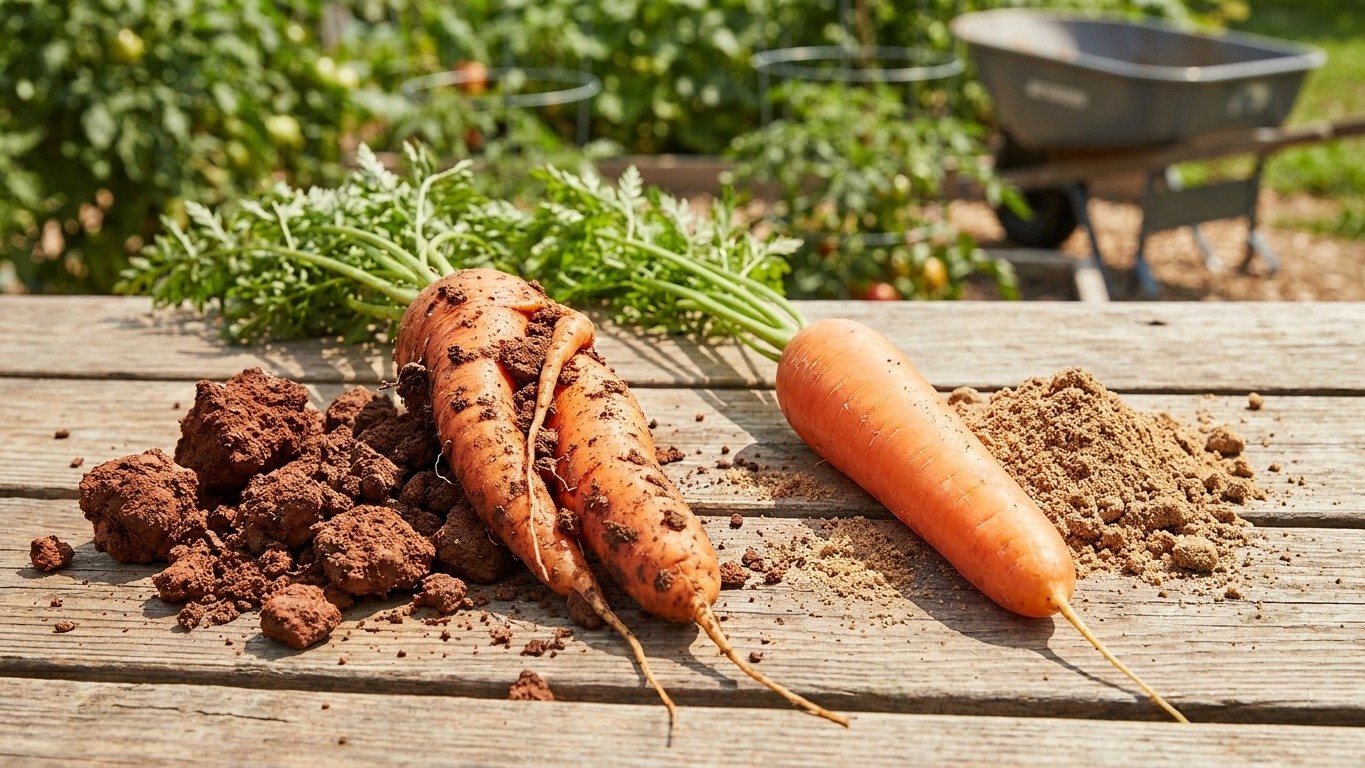

In Vermont, carrots are eaten from three directions: soil-dwelling larvae that tunnel into the roots, chewing and sap-feeding insects on the tops, and deer, rabbits and woodchucks that take whole plants. Each group arrives at a different point in the days that run from seeding to harvest. Carrots are sown in place and never transplanted, so the calendar starts the day the seed goes in. Knowing which stage you are in tells you what to look for.
Which pests attack carrot in Vermont
The University of Vermont Extension tracks garden insects and diseases in the state, and its county-level offices are where a specific species gets confirmed. For a carrot bed, the problems fall into three working groups.
- Root feeders: larvae that live in the soil and chew tunnels or scars in the root itself.
- Foliage feeders: insects that chew the leaves or suck sap from the tops, weakening the plant and sometimes carrying disease.
- Mammals: deer that clip the tops, rabbits that cut seedlings at the soil line, and woodchucks that clear out a row overnight.
Insects that bore into or defoliate maples, apples and other trees feed on woody plants and never touch a root crop, so set those pest lists aside.
Root feeders cause the worst losses, because the damage stays hidden until the carrot is pulled. Foliage feeders and wildlife are easier to catch: you can see the chewed leaves, the clipped tops, the bare gap in the row.
The species active in a given garden differ by town and by year. Ask the extension office for the carrot pests active in your county before buying anything, and ask which products are registered for use in Vermont, since labels and registrations change.
When each one shows up, and what it does first
Count from the day the seed goes in. The three groups take their turns across the days to harvest. If you are still deciding when to plant, When to Sow Carrots in Vermont: Counting Back From the Last Frost walks through the count.
What shows up in the first weeks after seeding?
Rabbits and other small mammals are the first visitors. The symptom is a row that was thick with seedlings and is now patchy, with stems cut clean near the soil. Insects that feed on tiny seedlings can cause the same gaps, so look at the cut. A clean angled cut points to a rabbit. A ragged chewed stem, or a seedling that wilts and falls over with its base eaten, points to something smaller.
What happens while the tops are filling out?
Once the feathery tops are established, foliage feeders move in. The first sign is usually on the leaves: chewed edges, small holes, curled or distorted growth, or a sticky residue. Deer browse in the same weeks and leave tops cut off, often at a uniform height. Ragged, torn stems suggest deer, since they have no upper front teeth.
Underground, root-feeding larvae are already working. Nothing on the surface may show it, though some beds develop tops that look stunted, off-color or wilted on warm afternoons. That symptom has several possible causes, which the next section sorts out.
What shows up as roots size up toward harvest?
Late in the season, damage becomes visible at the shoulder of the root. Tunnels, rusty-brown scars and soft spots appear where larvae fed. Woodchucks may also take whole plants at this stage, leaving a hole where the root was. Gaps in the row that appear this late are usually a mammal, because insect damage to a mature carrot leaves the root in the ground.
Pull one or two carrots a couple of weeks before you expect to harvest, rather than waiting for the whole bed.
Telling the damage apart from everything else
Half the carrot problems that look like insect damage turn out to be soil, water or disease. The root itself is the best evidence, because insect feeding leaves tunnels and scars, while stress from soil or weather changes the shape or color without chewing marks.
| What you see | Possible causes | What settles it |
|---|---|---|
| Forked, stubby or hairy roots with a smooth surface | Heavy or rocky soil, or a bed that was not loosened deeply | Dig around the root. Stones and compacted layers point to soil. Check for tunnels by cutting the root open. |
| Winding tunnels or rusty scars on the root | Root-feeding larvae | Slice the root lengthwise. Take the carrot to your extension office for identification. |
| Wilting tops on a hot afternoon that perk up by morning | Water stress | Push a finger into the soil beside the row. Dry soil a few inches down means water. |
| Yellow, purplish or stunted tops across the whole bed | A nutrient or soil acidity problem | A soil test. Insects rarely stunt a whole bed evenly. |
| Dark spots or blotches on leaves | A leaf disease | Bring a sample to the extension office. Insects leave holes, while disease leaves spots. |
| Split or cracked roots | Heavy rain or watering after a dry spell | Splits with clean edges and no chewing mean water, not insects. |
Soil deserves a second look in Vermont. USDA NRCS records the state soil, the Tunbridge series, as a Spodosol, a sandy, acidic, strongly leached soil typically found under conifers, with a pH around 3.5 and good drainage. That describes what Vermont ground tends toward, and your garden may be nothing like it. River-bottom fields, hill pastures and fill scraped by a builder all differ.
Utah State University Extension notes that carrots want deep, sandy, well-drained soil rich in organic matter, and that heavy or rocky soil makes the root fork. Forking is a soil and bed-preparation problem. The article Will Carrots Fork in Vermont Soil? covers it in detail.
What actually works here, and what is a waste of time
A physical barrier set at the right moment beats any treatment applied later. On a short northern season, getting the calendar right matters more than the product you choose.
Lightweight floating row cover works well against flying insects that lay eggs at the base of the plants. Put it over the bed the day you seed, bury or weigh down every edge, and leave it on. If you lay it down after adults have already laid eggs, you have sealed the larvae in with the crop.
Rotation does the rest. Move carrots to a different bed each year and keep them away from where carrots or their relatives grew the season before. Root-feeding larvae overwinter in or near the soil where they fed, so a crop planted in the same spot meets them as they emerge.
For deer and rabbits, a fence works where repellents fail. It needs to be tall enough that deer will not clear it, and tight against the ground, bent outward at the base or buried, so rabbits cannot slip under. Woodchucks dig, so the bottom of the fence has to go down into the soil as well.
Thinning needs care too. Bruised tops give off a scent that draws egg-laying insects, so thin on a cool day, press the soil back around the remaining plants, and carry the thinnings out of the garden.
Several common habits waste time. Spraying after tunnels show on the root fails because the larvae are inside the carrot. Home repellents such as scattered hair or pepper wash off with the first rain and are no match for a hungry deer. Replanting a heavy bed with a different variety does not fix forking, since the cause is the soil. Heavy soil needs compost and double digging, or a raised bed.
Harvest and storage can also protect what you grew. Clemson Cooperative Extension advises harvesting about 65 to 75 days after planting and storing carrots at 33 °F with high humidity to prevent wilting. Cut the tops off first, because the leaves keep drawing moisture from the root. With tops on, bunched carrots keep only about 10 to 14 days. The full guidance is in the Clemson factsheet. Eat any carrot with tunnels first, since a damaged root rots in storage faster than a clean one.
Where to check this for your own county
The University of Vermont Extension is the right place to confirm which pests are active near you, and the office that serves your county can look at a real sample. Pest pressure changes within the state, between the Champlain Valley and the hill country, and even between neighboring lots. The Tunbridge series stands for the state, and your own ground may be river silt, a clay pocket or filled ground, so take a soil test before you amend the bed or blame an insect.
For background on the crop itself, Growing Carrots in Vermont covers the full season. Before you contact the office, pull two or three affected carrots, cut them open, photograph the damage and keep them cool in a sealed bag. Bring the samples and a soil test result, and ask what is active in your area and what is currently registered for carrots in Vermont.
Common questions
Do I need to spray carrots in Vermont?
Often the answer is no. A row cover set at seeding, rotation and fencing handle most problems without a product. If you do need one, the extension office knows what is registered in the state.
Why are my carrots forked when nothing seems to have chewed them?
Forking usually comes from heavy or rocky soil or a bed that was not loosened deeply, according to Utah State University Extension. Cut one open. If there are no tunnels, look at the soil and consider double digging, compost or a raised bed.
Can I reseed after something eats my seedlings?
Yes, if there are enough days left. Count the days from the new seeding date to see whether the crop can finish. When to Sow Carrots in Vermont: Counting Back From the Last Frost shows how to do that count.