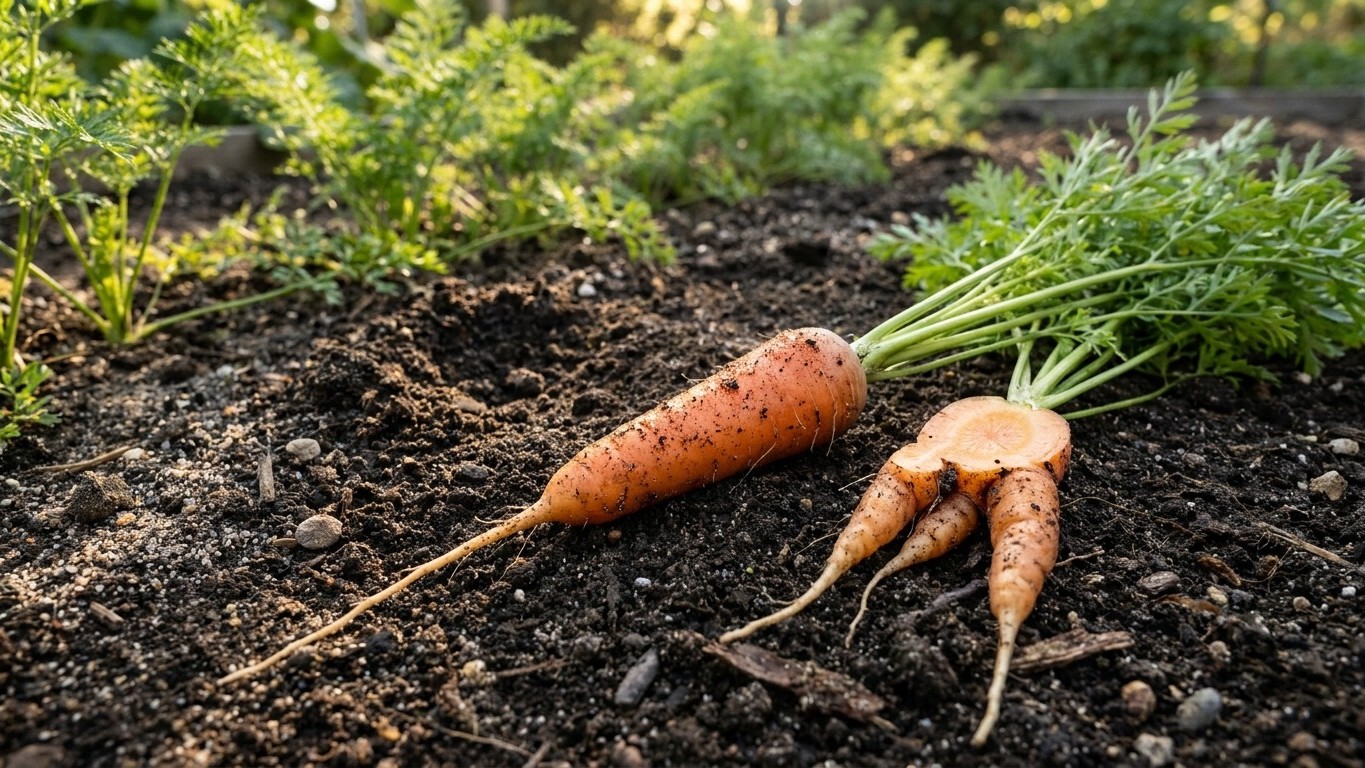

Pull carrots when the roots have run their full count of days from seeding, which is 70 to 100 days on most packets, and before the soil freezes hard. Cut the tops off right away. Then cool the roots to 33 °F with high humidity, the storage conditions Clemson Cooperative Extension gives. Carrots stored with their tops on keep only about 10 to 14 days, so the order of those steps matters more than the calendar date.
When do you pull carrots in Wyoming?
The clock starts the day the seed goes in. Carrots are sown in place and never transplanted, so there is no second date to count from. Packets list 70 to 100 days from seeding, and Clemson Extension puts harvest at about 65 to 75 days after planting. That gap comes from variety, from how warm the summer ran, and from how thick the row is. Count forward from your sowing date and start testing a week before the earliest number.
Testing means looking, not guessing. Brush the soil back from one or two shoulders. A ready root has filled out to the width the packet describes and shows deep, even color at the top. Pull one and taste it. If it is thin and pale, give the row another week and check again.
Fall sets the real deadline. Carrots in cool soil hold their sugars, and a light frost that blackens the tops does the roots no harm. The signal to hurry is ground that has started to stiffen and nights cold enough to crust the bed. Where seasons are short and fall arrives fast, as it does in much of Wyoming, that window can close within days. Your county extension office can tell you the average first hard freeze for your elevation.
Does Wyoming soil change how you harvest?
It can. The soil USDA lists as representative of the state is the Forkwood series, an Aridisol, which is a dry-climate soil that is usually alkaline and often carries salts. Its surface runs about 7.2 in pH (near neutral) and is a loam to silt: 42 percent sand, 20 percent clay and 38 percent silt. Organic matter is about 1.5 percent, and the ground is well drained. Those are representative values for the mapped surface of that series. A state has hundreds of soil series, and river bottoms, hill country and any lot a builder has scraped or filled will differ.
Utah State University Extension says carrots want deep, sandy, well-drained soil rich in organic matter, and that heavy or rocky soil makes the root fork. Against that, the representative Wyoming surface drains well but is low in organic matter and silty, so it tends to set hard when it dries. A dry bed fights back at harvest, and roots snap or fork. Water the row the day before, then loosen the ground with a garden fork a few inches out from the row before you pull. If your roots come up split or stubby, the cause is usually in the ground, and the article on whether carrots fork in Wyoming soil covers raised beds and double digging. To learn what your own bed is made of, fill a jar with soil and water, shake it, and let it settle to see the sand, silt and clay layers. Then send a sample for a lab result: a soil test through the county extension office settles what no state average can.
Harvest is also when you find out who else has been eating. Tunnels, chewed shoulders and missing roots show up as you dig, and what eats carrot in Wyoming, and when helps you read them. Set damaged roots aside to eat first, because they will not keep. For the full growing season, start with growing carrots in Wyoming.
Keeping them, and for how long
Clemson Cooperative Extension’s Home & Garden Information Center says to harvest carrots about 65 to 75 days after planting and to “store them at 33 °F and high humidity to prevent wilting.” It adds that bunched carrots, meaning plants with the tops still on, can be stored for about 10 to 14 days. Write down the temperature, because it is the number most people get wrong.
The 33 °F figure sits just above freezing. A root cellar in autumn usually runs warmer than that, and a carrot held at 50 °F will sprout and go soft in a fraction of the time. Treat the 10 to 14 days as a maximum under the best conditions. A fridge that drifts warm, or a harvest that went in damp or bruised, will cut that short.
Why do the tops have to come off first?
The leaves keep pulling moisture out of the root after it leaves the ground. A carrot with its greens on is wilting from the inside, which is why bunched carrots last 10 to 14 days and trimmed ones last far longer. Cut the tops off as soon as the roots are out of the ground. Leave a short stub so the crown stays sealed, and set the greens in the compost.
How long do trimmed carrots keep?
Trimmed roots can keep for months when the cold and the humidity both hold. That is the best case, and it takes sound roots, steady cold and air that does not dry them out. A carrot with a nick or a wet spot will rot first and can spoil its neighbors, so sort as you pack. A simple routine covers it:
- Dig on a dry day and let loose soil fall off. Do not scrub the roots.
- Cut the tops right away.
- Sort out split, nicked or insect-tunneled roots and eat those first.
- Pack the sound roots in a container or bag that holds moisture, and keep them cold.
- Check the stored roots every week or two and remove any that have gone soft.
Where in the house that actually is
Few rooms in a house sit at 33 °F. Some are too warm for carrots, and the coldest spots can drop low enough to freeze them. The table below lays out where each place falls short.
| Place | What it does to carrots | Verdict |
|---|---|---|
| Refrigerator crisper drawer | Closest to 33 °F, and a bag holds in humidity | Best match, with a check on how cold the back runs |
| Heated kitchen or pantry | Far too warm, so roots soften and sprout | Short-term only |
| Basement or cellar | Often warmer than 33 °F in autumn, steadier than a garage | Fine for a few weeks if cold |
| Attached or detached garage | Swings with the weather, warm in early fall and below freezing on a hard night | Risky without a thermometer |
A domestic fridge comes closest to the target, and the crisper drawer is its best spot. Put the carrots in a closed bag or box so the humidity stays up. The back wall of the fridge can run colder than the front, so check that spot before you trust it with a whole harvest.
Most of a Wyoming harvest will not fit in a fridge. The next best place is a cold, dark room that stays above freezing, such as a basement corner against an outside wall. Leave a thermometer in the spot for several days before the carrots go in, reading it morning and evening. A min/max thermometer is better, because it records the overnight low you would otherwise miss. Skip that check and one cold night in a garage can freeze a winter’s worth of roots. Frozen carrots go limp and watery once they thaw.
Common questions
Can carrots stay in the ground over winter?
Where the ground freezes hard, they should not. A thick mulch of straw can extend picking by a few weeks, but frozen soil is hard to dig and roots can be damaged. Pull the main crop before the bed stiffens, and ask your county extension office for the usual timing near you.
How do I know a carrot is ready to pull?
Count the days from seeding against the packet, then check the shoulders. A ready root has reached its described width and shows deep, even color. Pull one and taste it. Thin and pale means wait another week.
Why did my stored carrots go rubbery?
Rubbery roots have lost water. The usual causes are tops left on, air that is too dry, or storage warmer than 33 °F. Cut the tops, keep the roots in a closed container, and recheck the temperature with a thermometer.
Does a light frost hurt carrots?
A light frost may blacken the tops, but the roots in the ground are fine. A hard freeze that locks the soil is the real danger, because it damages roots and makes digging difficult.