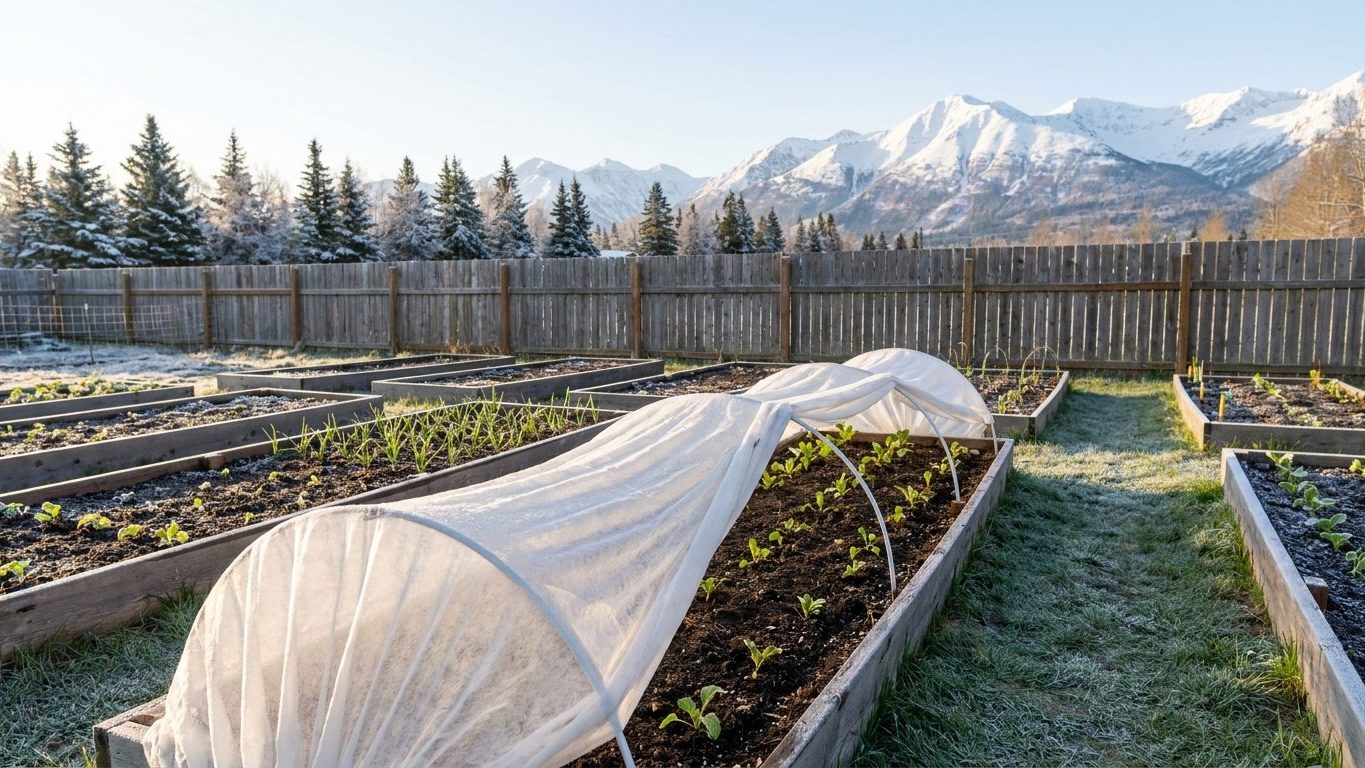

Cover your garden in the Northwest Territories on any night when frost is forecast, starting before the average last spring frost of May 25 and again in late summer, ahead of the average first fall frost of September 18. Both dates come from the Yellowknife A weather station, and each one is a midpoint. In half of all years, frost lands later in spring or earlier in fall, so keep covers within reach for weeks on either side.
The short answer for Northwest Territories
Yellowknife A averages its last spring frost on May 25 and its first fall frost on September 18 (Environment and Climate Change Canada normals, 1981-2010). The station has about 116 frost-free days between those two dates. That is a short run for anything that wants warm nights, and it is the reason covers matter more here than in most of North America. Remember what the dates are: averages. In one spring out of two, frost comes after May 25, and in one fall out of two, it arrives before September 18.
When should you cover plants in spring?
Put covers on the same day you set out transplants or sow, and leave them on every night until the forecast lows stay well above freezing. In practice, that means keeping a roll of row cover or a few buckets and sheets handy, even though the average last frost falls on May 25. A cover also earns its keep in the days before planting. Laid over bare ground, it warms the top few inches faster than open soil, so seeds go into a bed that is ready for them.
Cold-tolerant crops such as peas, spinach, lettuce, radishes and kale can go under cover earlier, because a light frost does not set them back. Tomatoes, squash, cucumbers and beans cannot take a single frosty night, so they wait until the weather has truly settled.
When should you cover plants in fall?
Start watching the forecast in late August. A clear, calm night after a warm day is the one that drops lowest, and that is the night to cover. Drape the cover over the plants in the evening, anchor the edges, and pull it back the next morning once the frost has melted. Fall frosts often come as a brief first touch, followed by another stretch of mild days. A few cold nights covered can buy you more harvest. For a wider look at the tools and timing, see Extending the Growing Season in Northwest Territories.
What will not work here
Season extension cannot make a 116-day frost-free run into a long one. Crops that need a hot, long summer, such as melons, sweet corn and full-season winter squash, tend to run out of time even under plastic. Choose short-season types, start them indoors, and treat any extension as a way to protect a crop that is already suited to a short season.
Waiting for May 25 and planting that day is another common mistake. The date is the middle of the range, so half of all springs bring frost later. Tender plants set out right on the average date lose that bet about half the time. Plan to cover them, or hold them back into June.
Thin row cover on its own will not carry tender plants through a hard freeze. A lightweight fabric adds some protection, enough for a light frost but not for a deep one. If the forecast calls for a real freeze, add a second layer or a rigid frame, or bring containers inside.
Can covers carry a crop through winter?
No. The mean daily minimum of the coldest month at Yellowknife is -29.5 °C (-21.1 °F). An unheated cold frame or a plastic tunnel cannot hold that kind of cold back, and any plant left growing inside will freeze solid. Fall-sown crops that get through mild winters in the lower 48 will not make it through here without deep, reliable snow cover. Season extension in this territory works at the edges of the season, in spring and fall. It does not turn winter into a growing season.
Plastic has its own failure mode in the north. In late spring the days are very long, and a sealed low tunnel can overheat on a sunny afternoon even when the night before was frosty. Vent it in the morning, and close it again in the evening. Wind is the other trouble: a cover that is not pinned down along every edge will end up in the next yard. For the full comparison of tools, Which Season Extenders Work in Northwest Territories sorts them by how much protection each one gives.
What changes across Northwest Territories
The frost dates above belong to one weather station at 62.46 degrees north. The Northwest Territories is a very large place, and no single date fits all of it. Gardens farther north, toward the Arctic coast, run weeks behind Yellowknife, with a later spring thaw and an earlier fall freeze. Communities in the south, closer to the Alberta border, tend to start sooner and finish later. If you live near the edge of the territory, check your own latitude, because day length shifts noticeably across several degrees.
Canada rates Yellowknife as plant hardiness zone 1b, based on 1991-2020 normals from Natural Resources Canada. That is the Canadian system, and it does not convert to a USDA zone. The Canadian map weighs seven climate variables, while the USDA map uses one, so the two numbers cannot be lined up. The territory also covers more than one zone, so there is no single answer for the whole of it. To find the zone for your own community, use Canada’s Plant Hardiness Site and look up your municipality.
Small differences in the land matter as much as the large ones. A bed against a south-facing wall, a slope that faces the sun, or a spot sheltered from the wind can gain days at both ends of the season. Low ground, where cold air settles, loses days. A shift of ten feet can matter more than a shift of ten miles. If you are north of Yellowknife or at higher ground, assume your spring covers will go on later and your fall covers will come out earlier, and plan for fewer frost-free days than the 116 above.
Where to check this for your own county
The Northwest Territories does not have counties, so the closest equivalent is your own community or region. The best local source is the territorial government’s agriculture services, which is the closest thing the territory has to an extension office. Ask there for the local planting calendar, the expected frost window for your area, and which varieties have been grown successfully near you.
A recommendation for your own community will always beat a territory-wide one. The guidance here covers the whole territory and leans on a single station’s averages. It is a sound starting point, but a local grower or agricultural office knows how your valley, lakeshore or hillside actually behaves, and which varieties have done well there year after year.
When you contact them, ask three things. First, what the usual last spring frost and first fall frost are for your community, and how much those dates vary from year to year. Second, which varieties of the crops you want have been trialed or grown reliably nearby. Third, what covers local growers use and when they put them on. Write the answers on your calendar, then compare them with the Yellowknife dates here and note the difference.
Checking this against your own garden
Your own garden outranks every date in this article. Three things are worth watching, and none of them needs equipment.
- Soil warmth by feel. Push your hand a few inches into the bed in the morning. If it feels cold and damp, the soil is not ready for tender seedlings, covered or not. A bed that feels noticeably warmer than your neighbor’s tells you it has a head start.
- The first male flowers. Squash and cucumbers produce male blooms first. When they open, the plants are growing steadily. If they are slow to appear, the plants are probably cold, and you should keep the cover on.
- The first true leaves. Seedlings first show seed leaves, then the true leaves that look like the mature plant. If those come in steadily under your cover, the spot suits them. If growth stalls or the leaves yellow, the spot is cold or the cover is overheating.
Write the date of each observation in a notebook, year after year. After three or four seasons, you will have a better frost calendar for your own garden than any regional average can give you.
Common questions
What date is safe to plant tender vegetables in the Northwest Territories?
No date is safe, because May 25 is only the average last frost at Yellowknife A. Frost falls later in about half of all years. Plant tender crops in early to mid June, and keep a cover ready for cold nights.
Is the Canadian hardiness zone the same as a USDA zone?
No. Yellowknife is zone 1b in the Canadian system, which uses seven climate variables. The USDA system uses one, and the two do not convert. Natural Resources Canada says as much on its own site.
Can I leave a row cover on all summer?
Heat-loving crops like tomatoes can stay under a light cover for much of the season, but flowering crops that need pollinators, such as squash, must be uncovered so insects can reach them. Vent plastic on sunny days.
How cold does it get in winter?
The mean daily minimum of the coldest month at Yellowknife is -29.5 °C. Covers will not keep plants alive through that, so season extension here is for spring and fall only.