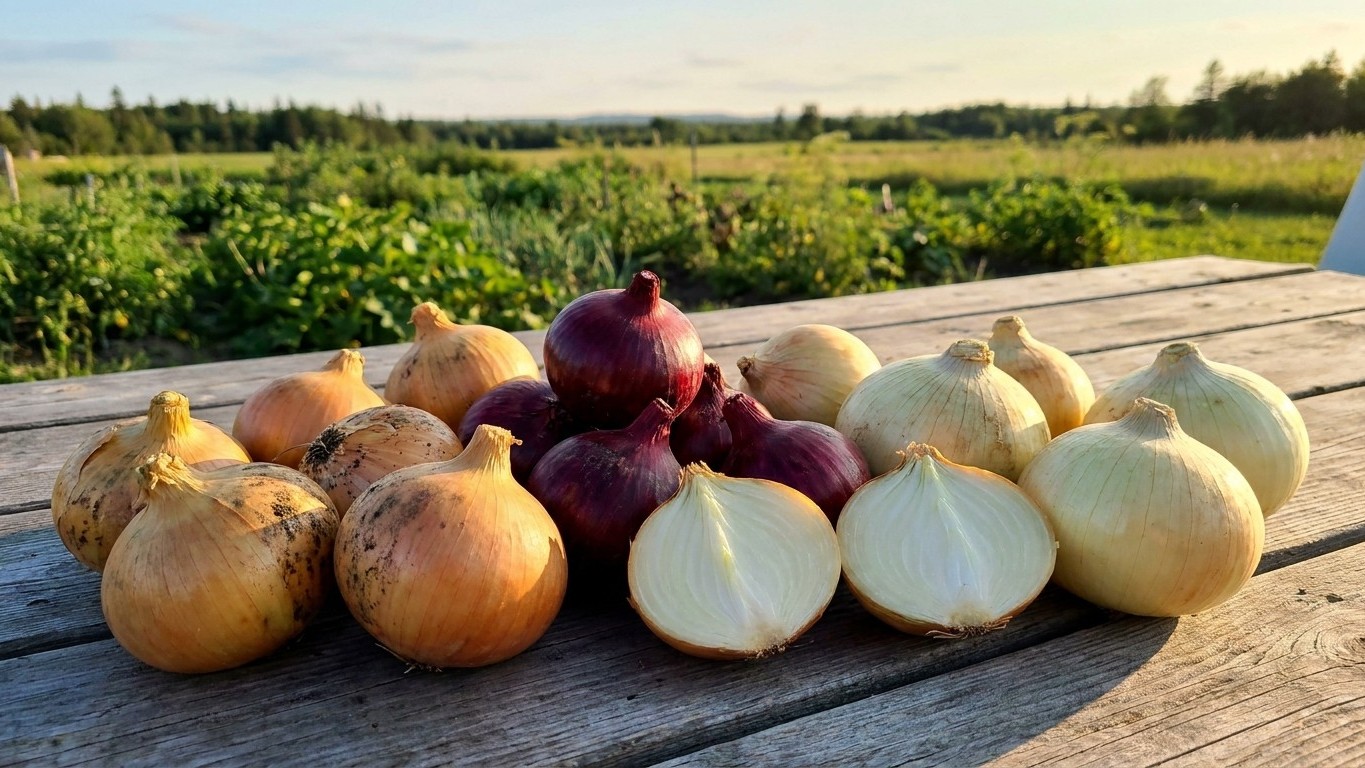

Lift onions when most of the tops have flopped over and the necks have gone soft. Pull them on a dry day, then cure them in a warm, airy spot until the necks are tight and the skins feel papery. Only then do they go into storage, where the target is 45 °F to 55 °F and 50 to 60 percent humidity. A well-cured pungent onion can last into March. A sweet one will not.
Keeping them, and for how long
What decides the storage life of an onion is largely chemistry. The bite comes from volatile sulfur compounds, and those same compounds help protect the bulb while it sits in the dark for months. University of Missouri Extension puts the rule plainly: “As a rule, ‘sweet’ onions do not store as well as the more pungent types.” A sweet variety carries fewer of those compounds. That makes it better raw and a poor candidate for the winter shelf. Plant one expecting to store it and you will be disappointed.
Day length lines up with this trade-off. Bulbing is triggered by the length of the day, not by warmth. Short-day varieties start bulbing at about 12 hours of daylight (a threshold published by Clemson Cooperative Extension). They bulb early, stay small in the north, and run sweeter. Long-day varieties wait for 14 to 16 hours and keep longer. Burlington, the reference city for Vermont’s climate normals, sits at 44.47 degrees north and gets 15 h 22 of daylight on the longest day. That falls inside the long-day window, which is why northern gardens grow the onions that feed you into March. If your garden is at the far northern or southern end of the state, look up your own latitude, because day length shifts with it. The best onion varieties for Vermont are the long-day, pungent types for exactly this reason.
What temperature and humidity keep onions longest?
Clemson Cooperative Extension’s Home & Garden Information Center states it this way: “Ideal conditions are between 45 °F and 55 °F, and 50 to 60 percent humidity.” Write down 45 °F to 55 °F at 50 to 60 percent humidity and measure your storage spot against it. You can read the full fact sheet at the Clemson HGIC onion, leek, shallot and garlic page.
Onions want it dry, which is the opposite of carrots, beets and other roots that keep best in cold, damp conditions. A single cellar cannot hold both groups well. If you grow both, the onions need their own corner or their own room.
How long do stored onions really last?
Treat any duration as a ceiling. A cured, pungent, long-day onion held in that temperature and humidity range can reach March. That is the best case, and it assumes sound bulbs. A bulb with a thick, green or wet neck, a cut, or damage from the field will fail well before then. Bulbs chewed by maggots or thrips tend to rot first, so it helps to know what eats onion in Vermont, and when. Sort the crop at lifting time. The sound, tight-necked bulbs go to storage, and the doubtful ones go to the kitchen this week.
Sweet types follow a shorter clock. Eat them first, while the sulfur-poor flesh is still firm, and save the pungent bulbs for midwinter. For the broader picture of growing them here, start with onions in Vermont.
Where in the house that actually is
A range of 45 °F to 55 °F sounds easy until you walk through a real house. The refrigerator is the first place people think of, but a domestic fridge runs colder than that range, and the closed, moist air inside is the wrong environment for a dry-storage bulb. Keep it for the onions you have already cut. A heated living space fails the other way. Kitchens and family rooms sit above the range for most of the year, and the bulbs there dry out and sprout sooner.
The garage is tempting because it has space, but it follows the weather. In September it can be warm and dry, which suits curing. In a cold winter it can drop below freezing, and a frozen onion turns to mush when it thaws. Use the garage, a covered porch or a barn for the curing weeks, then move the crop before the first hard cold.
For winter, the best candidate in most Vermont homes is an unheated interior room or a cool corner of the basement that sits away from the furnace and the water heater. Think of a pantry on an inside wall, a cool back bedroom with the register closed, or an enclosed mudroom that stays above freezing. A cellar with a dirt floor or a sump is usually too damp. Humidity there can climb through summer and fall, and moist air soaks into the necks and starts rot.
Do not trust your hand to judge it. Set a thermometer and a hygrometer in the spot where the onions will sit and watch them for a week before you commit the crop. Skip the check and you may find out later, when much of the harvest has gone soft or sprouted. A min/max thermometer is worth the few dollars, because it shows the overnight low and the afternoon high you would otherwise miss.
Once the spot passes, store the bulbs in single layers or loose, so air moves around them. Mesh bags, slatted crates and open baskets all work. Sealed plastic bags and closed boxes do not, because they trap moisture around the necks. Check the stored crop regularly and pull out anything soft before it spoils its neighbors.
Common questions
How do I know onions are ready to lift?
Watch the tops. When most of them have fallen over and begun to yellow, and the necks feel soft where the leaves meet the bulb, the plant has finished growing. Pick a dry day, loosen the soil with a garden fork, and lift the bulbs by hand without bruising them. Leave the tops attached. If you wait too long in wet soil, the outer skins can split and the bulbs can rot or push out new roots.
How do I cure onions after lifting?
Spread the bulbs in a single layer where it is warm, dry and airy, out of rain and direct sun. A covered porch, a barn or a garage in good weather all work. Leave the tops and roots on. The bulbs are cured when the necks are tight and dry and the outer skins feel papery. Then trim the tops short and move the onions to storage. Any bulb whose neck stays thick or damp after curing should be eaten first, because it will not keep.
Can I store sweet onions through winter?
No, not reliably. Sweet onions hold fewer of the volatile sulfur compounds that protect a bulb in storage, so they spoil sooner than pungent types. Eat them in the weeks after harvest and keep the sharp, strong-flavored onions for later. If a variety is sold mainly for its mildness, plan to eat it fresh.
Can onions share a cellar with carrots?
Not well. Carrots and other roots keep best in cold, damp air. Onions need 50 to 60 percent humidity and 45 °F to 55 °F. Put them together and one crop suffers. If you have only one cool space, give the onions the drier end and keep the damp-loving roots in a separate container as far away as you can, or in another room.