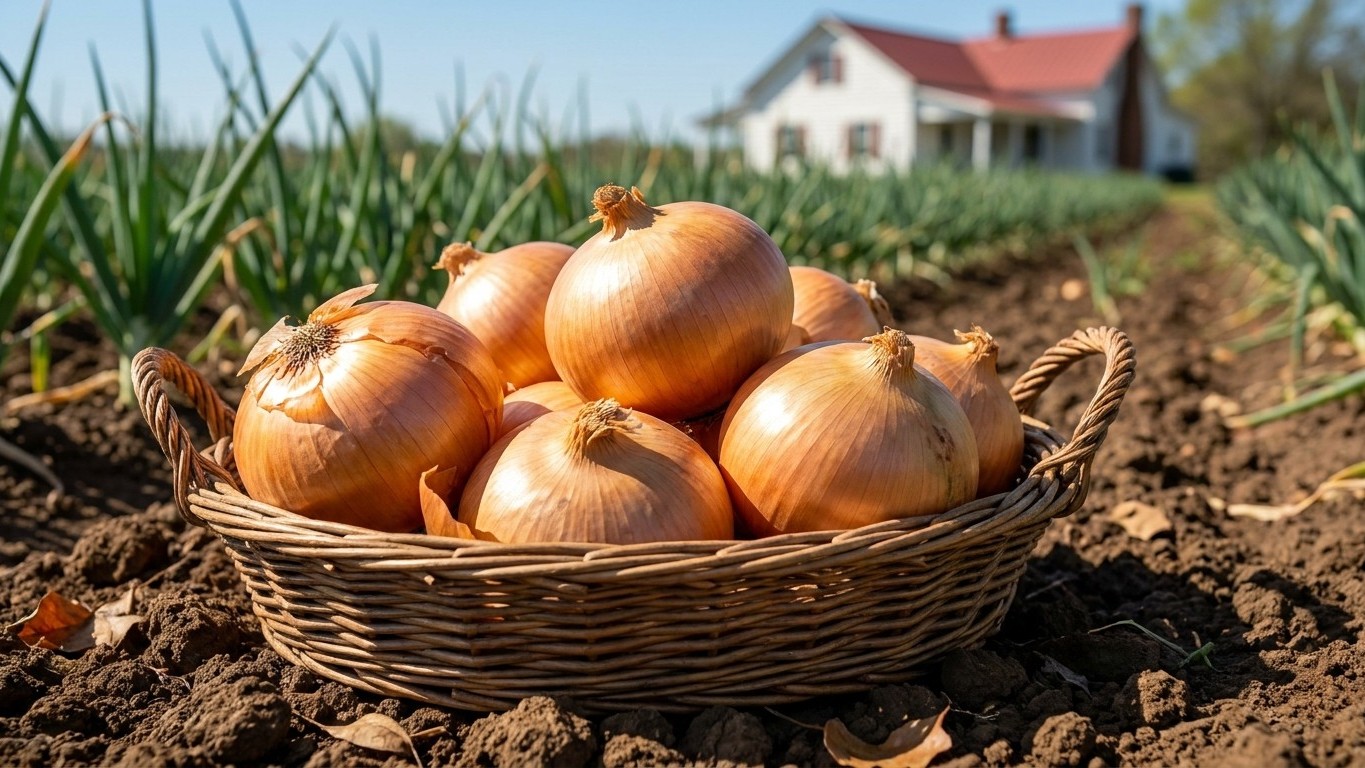

Lift onions once most of the tops have fallen over and turned yellow, and pull them on a dry day. Do not carry them straight to the pantry. Cure them first in a shaded, airy spot until the necks are tight and the outer skins are papery. Only then do they go somewhere cool and dry, between 45 °F and 55 °F with moderate humidity. Skip the curing and even a good keeper onion will rot from the neck down.
Keeping them, and for how long
The bite of an onion comes from volatile sulfur compounds, and those same compounds protect the bulb in storage. University of Missouri Extension states the consequence plainly: “As a rule, ‘sweet’ onions do not store as well as the more pungent types.” A sweet variety carries fewer of these compounds, so it tastes better raw and will not last the winter. Day length lines up with this. Short-day types run sweeter and long-day types keep longer, which is why a southern garden gives you onions to eat soon and a northern one gives you onions that feed you into March.
Tennessee sits in the middle of that split. Nashville, the reference city here, lies at 36.12 degrees north and gets 14 h 28 of daylight on the longest day of the year. Clemson Cooperative Extension says a short-day onion starts bulbing at about 12 hours of daylight. A long-day onion waits for 14 to 16 hours, and Nashville only reaches the bottom of that range around the solstice. So a Tennessee garden ends up with short-day onions that run sweeter and are meant to be eaten first. A reader in the far northeast or along the southern border should check the latitude of their own town, since a few degrees change the day length. The best onion varieties for Tennessee are sorted with that in mind, and the broader season is laid out in Onions in Tennessee.
When are onions ready to lift?
Watch the tops. When the necks soften and the leaves flop over on their own, the bulb has stopped growing. Wait until most of the tops are down and yellowing, then loosen the soil with a garden fork and lift the bulbs by hand. Choose a dry day. Wet soil clings to the skins and carries rot into the neck.
Do not bend the tops over yourself to speed things up. A bulb that is still sizing up needs those leaves. Let the plant do it.
How do you cure onions?
Leave the tops on. Spread the bulbs in a single layer on a screen, a slatted crate or a rack, somewhere shaded, dry and breezy, such as a covered porch or an open-sided shed. Direct sun can scald the bulbs, and a rain-soaked pile will rot. In hot, humid weather, curing takes longer, so a fan helps.
The test is physical. The neck, which is the stem just above the bulb, should be tight and dry, with no give when you squeeze it. The outer skins should be papery and rustle. Once they do, trim the dead tops to a short stub, brush off loose dirt (do not wash the bulbs), and sort. Any onion with a soft spot, a bruise or a damaged neck goes in the kitchen bowl, not the storage crate. Bulbs chewed by pests are the usual entry point for rot, so it pays to know what eats onion in Tennessee, and when.
What conditions keep cured onions, and for how long?
Clemson Cooperative Extension’s Home & Garden Information Center gives the target: “Ideal conditions are between 45 °F and 55 °F, and 50 to 60 percent humidity.” Onions want dry air. That is the opposite of carrots and other roots, which need damp, and it is why one cellar cannot hold both well.
Any storage time you hear for onions is a maximum under those ideal conditions, never a promise. A pungent onion held in that range lasts longest. A sweet one should be used first, soon after curing, and never counted on for winter. Check the crate every couple of weeks and pull any bulb that has gone soft, because one bad onion spoils its neighbors.
Where in the house that actually is
Most homes in the mid-South have no spot that matches 45 °F to 55 °F and 50 to 60 percent humidity all winter, so the job is finding the closest one. Here are the usual candidates:
- Refrigerator: colder than the range, and it shares moisture with everything else in it. Fine for a cut half-onion, a poor home for a crate of bulbs.
- Heated living space: a kitchen cabinet or pantry on an inside wall runs warmer than 55 °F, so the bulbs soften and sprout early.
- Garage: it swings with the weather, from damp and warm in a humid spell to below freezing on a hard January night. Frozen bulbs turn to mush when they thaw.
- Basement or cellar: usually the right temperature in winter, but in hot, humid summers the air is often damp, so it can run over 60 percent.
In practice, the closest match is an unheated interior room: a basement corner with a dehumidifier running, a spare bedroom with the vent closed, or a closet on a north wall. Cold nights in the garage can still work if the crate sits against the shared wall with the house, but the swings make it a gamble.
Then measure. Put a thermometer with a humidity readout beside the crate and read it for a few days before you commit the whole harvest. If you skip it, a basement that feels cool can sit at 70 percent humidity and mold the crop by January. Store the bulbs in mesh bags, open crates or slatted baskets, never sealed plastic, so air moves around them. Keep them away from potatoes, which want it damper.
Common questions
Can I keep whole onions in the refrigerator?
It is a poor choice. A refrigerator is colder than the 45 °F to 55 °F range and tends to be moister than 50 to 60 percent. Use it only for onions you have already cut, wrapped well so the smell stays contained.
Will a sweet onion last through winter?
No. Sweet onions have fewer of the volatile sulfur compounds that protect a bulb in storage, so they keep poorly. Eat them first, within the first stretch after curing, and save the pungent bulbs for later.
How do I know an onion is cured?
Squeeze the neck. If it is tight, dry and has no give, and the outer skins are papery and rustle, the bulb is ready for storage. A neck that is still thick or moist means more curing time.
Can I store onions with carrots or potatoes?
Not for long. Onions need dry air at 50 to 60 percent humidity, while carrots and other roots need damp conditions. In one cellar, one of the crops loses out. If you must share a space, keep the onions on a high shelf in their own open container, as far from the damp crops as you can.