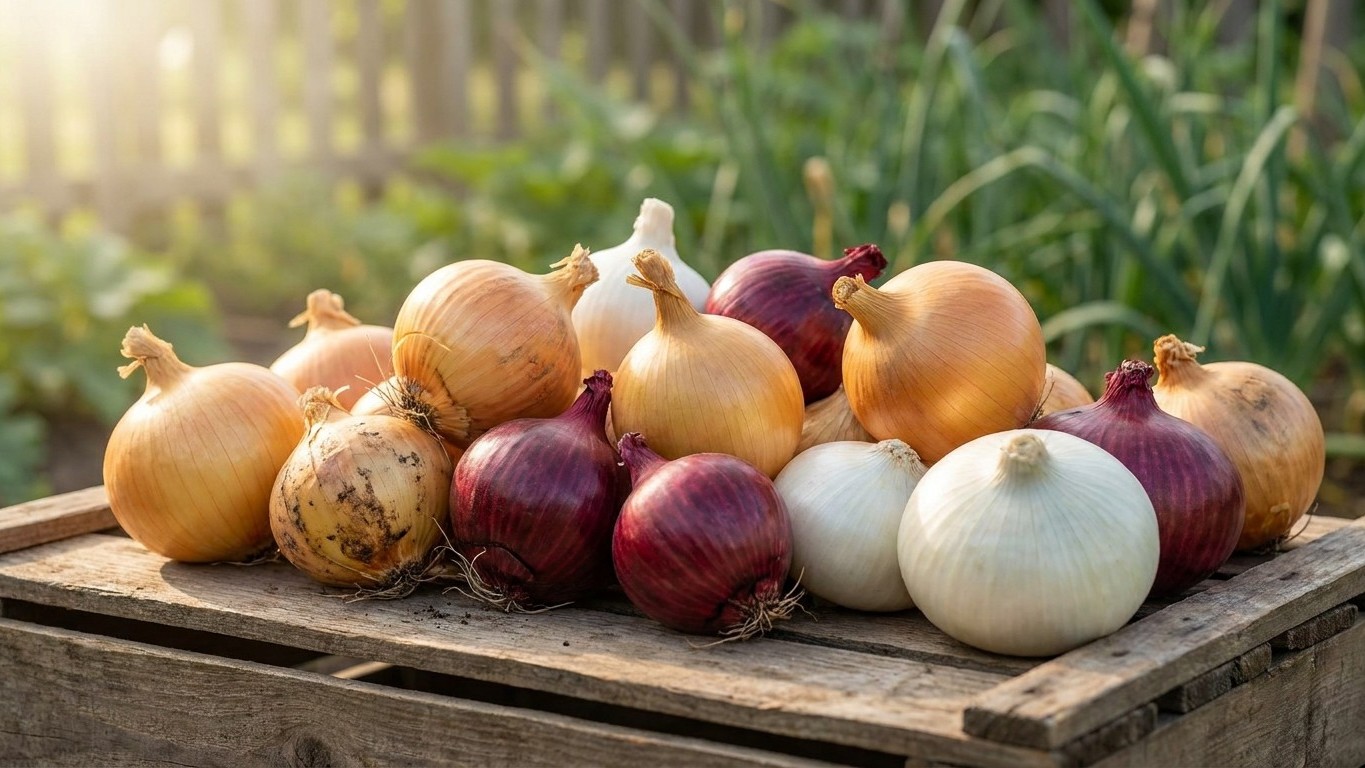

Lift onions when most of the tops have flopped over and the necks have gone soft, then cure them in a dry, airy spot until the necks are tight and the skins papery. Only then do they go into storage. Bulbs that have cured keep best at 45 to 55 °F with the air on the dry side. Western Washington’s wet fall and the drier east side change how and where you do the curing.
Keeping them, and for how long
Clemson Cooperative Extension’s Home & Garden Information Center puts it in one sentence: “Ideal conditions are between 45 °F and 55 °F, and 50 to 60 percent humidity.” That is the range to aim for. Above it, bulbs sprout and soften. Below it, or in damp air, they rot at the neck. Onions want dry air, which is the opposite of carrots and other roots. One cellar can’t hold both well.
How long they last inside that range depends on the onion you grew. Clemson doesn’t promise a number of months, and neither should anyone else. Treat any duration you read as the best case for a sound, well-cured bulb of a keeping variety. A bruised or thick-necked bulb will go in weeks.
The biggest factor is bite. University of Missouri Extension says it plainly in its onion guide (G6355): “As a rule, ‘sweet’ onions do not store as well as the more pungent types.” The reason is chemical. The sharpness of an onion comes from volatile sulfur compounds, and those same compounds help protect the bulb through storage. A sweet onion has fewer of them. It tastes better raw, and it won’t last the winter. No sweet variety stores like a pungent one, so plan to eat the sweet ones first.
Why day length decides what you can store in Washington
Bulbing is triggered by day length, not by warmth. A short-day onion starts to bulb at about 12 hours of daylight, a threshold Clemson publishes. A long-day onion waits for 14 to 16 hours. At the Sea-Tac station, 47.44 degrees north, the longest day of the year runs 15 hours 45 minutes of daylight. That is enough for long-day types, which is why they suit most Washington gardens. If you garden well north or south of Seattle, check your own latitude, because the far edges of a big state get noticeably different day lengths.
Short-day types run sweeter and long-day types keep longer. A Washington gardener who grows long-day, pungent onions can plan on eating from the pantry deep into winter, in a good year as late as March. A short-day sweet onion grown here would bulb small and early and then fade fast in storage. For names that fit this climate, see The Best Onion Varieties for Washington.
One more factor starts in the garden. Bulbs chewed by maggots or scarred by thrips rot first and can spoil their neighbors. What Eats Onion in Washington, and When explains what to look for. Sort damaged bulbs out for the kitchen before anything goes into storage.
Where in the house that actually is
Hitting 45 to 55 °F with dry air sounds easy until you walk around a house with a thermometer. A domestic refrigerator runs colder than onions tolerate, and it is humid inside, especially in the crisper drawer. Onions kept there turn rubbery and sprout. A heated living space is too warm, and a kitchen counter is warmer still. The bulbs will keep for a few weeks, but they will soften and sprout well before spring.
A garage is the usual compromise, and it is the least reliable one. It follows the weather. In eastern Washington, a cold snap can freeze bulbs solid, and a thawed onion turns to mush. In western Washington, the problem is more often damp, still air that invites mold. A garage on a mild day can sit right in the range, then miss it by a wide margin two days later.
The room that comes closest in most Washington homes is an unheated interior space with a steady, cool temperature. That could be a spare bedroom with the heat vent closed, a pantry on a north wall, or a dry closet off a basement. Many basements in the wetter western half of the state are too humid, so don’t assume yours qualifies. A cool, dry room beats a cold, damp one.
Put a thermometer and a hygrometer where you plan to store the onions and read them for several days before you commit the harvest. Skipping that check can cost you the whole crop by midwinter. A basic hygrometer is cheap. If it reads damp, run a small fan for air movement or pick another spot.
Whatever the room, store the bulbs where air can move around them. Use mesh bags, slatted crates, or old nylon stockings with a knot between bulbs. Keep them off a concrete floor and away from apples and potatoes. Potatoes want cooler, moister air than onions do.
When do you lift onions in Washington?
The plant tells you. As bulbs mature, the green tops yellow and fall over on their own. When most of the tops in the row are down and the necks have gone soft, the onions are ready. Don’t bend the tops over by hand to speed things up, because a neck that is still green and thick won’t seal and will rot in storage.
Stop watering once the tops begin to turn so the bulbs dry down in the ground. Then pick a dry stretch to lift. Slide a garden fork under the row to loosen the soil and pull the bulbs gently. Handle them like eggs, because bruises are where rot starts.
Timing runs later in a cool, wet year and earlier in a hot, dry one, so a calendar date is a poor guide. Watch the tops instead, and ask your county extension office about local timing if you plant at higher elevations.
How do you cure onions before storing them?
Curing dries the neck and the outer skins so they seal the bulb. Spread the onions in a single layer on screens, racks, or a table, with tops still attached. They need warm, dry, moving air and no direct sun, which can scald the skins.
On the drier east side, an open shed or shaded porch usually works. In the damp west, a rainy week can ruin a harvest laid out under an open sky, so cure under cover in a garage, a covered porch with open sides, or a spare room with a fan. A few weeks is typical, though a wet fall stretches it out.
The onions are cured when the necks are tight and dry, with no give when you squeeze them, and the outer skins are papery and rustle in your hand. Roots should be shriveled. Trim the roots, cut the tops back to a short stub, and brush off loose soil without peeling away the good skins. Eat any bulb with a thick, green, or damp neck first. It never sealed, so it won’t keep.
Common questions
Can I store sweet onions through the winter?
Not reliably. Sweet onions have fewer of the sulfur compounds that protect a bulb in storage, so they spoil sooner than pungent types. Cure them well, keep them cool and dry, and eat them first.
Can I keep onions in the refrigerator?
A whole, cured onion does better in a cool, dry room than in the fridge. The fridge is colder than the range onions prefer and holds more moisture. Once you cut an onion, wrap it and refrigerate it.
How do I know an onion is cured?
The neck is tight and dry, the outer skins are papery, and the roots are shriveled. If the neck is still thick or moist when you squeeze it, give it more time in dry, airy conditions.
Can I store onions near potatoes?
Keep them apart. Potatoes want cooler, moister air, and onions want 50 to 60 percent humidity. Put them in separate containers, ideally in different parts of the house.