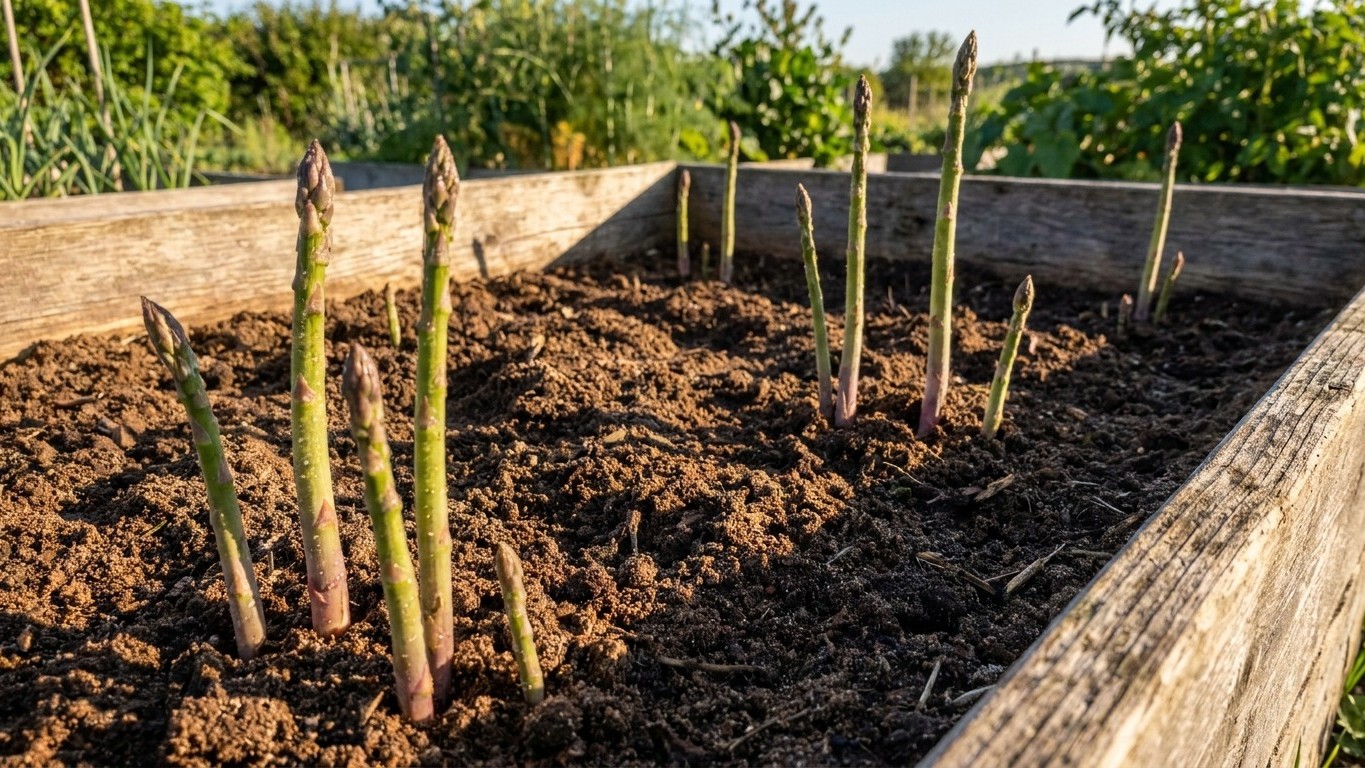

Cut asparagus until most of the spears coming up are thinner than a pencil, then stop and let the ferns grow. That rule holds every year, but only once the bed is old enough, because nothing gets cut before year 3. After the cut, the spears keep best cold, wet at the butt end and out of the kitchen’s warmth. Storage conditions decide whether they are still tender when you cook them.
When do you stop cutting asparagus?
Asparagus is planted as crowns in 8-inch furrows in early spring. Utah State University Extension is firm on the next part: the bed is not harvested until year 3. It then produces for 10 to 15 years. The first two years belong to the plant. Every spear left alone becomes a fern, and the ferns feed the crown that will carry the bed for a decade or more.
How long is the cutting season each year?
Cutting continues in the years after that. The bed then keeps producing for years. Those weeks are the length of the season, and the spears themselves give the signal to quit. When most of the spears coming up are thinner than a pencil, stop cutting, even if the weeks have not run out. Thin spears mean the crown is running low on stored energy.
The furrow fills in gradually. Backfill the furrow gradually across the year, never all at once, until it is level. Filling it in one pass can smother crowns that have barely started to push.
What should the bed do after the last cut?
Let every remaining spear open into fern. Across the Nevada desert the summer is nearly rainless. The reference station recorded about 0.7 inches across June, July and August, with June at just 0.04 inches, July at 0.38 and August at 0.32. That is a normal for one station over a stretch of years, so a rain gauge on your own plot settles what your bed gets. The state’s representative soil, the Orovada series, is sandy (66 percent sand) and well drained, so even those small rains pass through quickly. Expect to water a fern bed on a regular schedule through the hot months. Your own ground may differ from the state soil, and a soil test gives your number. The guide on Will Nevada Soil Hold an Asparagus Bed for Fifteen Years? covers what to do when drainage is poor.
Standing ferns also draw insects, so check them now and then. What Eats Asparagus in Nevada, and When lists what to look for. For the full planting picture, start with Growing Asparagus in Nevada.
Keeping it, and for how long
Once a spear is cut, it has no roots and no supply of water, so the clock starts. The UC Davis Postharvest Technology Center gives the optimum for green asparagus as 0°C to 2°C, which is 32°F to 35.6°F, with relative humidity of 95 to 100 percent. That band is only 3.6 degrees wide. High humidity matters because it keeps the spears from drying out, and the cut end loses water faster than any other part.
Both edges of the window do damage. Spear toughening occurs rapidly above 10°C (50°F), and a kitchen counter sits well above that. At -0.6°C (30.9°F) or lower, freezing injury sets in. The spears take on a water-soaked look and then go extremely soft. So the target is cold without freezing and wet without sitting in standing water over the tips.
Duration is where people get misled. The longest keeping time anyone quotes for asparagus assumes that exact cold, humid room. A home refrigerator rarely matches it, so treat any storage period as a ceiling that your setup will fall short of. Plan to eat the spears soon after cutting.
Three signs tell you the ceiling has been hit. The tips go limp or slick, the butts look dry and shriveled, and a spear bends instead of snapping when you flex it. Spears that have toughened will not recover, and cooking will not fix them. Spears that were frozen and thawed turn soft, so skip the coldest corner of the fridge too.
Cut early in the day, while the spears are cool, and get them into the cold within a short time. A basket left in a sunny kitchen or a hot car passes 50°F quickly in the low desert, where spring days warm fast. Across the state’s cooler valleys and high ground the spring starts later, so cutting happens at a different time of year, but the same rule on warmth applies.
Where in the house that actually is
A domestic refrigerator runs warmer than the 32°F to 35.6°F window, and the door runs warmer still. Every time the door opens, the shelves on it swing with the kitchen air. Skip the door for asparagus. The shelf that comes closest is the lowest main shelf toward the back, where the air is coldest and steadiest. A cheap fridge thermometer set there tells you more than guessing. If the spears turn glassy or water-soaked, they are touching the back wall or sitting in a spot that dips below 30.9°F. Move them forward a few inches.
Humidity of 95 to 100 percent is far more than the open air of a fridge holds. Producing it at home is simple. Stand the spears upright with the cut ends in about an inch of water in a jar or a tall container, and change the water if it clouds. Skipping that step costs you the most, because the cut end dries out faster than anything else. Then drape a loose plastic bag over the tips. The bag holds humidity around the spears without sealing them tight. If a jar will not fit, wrap the butts in a damp paper towel and slip the bundle into a bag with the tips poking out.
The crisper drawer can help if it closes and you set its humidity slide to high. It is usually cooler than the door and holds moisture better than an open shelf. Spears lying flat in it can still dry at the cut ends, so the damp wrap or the jar still applies.
Common questions
Can I cut asparagus the year I plant the crowns?
No. Utah State University Extension says the bed is not harvested until year 3. Cutting earlier takes the energy the crown needs to build a root system for the next 10 to 15 years of production.
Which variety should I plant?
Sex is the one difference to plan around. Do not assume anything about flavor or yield from the name, and ask your county extension office what grows well locally.
Can I leave cut spears on the counter for an hour or two?
You can, but they toughen rapidly above 50°F, and a kitchen is well above that. Put them in the fridge as soon as you can, cut ends wet. Spears that sit warm for long will be tougher than ones that went straight into the cold.
Does the Las Vegas spring frost date apply across Nevada?
No. At the Las Vegas reference station, NOAA NCEI shows the last 32°F freeze falling between January 7 and February 1 across the 30 to 70 percent probability band. That airport sits in a desert urban heat island. Reno, Carson City and anywhere at elevation freeze later in spring and start earlier in fall. Your county extension office can give your local range.