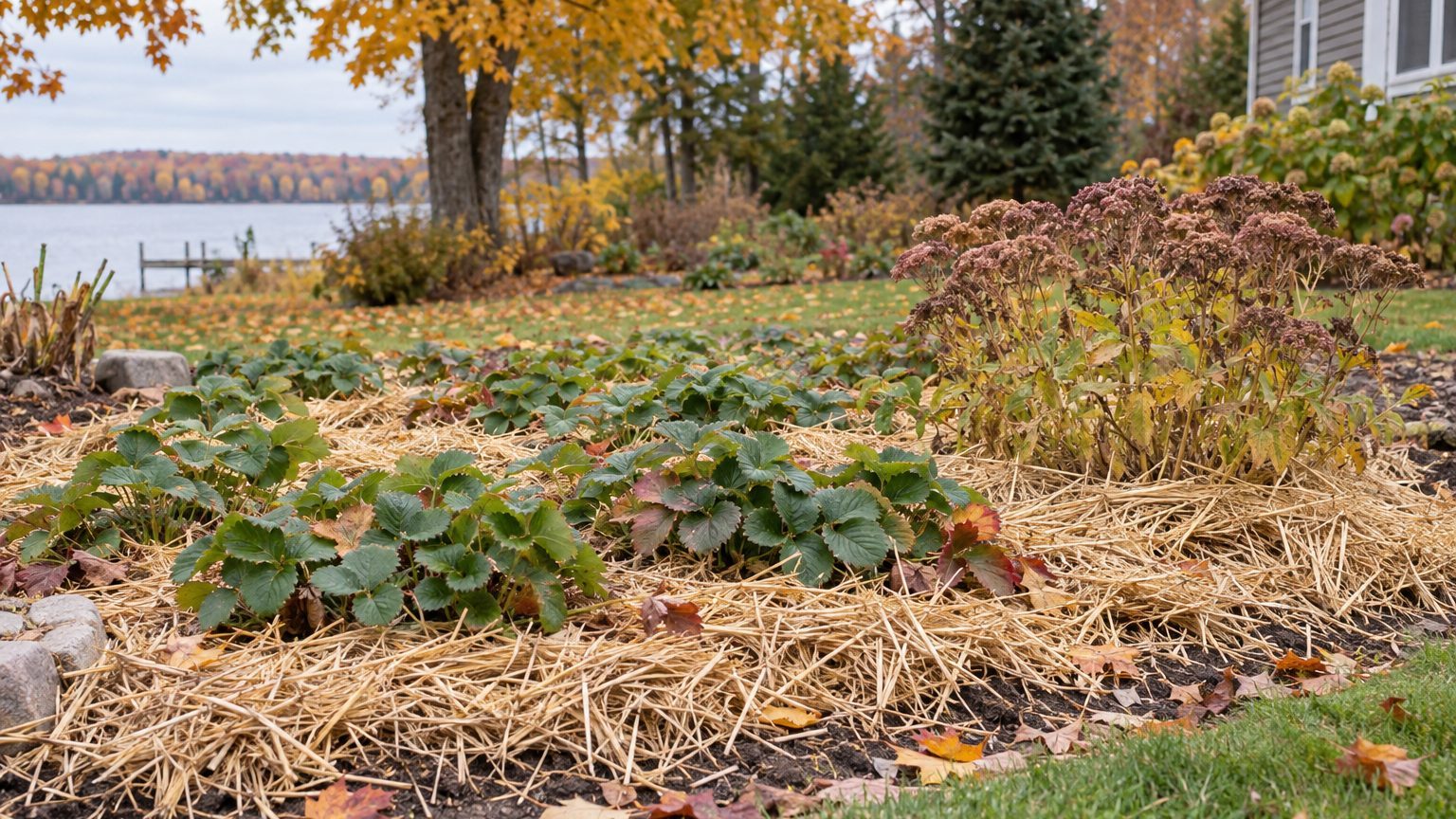

Wait until the ground starts to freeze. At Little Rock, the first fall freeze arrives between November 7 and November 20, and winter mulch goes down in the weeks after that, which usually means late November into December. Strawberries get a loose layer of clean straw over the crowns. Borderline perennials get a ring of mulch that stops short of the stems. Spread it in October and you hold warmth against the plants. Plant-by-plant detail follows, and the Arkansas guides cover timing for other parts of the state.
When to put winter mulch down in Arkansas
The first frost is the date most gardeners remember, and it is the wrong cue for mulching. NOAA’s NCEI 1991-2020 Climate Normals for Little Rock (station USW00013963) put the first fall 32°F freeze somewhere between November 7 and November 20, the band where the odds of a freeze having occurred run from 30 to 70 percent. That marks the start of cold weather. Mulch goes on after the ground has started to freeze, in the weeks following the November 7 to November 20 freeze window.
Why does winter mulch go on after the first freeze?
Winter mulch acts as a thermostat for cold ground. It keeps soil that is already chilled from thawing and refreezing, and it cannot do that job over warm soil. Mulch laid in October holds the summer’s heat in, keeps the surface damp, and gives mice and voles a dry shelter while the plants above are still green. Crowns that should be hardening off stay soft and wet instead.
Cold in Arkansas comes in pulses. NOAA’s 1991-2020 Climate Normals list the mean daily minimum of the coldest month at Little Rock as 30.9°F, just under freezing. Nights dip below 32°F and afternoons climb back above it. That daily swing is what lifts shallow-rooted plants out of wet soil, and a settled layer of mulch smooths it out. A long, solid freeze is the exception here. The mulch earns its keep mostly on the nights when a hard snap follows a mild spell.
Is winter mulch needed everywhere in Arkansas?
Not equally. The USDA Plant Hardiness Zone Map 2023 places the state across 6b to 8a, a system built on one number: the average annual extreme minimum temperature. Northern Arkansas and higher ground sit colder than Little Rock, with an earlier first freeze, so fall mulching moves earlier there. The southern part of the state runs milder and later. Established, hardy perennials in the milder areas often get through winter without help. Strawberries and new plantings still gain from a layer almost everywhere.
Your own county’s dates may differ from Little Rock’s, and First and Last Frost Dates in Arkansas lays them out. Tender plants run on a tighter calendar. NWS Little Rock gives April 3 to October 31 as the stretch between the 36°F light-frost dates, so row covers for basil and peppers belong near the end of October. Covers are for the plants that must stay green. Mulch waits for the ground.
Strawberries
Strawberries gain more from winter mulch than almost anything else in an Arkansas yard. The crown sits at the soil surface, and it holds next spring’s flower buds. Cold by itself seldom kills it in a climate where the coldest-month mean minimum at Little Rock is 30.9°F (NOAA NCEI Climate Normals 1991-2020). The damage comes from soil that freezes and thaws over and over, which pushes crowns upward and snaps fine roots, and from a bare crown taking a sharp, dry cold snap with nothing over it.
What should you use to mulch strawberries?
Clean wheat or oat straw is the standard. Buy bales sold as straw, because hay carries seed and fills the bed with grass by April. Pine needles work too and stay springy. Whole oak and maple leaves are a poor choice, since they pack into a wet mat against the crown, which is the opposite of what you want. Shredded leaves are better than whole ones but still hold more water than straw.
How deep should straw be on strawberries?
NC State Extension’s Gardener Handbook says, “A 2-inch to 3-inch layer of mulch suppresses most annual weed seeds and makes it easy to hand-pull any that do germinate.” Straw is fluffy and settles over the winter, so that range fits well. Cover the crowns and fill the space between plants, and stay inside the range. A deeper pile mats down, holds water, and smothers the crown it was meant to protect. The full text is in the NC State Extension Gardener Handbook.
Spread 2 to 3 inches of clean straw over the crowns after the ground has started to freeze, late November into December. Check that the plants have gone dormant first. Outer leaves darken and the plant stops pushing new growth. Details on beds, spacing, and fall care are in Growing Strawberries.
When do you pull strawberry mulch back in spring?
Pull it off the crowns when new leaves show yellow-green at the center. Rake the straw into the aisles, where it keeps berries clean and weeds down. Keep it close at hand, because NWS Little Rock’s 36°F light-frost season ends around April 3, and strawberries bloom early. On a frost night, drape straw or a cover over the plants in the evening and take it off the next morning.
Perennials and borderline plants
Most hardy perennials need little winter help in Arkansas. A few groups do benefit. Plants set out this fall have not grown the roots to hold themselves down. Shallow-rooted perennials heave out of wet clay as it freezes and thaws. Plants rated near the edge of the local USDA zone get the most protection from a layer of mulch. Check the tag against the zone map for your county, which runs from 6b to 8a across the state, before deciding which of your plants count as borderline.
| Plant group | Why mulch helps | What to do |
|---|---|---|
| Perennials planted this fall | Roots are shallow and the soil around them is loose, so freeze and thaw can lift them | Mulch after the ground starts to freeze, then press any heaved plant back in |
| Shallow-rooted plants such as coral bells and garden mums | Wet clay heaves the crowns out of the ground | Add a ring of mulch and leave the foliage uncovered |
| Borderline herbs such as lavender and rosemary | Wet crowns and cold wind do more harm than cold alone | Mulch the outer root zone lightly and keep the stems clear |
| Established hardy perennials | Little added protection | Skip it, or apply a thin layer for moisture and weeds |
How do you mulch perennials without smothering the crown?
Make a ring, not a pile. Keep a visible gap of bare soil around the crown or stems, so the plant can shed water and the base stays dry. Mulch piled against a stem holds moisture where bark and buds are most exposed, and it hides the gnawing of mice. NC State Extension’s handbook advises, “Provide a 3-inch layer of mulch to reduce water loss and maintain uniform soil moisture and temperature around roots.” That sentence is written about trees, and it gives the same order of depth as the 2- to 3-inch weed-suppression range. Spread 2 to 3 inches in a ring after the ground starts to freeze, late November into December, with the crown left open.
Shredded bark, pine needles, and chopped leaves all work. Evergreen perennials keep their leaves, so lay the mulch around them and leave the foliage uncovered. Lavender and rosemary resent wet feet, so they get the lightest touch, with more guidance in Getting Perennial Herbs Through the Winter. A fuller look at depth and placement is in Mulching Without Killing the Plant.
What goes wrong
Winter mulch fails in a few predictable ways, and each one leaves visible signs by midwinter.
What happens when you mulch too early?
Mulch spread over warm October soil keeps the ground damp and mild. Crowns stay soft, and fungal rot gets a start in the humid Arkansas fall. Look for crowns that are brown and mushy when you peel a bit of mulch back, or leaves that stay green and floppy while neighbors have gone dormant. The fix is to wait. Mulch goes on after the first freeze (Little Rock’s window is November 7 to November 20) and once the ground has started to freeze.
Why does mulch mat and rot crowns?
Whole leaves and wet grass clippings pack into a dense sheet. Winter rain keeps it soggy, and air cannot reach the crown. A slick, gray layer that sticks together when you lift it is the sign. Use straw, pine needles, or shredded bark instead, keep the layer within 2 to 3 inches, and fluff it with a fork after a long wet spell.
Do voles nest in winter mulch?
They can. Voles and mice take shelter in deep, dry mulch and chew bark and crowns through the winter. Small runways and holes at the edge of a bed give them away. Thin the mulch to the 2- to 3-inch range, keep it back from stems and trunks, and cut tall grass around the bed so there is less cover nearby.
What if you forget to uncover in spring?
Plants smothered by mulch grow pale, thin, and late, and strawberry crowns under heavy straw rot or bloom weakly. Pull the mulch back from the crowns when new growth shows, late March to early April. Keep the straw nearby for frost nights, since NWS Little Rock’s 36°F light-frost season ends around April 3. Colder northern parts of the state thaw later, so uncover there when the soil has thawed.
Common questions
Can you mulch strawberries in October?
Mulch laid in October goes over warm soil and invites rot and rodents. Wait for the ground to start freezing, in the weeks after the first fall freeze (Little Rock: November 7 to November 20). October 31 marks the 36°F light-frost date from NWS Little Rock, and that date calls for covering tender plants, not for spreading mulch.
What is the best winter mulch for Arkansas gardens?
Clean straw suits strawberries, and shredded bark or pine needles suit perennial rings. Whole leaves mat and rot. Stay within the 2- to 3-inch range from NC State Extension for every material.
Do established perennials need winter mulch?
Hardy, well-rooted perennials usually get through without it, especially in the milder southern part of the state. New plantings, shallow-rooted plants, and anything rated at the limit of the local USDA zone benefit from a ring. Your county extension office can tell you how local winters have run.
Is the timing the same in other states?
The rule travels, but the calendar dates change with local frost dates. For comparison, see winter mulch in Alabama and winter mulch in New Mexico. Even inside Arkansas, a northern county with an earlier first freeze mulches earlier in the fall and uncovers later in spring than a southern one.