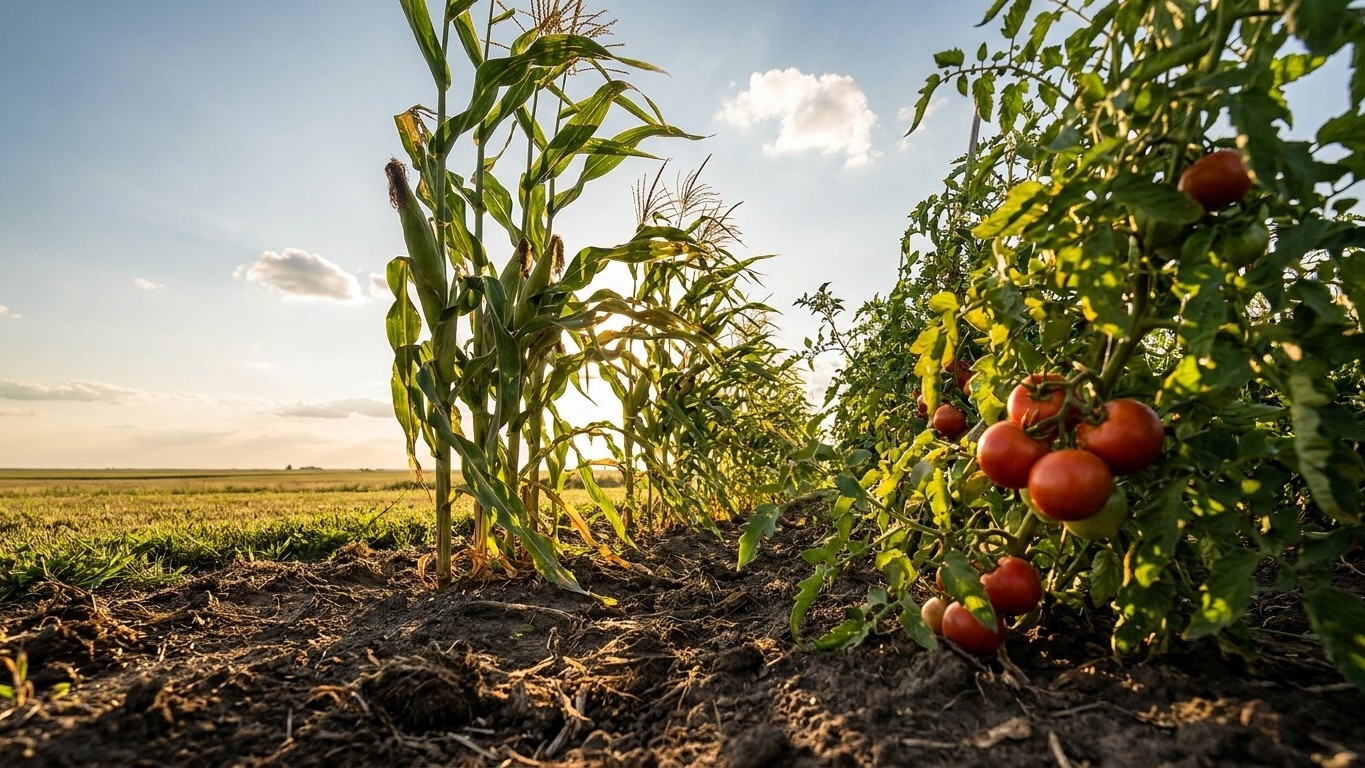

Sweet corn is ready when the silks have dried brown, the husk is still green and moist, and a punctured kernel runs milky. For spring plantings around Oklahoma City, that usually means late June into July. The peak is short, though. Sugar starts leaving the kernel the moment the ear is picked, and heat speeds the loss, so the best corn goes from stalk to cold storage to table with no detours.
When sweet corn are ready in Oklahoma
Check the ear, not the calendar. Dry brown silks, a husk that is still moist and green, and milky juice when you puncture a kernel with a thumbnail must all be true at once. Those signs arrive as the kernels fill and the silks dry down, which puts spring-planted corn around Oklahoma City in the heat of summer.
That count answers one question: which week to pick. A separate clock answers whether the crop fits the season at all. Sweet corn needs 60 to 90 days from planting, according to Utah State University Extension, and those days have to fit between warm soil and the first fall frost. The two figures should never be added together or swapped.
Which dates fit Oklahoma frost and soil temperature?
At the Oklahoma City airport reference station, NOAA’s NCEI climate normals put the last spring freeze between March 28 and April 10, and the first fall freeze between October 29 and November 8. Those are the 30 to 70 percent probability band for a 32 F freeze. Suburban and rural gardens usually see the last spring frost later and the first fall frost earlier, often by one to two weeks, and more at higher elevation. Your county extension office can tell you how far your ground sits from the airport.
The last frost is not the planting date. Soil warms well after it, and corn cares about the soil. Utah State University Extension says sweet corn needs soil above 60 F. Clemson Cooperative Extension is more specific about how to measure: “Do not plant before the soil temperature at the 4-inch depth is at least 50 ºF. Wait to plant extra-sweet varieties until soil temperatures reach 65 °F.” A surface reading runs warmer than the 4-inch depth, so push the thermometer down before you trust it.
The two thresholds are not interchangeable. Ordinary sweet corn goes in at 50 F. Extra-sweet (sh2) seed sown into soil at that temperature rots instead of sprouting. That explains why a gardener can have a good stand one year, switch to an extra-sweet type, and lose the row the next.
The far end of the season matters too. A 90-day type sown late has to finish before the fall freeze window, and in a rural garden that window opens one to two weeks earlier than at the airport. At the reference station, 70.7 days a year reach 90 F or more, so corn silking in July is working through real heat and needs steady water. For a planting calendar built on these numbers, see When to Sow Sweet Corn in Oklahoma.
Does what the neighbors plant change the sweetness?
It does, and climate has nothing to do with it. Utah State University Extension warns that sweetness is lost if su, se and sh2 types tassel at the same time. The source gives no separation distance, so the useful rule is about timing. Keep the types from tassel-shedding together by sowing them on different schedules, or grow a single type. Plant in blocks of three or more rows rather than one long single row, which also helps pollination.
Keeping them, and for how long
Clemson Cooperative Extension’s Home and Garden Information Center states the problem plainly: “Sweet corn loses sugar from the kernel rapidly at high temperatures… Sweet corn can be stored under optimal conditions for about five days, but will lose sweetness with each day of storage.” This is the real reason behind the old advice to run from the garden to the pot. The sugar leaves the kernel, and heat hurries it out.
Read that sentence closely. About five days is a ceiling under optimal conditions, and the loss starts on day one. An ear picked in the morning and left on a kitchen counter in July is already behind. A reference station that logs 70.7 days a year at 90 F or more tells you what an ordinary Oklahoma summer counter, porch or truck bed can do to a bag of ears.
The practical rule in words is cold and moist, and quickly. Get the ears out of the sun and into cold storage soon after picking, and plan the meal for the first couple of days instead of the fifth. Ears with damage at the tips are worth eating first. What Eats Corn in Oklahoma, and When explains what chews on them and when it shows up.
Which type of sweet corn keeps its sugar longest?
The genetics of the seed change how fast the sweetness drains. Type su loses sugar fastest. Type se holds it longer, and sh2 holds it longest. That is the practical reason to choose one type over another, and the packet usually says which one you are buying.
If you grow a lot, or you pick on a Saturday for a Wednesday dinner, an sh2 type buys you margin. It also asks more of the garden. It wants warmer soil at planting (65 F at 4 inches, as Clemson says), and it must not tassel at the same time as the su and se types nearby. A long storage life does not cancel the five-day ceiling. It only slows the slide.
If you grow su or se types, the clock is tighter. Pick what you will eat in the next day or two, and leave the rest on the stalk until you need it. The plant is a better holding place than the refrigerator, as long as the three ripeness signs still read right and you check the ears every day or two once the silks brown.
Where in the house that actually is
A heated room is too warm for sweet corn, and the kitchen counter is the worst offender in summer. The garage is not much better. It follows the weather, so a bag of ears can sit in a cool morning and then bake through an afternoon that reaches 90 F, the kind of day the reference station sees 70.7 times a year. Swings like that undo whatever the cold did overnight.
The refrigerator comes closest to the cold, moist conditions the university describes. Some crops cannot take a modern fridge, because it runs colder than they tolerate. Sweet corn is not one of them. The crisper drawer is usually the best spot, since it holds more humidity than the open shelves, and the ears sit steady instead of riding a door that opens twenty times a day.
How do you check a spot with a thermometer?
Fridges drift, and a drawer can run a few degrees off the dial. Put an appliance thermometer in the crisper drawer for a full day before the first ears come in, and read it morning and evening. If the readings wander upward, move the corn to the back of a shelf, away from the door, and recheck. Skipping this step is how a careful gardener ends up with ears that taste flat by day three and no idea why.
Humidity matters as much as temperature. A drawer that has dried out pulls moisture from the husk, and a husk that has gone limp is one of the signs of an ear past its best. A loose bag around the ears holds moisture without sealing it in tight, and a quick look every day tells you how the drawer is behaving. The goal is a spot that stays the same from morning to night, because steady cold slows sugar loss more reliably than a fridge that is sometimes very cold and sometimes not.
For the full season, from seed to table, Growing Sweet Corn in Oklahoma pulls the pieces together.
Common questions
How can I tell sweet corn is ripe without pulling the husk back?
Use three signs together. The silks should be dry and brown, the husk should still be moist and green, and a punctured kernel should run milky. One sign alone can mislead you. Watch the silks dry down and the kernels fill to tell you when to start checking.
Is the last frost the day to plant sweet corn?
No. Soil warms well after the last frost. Ordinary sweet corn goes in once the soil at the 4-inch depth is at least 50 F, and extra-sweet types wait until it reaches 65 F. The reference station’s last spring freeze falls between March 28 and April 10, but your own county may run one to two weeks later.
Does an extra-sweet type give me more time to eat the corn?
It gives some. Type sh2 holds sugar longest, se holds it longer than su, and su loses it fastest. Clemson Cooperative Extension still describes about five days as the most you can expect under optimal conditions, with sweetness fading each day.
Can a late planting finish before the first fall freeze?
Only if the 60 to 90 days from planting fit before it. At the reference station the first fall freeze falls between October 29 and November 8, and gardens outside the city often see it one to two weeks sooner. A 90-day type needs to be in the ground roughly three months ahead of your local date, so ask your county extension office when that frost usually arrives where you live.