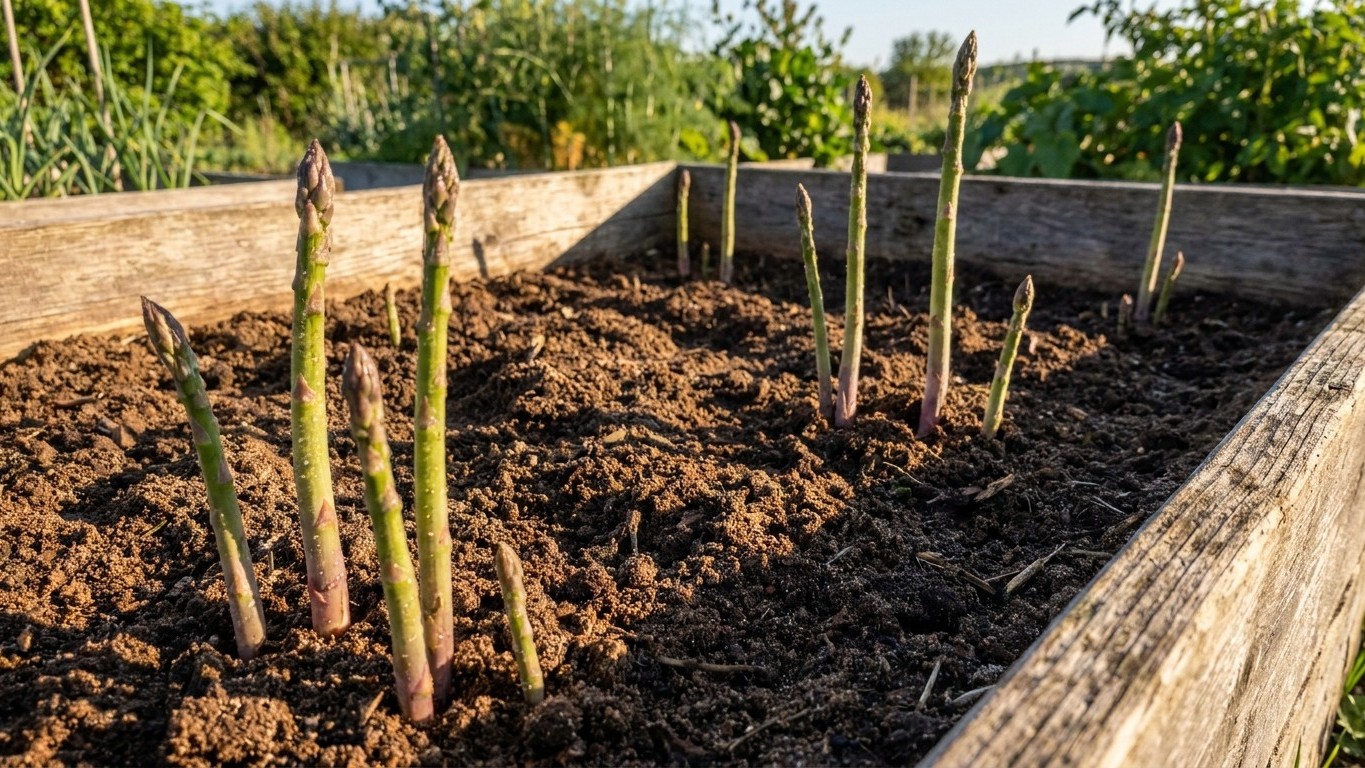

Stop cutting when most of the spears coming up are thinner than a pencil. That signal matters more than any date on the calendar. Spears you do cut need cold, wet air to stay tender: 32°F to 35.6°F with near-saturated humidity, and little room for error on either side. Here is how those numbers play out in a Virginia kitchen, and how the season ends in the garden.
Keeping it, and for how long
What temperature and humidity keep asparagus spears best?
The UC Davis Postharvest Technology Center gives the optimum for green asparagus as 32°F to 35.6°F (0°C to 2°C), with relative humidity of 95 to 100 percent. That is colder and wetter than most people think of as normal refrigerator air. A spear is a stem cut off from its roots. It keeps breathing and keeps drying out, and the cold and the moisture slow both.
The window has an edge on each side, and both bite. UC Davis reports that spear toughening occurs rapidly at temperatures above 50°F (10°C). On a warm counter, in a truck cab, or in a grocery bag left in the car, that can happen within hours. On the cold side, freezing injury shows up at 30.9°F (-0.6°C) or lower. The spears take on a water-soaked look and turn extremely soft, and they collapse once they thaw. The target sits in the cold part of that range, a few degrees above freezing.
Humidity matters as much as temperature. UC Davis states that high relative humidity prevents desiccation, and the cut end loses water faster than any other part of the spear. A spear in dry fridge air shrivels from the butt up, and the tips go limp and wrinkled. Cold alone does not stop that.
How long will cut asparagus last?
Any storage time quoted for asparagus is a ceiling that assumes the optimum from the start. That means spears cooled soon after cutting and held at 32°F to 35.6°F in near-saturated air the whole time. Every hour on a warm surface comes off the total, and a home refrigerator usually runs warmer than the optimum. Plan on using garden spears soon after you cut them rather than counting on a long shelf life.
Store-bought spears have already spent part of their time in transit and on display, so they have less left than yours. A simple freshness test works for either source: a good spear snaps cleanly near the butt and has tight, closed tips. If it bends without breaking, it has started to toughen and dry.
Move cut spears from the bed straight into the cold. Don’t leave them on the porch rail, and don’t lay them in a sunny basket while you finish the row. Carry a bucket with a little water in it so the butts are wet from the moment they are cut.
Where in the house that actually is
Which fridge shelf is closest to the optimum?
A household fridge runs warmer than 35.6°F in most spots, and the door is the warmest place of all. It swings every time someone grabs the milk. Keep asparagus off the door shelves entirely. The lowest shelf toward the back is usually the coldest part of the main compartment, so that is the best bet. An inexpensive appliance thermometer left there overnight will tell you what your fridge is really doing.
Check the other edge too. Some refrigerators run cold enough at the back wall that a spear pressed against it can dip toward the freezing injury point of 30.9°F. If you find water-soaked, glassy-looking spears that went limp, that is the likely cause. Pull them a few inches away from the wall, or move up a shelf.
The crisper drawer can work well if you close its humidity slider, which holds moisture in. It is not a guarantee, because the drawer’s air is only as cold as the fridge around it. Treat the thermometer reading as the deciding fact.
How do you get 95 percent humidity in a home refrigerator?
You don’t get the full range in an open fridge, and you don’t need to. Two habits do most of the job. The first is to give the cut ends water. Trim a sliver off the butts, then stand the spears upright in a jar with the cut ends in water, the way you would a bunch of flowers. Skipping this step costs you the tenderness, because the butts lose water faster than anything else on the spear. A damp paper towel wrapped around the butts is a second-best version of the same idea.
The second habit is to enclose the tops loosely. Slip a plastic bag over the jar, open at the bottom or gathered loosely so the air is not sealed tight, and the tips stay in humid air. Don’t soak the whole spear and seal it wet. Standing water on the tips invites slime. The aim is wet butts and damp air around the heads.
Change the jar water if it clouds, and keep the jar on that low back shelf. A tall jar can block a shelf, so a shorter pitcher with spears trimmed to fit works fine.
When should you stop cutting asparagus in Virginia?
How long is the harvest each year?
Utah State University Extension describes the schedule plainly. Crowns go in as early spring plantings in 8-inch furrows, and nothing is harvested until year 3. After that the bed produces for 10 to 15 years. Taking a few spears earlier than year 3 does not help the bed. The crowns are still building the root mass that will carry the harvest for a decade or more.
The furrow is filled in gradually across the first year, two inches every other month, rather than all at once. That lets the young shoots keep reaching the light as the soil rises around them.
How do you know it’s time to stop?
The end of the season is marked by an object, and the object is a pencil. When most of the spears coming up are thinner than a pencil, stop cutting. Thin spears mean the crown’s stored energy is running low. Leave every spear from that point on, and let them open into ferns. Those ferns are what refill the crown for next year. A bed cut past that signal pays for it in thinner, fewer spears the following spring.
Spring warmth arrives on different schedules around the state. At the coastal reference station near Virginia Beach (NAS Oceana), NOAA NCEI climate normals put the last spring freeze between March 20 and April 3. That is the mild end of the state. The Blue Ridge and southwest Virginia run weeks later in spring and earlier in fall, so their cutting seasons start later. The pencil rule works the same everywhere, because it reads the plants rather than the date.
What does the bed need after cutting stops?
Water, for one thing. NOAA’s normals for that same coastal station show about 15.0 inches of rain across June, July and August, out of 46.6 inches for the whole year. June is the driest of the three at 4.15 inches, then July at 5.76 and August at 5.09. Those are what the region can usually expect, not a forecast, and they don’t settle anything alone. A thunderstorm on a hot day mostly runs off. Sandy ground drains an inch of rain in a day, while clay holds it for a week. A rain gauge on your own plot will tell you what the ferns are actually getting. Keep an eye out for beetles on the ferns as well, which is covered in What Eats Asparagus in Virginia, and When.
Soil decides whether the bed lasts. Virginia’s representative state soil, the Pamunkey series, is a well-drained loam to silt (50 percent sand, 11 percent clay, 39 percent silt) with about 1.2 percent organic matter, which tends to suit a crop that dislikes wet crowns. Your own ground may be nothing like it, since river bottoms, hill country and scraped building lots differ widely. Asparagus is a fifteen-year decision, so test your soil and check drainage before planting. The full picture is in Will Virginia Soil Hold an Asparagus Bed for Fifteen Years?, and the broader how-to is in Growing Asparagus in Virginia.
Common questions
Can I cut a few spears before year 3?
No. Nothing is harvested until year 3. Letting the early spears grow into ferns builds the crown that pays you back for 10 to 15 years.
What if my spears are all thin from the start of the season?
If most of the spears are thinner than a pencil as soon as they emerge, the bed is telling you to stop already, or to cut fewer weeks the next year. Check drainage, since a bed that stays wet will struggle. Your county extension office can help sort out whether the cause is soil, age, or too long a cutting season.
Why did my asparagus turn mushy in the fridge?
Freezing is the likeliest cause. UC Davis reports that freezing injury, a water-soaked look followed by extreme softening, will likely result at 30.9°F or lower. Spears pushed against the back wall of a cold fridge can get there. Wilted, wrinkled spears are a different problem, usually dry air at the cut ends.
Does the variety I plant change how the spears keep?
Nothing in the Utah State University Extension list ties a variety to storage. Beyond that, a name does not tell you which tastes best or yields most, so ask your county extension office what grows well locally. Storage comes down to the cut end in water, a cold back shelf and a loosely bagged top, whatever the variety.