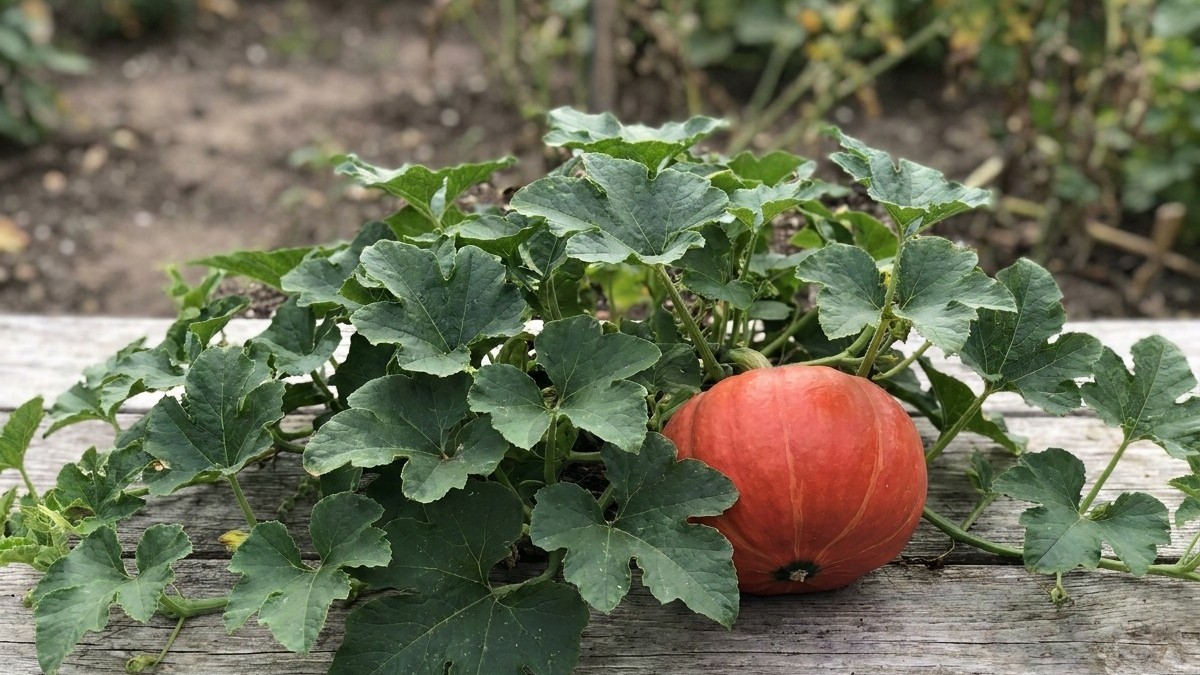

Cut a pumpkin when the rind is hard, the color is deep and even, and the stem has dried and turned woody. In the low desert no reliable fall freeze sets a deadline, so the plant has to tell you. Stored whole in a cool, dark spot between 45 and 50 F, a pumpkin can keep three to six months at best. The rest of this article covers how to read the signs and where in an Arizona house that storage spot really is. For planting, start with Growing Pumpkins in Arizona.
When pumpkins are ready in Arizona
Cut a pumpkin when a fingernail can’t dent the rind, the color has settled into a deep, uniform shade, and the stem has gone dry and corky. That happens roughly 45 to 55 days after flowering, counted from the day the flower that became that fruit opened. Seeding date and transplanting date don’t enter into it.
A vine can flower for weeks before it holds a single pumpkin, which is why counting from sowing misleads. Utah State University Extension gives the maturity window as 45-55 days after flowering, and says to sow when the soil reaches 65 F. That 65 F is a germination reading, and it is not the last frost date. Soil lags the air by weeks, so a warm afternoon in late winter can sit on top of soil that is still too cool for seed. Harvest with the stem attached, and do it before frost.
How does the low desert change the calendar?
The reference station at Phoenix has a 365-day frost-free season in NOAA’s most recent 30-year climate normals. Phoenix reached 32 F in only 6 of 30 springs, and when it does, it comes as a rare cold snap between late December and mid January. There is no reliable fall freeze either. A frost-based planting calendar therefore tells a low-desert gardener nothing useful.
Summer heat does the limiting. It stops fruit set for months, so the flowers that count are the ones that open once the worst of the heat eases. Here is the arithmetic for a flower that opens late in the season: add 45 to 55 days after flowering and the fruit is ready, but a flower that opens too late gives a green fruit. A flower that opens in early November lands in late December or early January, right in the zone of the rare cold snap. Fruit that is close to ready by late December is better off cut and indoors than left to gamble on a mild night.
How do you count the days where winters freeze hard?
Flagstaff and the rest of the high country are a different climate and freeze hard. The first fall freeze there depends heavily on elevation, so the county extension office is the place to get the usual date for your town. Then mark the day the first female flower opens, the one with a small swelling at its base, and count forward 45 to 55 days. If the count runs past the freeze date, the fruit set after that point will not finish on the vine. The article on Will Pumpkins Ripen Before Frost in Arizona? covers what to do with fruit caught in that gap.
Keeping them, and for how long
University of Illinois Extension, in its guide Choosing a Pumpkin, says a whole pumpkin keeps for three to six months in a cool, dark location between 45-50 F. Treat three to six months as a ceiling reached under optimal conditions. A pumpkin with one soft spot, a cut rind, or a warm closet will fall well short of it.
Sorting before storage matters as much as the storage spot. Cut each fruit with the stem attached, which is the standard advice from Utah State University Extension, and carry it by the body so the stem isn’t strained. Look over the rind for punctures, chewed patches, and soft areas. Insects often leave the first wounds, and the page on What Eats Pumpkin in Arizona, and When shows what to look for. A damaged pumpkin should go to the kitchen first, because rot starts at a wound and the fruit won’t last in storage.
Why not store pumpkins next to apples?
Illinois Extension also says to store pumpkins away from ripening fruit or vegetables such as apples, potatoes, or tomatoes. Ripening produce gives off a gas that ages the pumpkin, and most people have never heard of this. It explains why a porch bench next to the apple crate is the worst place for a pumpkin, and why a pumpkin on a counter beside a bowl of ripening tomatoes ages faster than one in a back room by itself.
Utah State University Extension adds a simpler rule: keep pumpkins where they will not freeze. In the low desert that rarely matters, but in the high country a pumpkin left on a porch or in an unheated shed can freeze on one hard night, and a frozen pumpkin turns to mush as it thaws. The 45-50 F range and the three to six months apply to a whole, uncarved pumpkin. A carved one is another matter entirely, so carve it close to the day you want it on display.
Where in the house that actually is
The target range is cooler than most living space and warmer than a refrigerator. A heated room is too warm for long keeping. A domestic fridge runs colder than 45-50 F, and a full-size pumpkin wouldn’t fit in it anyway. A garage swings with the weather, which makes it unreliable in both directions: in the low desert it can run far too warm for much of the year, and in the high country it can drop below freezing on a hard night.
In most Arizona homes, the closest match is an interior spot away from outside walls and windows. A closet on an interior wall, a pantry, or a seldom-used room with the vent closed all work. The room needs to be dark, because the guidance asks for a cool, dark location, and it should be a different room from the fruit bowl. Setting each pumpkin on a shelf or a piece of cardboard lets air move around it.
The real test is a thermometer, since a spot that feels cool to your hand may not hold between 45 and 50 F. Put a thermometer that records its low and high where the pumpkins will sit, and read it after several days, ideally in the weather you expect during storage. If the low dips toward freezing, move them. If the high stays well above 50 F, move them somewhere cooler, and expect a shorter keeping time than the three to six months. Skipping that check means finding out by the smell of the first soft pumpkin.
Check stored fruit every week or two. One pumpkin that starts to soften can be pulled out and used before it affects its neighbors.
Common questions
Should I wait for frost before cutting pumpkins in Phoenix?
No. Frost is not a reliable event there, and Phoenix reached 32 F in only 6 of 30 springs. Go by the plant: a hard rind that resists a fingernail, deep even color, and a dry, woody stem. Also keep the 45 to 55 days after flowering in mind. A rare cold snap can bring 32 F between late December and mid January, so fruit that is nearly ready by then is safer cut.
Do the 45 to 55 days start at planting?
No, they start at flowering. Utah State University Extension gives 45-55 days to mature after the flower opens. Sowing happens earlier, when the soil reaches 65 F, and the weeks between sowing and the first flower are not part of the count.
Can I keep a pumpkin next to my apples or tomatoes?
It’s best not to. University of Illinois Extension says to store pumpkins away from ripening fruit and vegetables such as apples, potatoes, and tomatoes, because the gas they give off ages the pumpkin. Put the pumpkins in a separate room or at the far end of the storage area.
How long does a carved pumpkin last?
The three to six months applies only to whole pumpkins kept between 45 and 50 F. A carved pumpkin has an open surface and doesn’t follow that timeline, so carve it close to the day you plan to display it and don’t count on it keeping for months.