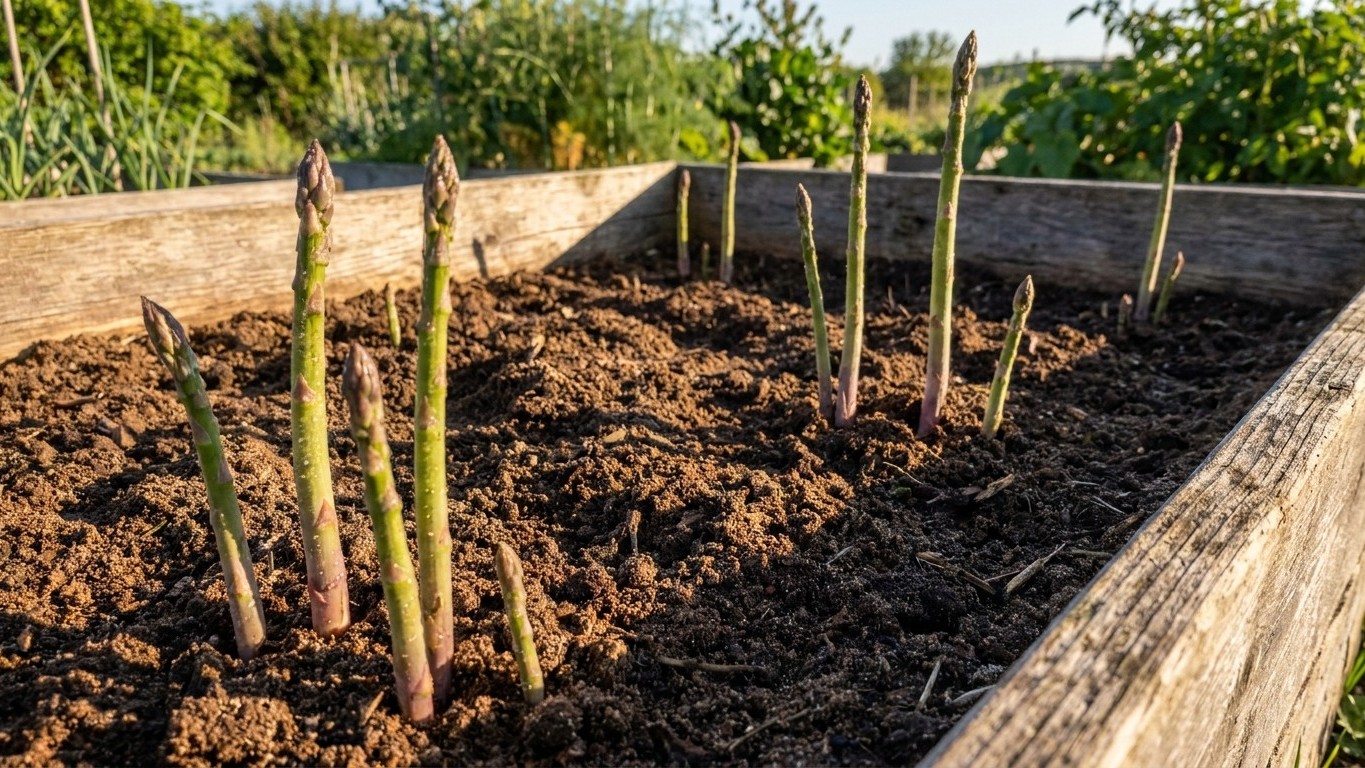

Stop cutting when most of the spears coming up are thinner than a pencil. That signal holds whether the bed is in its third year or its tenth. Cut spears run on their own clock. Held at 32°F to 35.6°F in near-saturated air, they stay tender, while above 50°F they toughen rapidly. Both rules are laid out below for a Maine bed and a Maine kitchen.
How do you know when to stop cutting asparagus in Maine?
A crown spends stored sugar every spring to push up spears, then rebuilds that store all summer through its ferns. Cut for too many weeks and the crown never catches up. The spears themselves are the best gauge: when most of what comes up is thinner than a pencil, the reserves are running low, and every spear after that should be left to grow into fern. A few thin spears among thick ones is normal. A bed that sends up mostly thin ones is finished for the year.
How many weeks can you cut asparagus each year?
Utah State University Extension describes crowns planted in 8-inch furrows in early spring, with no harvest until year 3. After that the bed produces for 10 to 15 years. The cutting window lengthens as the crowns mature.
| Year in the ground | Cutting |
|---|---|
| Year 1 | None |
| Year 2 | None |
| Year 3 | 4 weeks |
| Year 4 | 6 weeks |
| Year 5 and after | 8 weeks |
Treat those weeks as a ceiling. If most spears are pencil-thin in week three of a six-week year, stop at three. The count starts with the first spear you cut, so it carries no calendar date. At the Portland reference station, NOAA NCEI data put the last 32°F freeze of spring between April 22 and May 1. Coastal Portland is the mild end of Maine, and inland and northern gardens run later, so their counts begin later too.
What should the bed do after the last cut?
Let every spear grow. The tall ferns feed the crown for next spring, and that is the bed’s whole job until they turn yellow in fall. Summer water matters now. NOAA NCEI normals for the Portland reference station show about 11.2 inches of rain across June, July and August: 4.15 in June, 3.43 in July and 3.57 in August, out of 48.1 inches for the year. Those are what the region can usually expect, not a forecast.
The same inch of rain behaves differently from one spot to the next. Sand lets it through within the day, so a sandy bed can need water every second day even in a wet summer. A clay one holds it for a week. Days at or above 90°F speed evaporation, and a single summer thunderstorm mostly runs off. A rain gauge on your own plot settles how much your ferns really get.
A new bed still has a furrow to fill. The fern season is also when pests feed, and What Eats Asparagus in Maine, and When covers who shows up. For siting and planting, see Growing Asparagus in Maine.
Keeping it, and for how long
The UC Davis Postharvest Technology Center gives asparagus an optimum temperature of 0°C to 2°C, which is 32°F to 35.6°F, and an optimum relative humidity of 95 to 100 percent. Its fact sheet says high humidity is essential to prevent desiccation. A cut spear loses water through the cut end faster than anywhere else on it. Cold slows the aging of the spear, and saturated air slows its drying.
The window is narrow, and both edges bite. Above 10°C (50°F), spear toughening occurs rapidly. At -0.6°C (30.9°F) or lower, freezing injury is likely: the spears turn water-soaked, then go extremely soft. Barely a degree separates the bottom of the optimum range from that freezing line, so the target is just above freezing with air close to saturated.
How long the spears last depends on staying inside that range. Any shelf life quoted for asparagus is a ceiling that applies only when the spears are in the optimum range from the moment they are cut. Every hour on a warm counter or in a fridge door spends part of it. A sensible habit is to cook spears within a day or two of cutting and treat anything older as a bonus.
A young bed yields only a few spears a day, so most gardeners collect them over several days. Cut in the morning, carry the spears in the shade, and get them into the cold right away. Add each cut to one container and cook the batch every second day or so, so the oldest spears never sit long.
Where in the house that actually is
A household refrigerator is set for milk and leftovers. It usually runs warmer than 32°F to 35.6°F, and the door, which swings open to room air, runs warmer still. A door shelf is the worst spot for a bunch of spears, and the counter is worse.
The lowest shelf comes closest, because cold air settles there. Keep the bunch a little off the back wall and away from any vent, since those spots can dip to freezing. A cheap fridge thermometer left on that shelf for a day shows where you really stand. If the reading is under 31°F, move the spears up a shelf, because spears that freeze collapse when they thaw.
High humidity in a home kitchen comes down to keeping the cut ends wet. There are three common ways to do it:
- Stand the butts upright in a jar with an inch or so of water, like cut flowers, and slip a loose bag over the tips.
- Wrap the cut ends in a damp paper towel and put the whole bunch in a bag.
- Lay the spears in a crisper drawer set to high humidity, with a damp towel alongside.
Of the three, standing the butts in water is the one to pick. Skip it and the cut ends dry out first, which is where the spears lose water fastest. Change the water every day or two so it stays clean.
Common questions
Can I cut a few spears the year after planting?
No. Nothing comes off the bed until year 3, even a few spears, because the crowns are still building the reserves that will carry them through 10 to 15 years of production. The first cutting year runs four weeks, the next six, and the one after that eight.
Why did my stored spears turn tough or mushy?
Tough spears were kept too warm. Toughening happens rapidly above 50°F, which a counter or a fridge door can easily reach. Mushy, water-soaked spears were kept too cold, at 30.9°F or lower, often against the back wall or a vent. Aim for 32°F to 35.6°F with the cut ends in water.
Does the variety change what I should plant?
Ask your county extension office which varieties have done well nearby.
Is Maine’s state soil well drained enough for asparagus?
Utah State University Extension says most soils will do for asparagus provided they are well drained. Maine’s state soil, the Chesuncook series, is a loam to silt (35 percent sand, 12 percent clay, 53 percent silt) and moderately well drained, according to USDA NRCS. That is one step short of well drained, and a bed stays put for 10 to 15 years, so test your own ground. Dig a hole about as deep as a spade, fill it with water, and see whether it drains by the next day. If water still stands, raise the bed or pick another spot, and Will Maine Soil Hold an Asparagus Bed for Fifteen Years? goes deeper. The state soil represents Maine, not every garden in it, and river bottoms, hill country and scraped or filled ground can differ completely. The mapped surface of the series holds about 53.0 percent organic matter, which marks a natural forest-litter layer that a worked bed will not have.