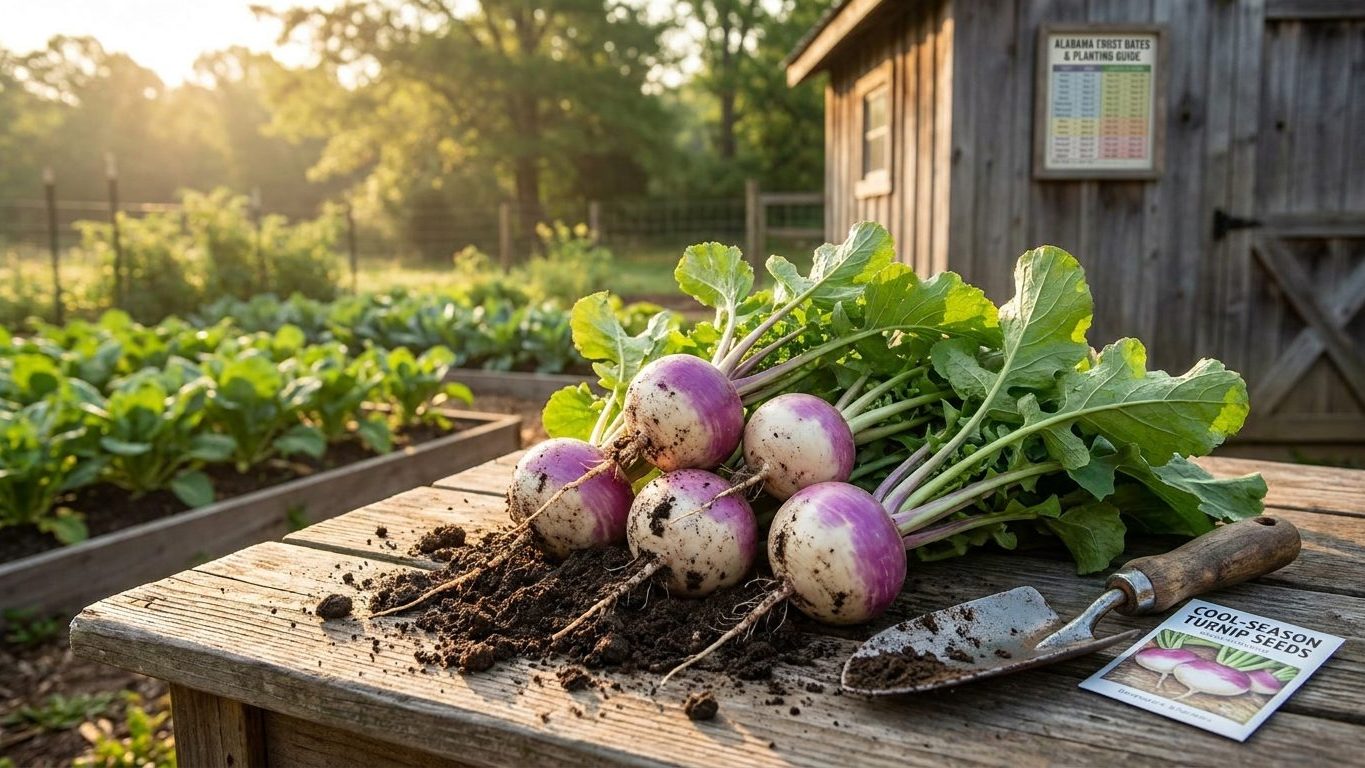

Sow turnips west of the Cascades from March into April for a spring crop, then again from late July through August for the better fall crop. East of the mountains and at higher elevations, spring sowing starts later and fall sowing starts earlier. Turnips are a cool-season root, so the whole calendar is built to get the roots swelling in cool weather rather than in July heat.
The short answer for Oregon
Spring sowing begins as soon as the soil can be worked, which in the Portland area means March, and it runs through April. Fall sowing runs from late July through August. That is when the roots have time to size up before the first hard freezes of November. The frost dates behind this come from NOAA’s 1991-2020 U.S. Climate Normals for the Portland reference station, and they are freeze probabilities. The mean last spring frost falls between March 6 and March 21, and the mean first fall frost between November 11 and November 27. Both ranges are the 30-70% band for a 32°F freeze, meaning the span of dates when the odds of a freeze sit between 30 and 70 percent.
When should you sow turnips in spring in Oregon?
Turnip seed germinates in cool soil, and young plants shrug off a light frost. You do not need to wait for the last frost date to pass. Sowing in March, right around that March 6 to March 21 frost window, puts the crop in the ground while days are short and cool. Sowings made through April still work. The later you go, the more the roots race against warming weather, and spring turnips that mature in heat turn woody, sharp-flavored and prone to bolting.
When should you sow fall turnips west of the Cascades?
Work backward from November 11 to November 27. Packet days to maturity count from the day you sow, so a variety listed at a given number of days needs that many days of growth before the first freezes arrive. Late July through August gives most turnips room to finish, and the cooling weather of September and October sweetens the roots. At Portland the mean daily minimum of the coldest month is 36.2°F, so winters on the wet side are mild enough that fall turnips can often stay in the ground and be pulled as needed. A hard freeze on a clear night is still possible, so a layer of straw or leaves over the row is cheap insurance.
| Sowing | Window west of the Cascades | What it is timed against |
|---|---|---|
| Spring crop | March through April | Mean last spring frost, March 6 to March 21 |
| Fall crop | Late July through August | Mean first fall frost, November 11 to November 27 |
Rutabaga runs on a slower clock than turnips and is sown earlier in summer, which the guide to Growing Turnips and Rutabaga in Oregon covers in more detail.
What will not work here
The most common failure is borrowing the Portland dates for a garden that does not share its climate. Central and eastern Oregon are high desert with a far shorter growing season. A March sowing there lands in frozen or sodden ground, and a fall sowing made in late August can be caught by freezing nights before the roots size up. The frost windows above describe the reference station and nothing else.
Why does a late spring sowing fail in Oregon?
West of the Cascades, summers are dry and warm. A turnip sown in May or June matures right into that stretch, and the roots turn tough and hot-tasting. Plants that sense warming days may also send up a flower stalk before the root has swelled. Watering on a fixed schedule does not fix this. A shallow-rooted crop in dry summer soil needs even moisture, and a weekly soak followed by days of drying produces cracked, stringy roots.
What goes wrong with fall sowing that starts too late?
A sowing made in October on the wet side of the state looks promising for a few weeks, then stalls as days shorten and soil cools. With the first freeze arriving between November 11 and November 27, seedlings that have not formed a decent root by then give you greens at best. Greens are worth eating, but they are a different harvest than the one you planned.
Cold, wet winters also punish crowding. Turnips sown thickly and never thinned hold moisture around their crowns, and slugs thrive in that dampness. Thin the seedlings once the first true leaves appear.
Finally, winter sowing in January or February rarely pays off. The soil is cold and saturated, seed sits and rots, and the few seedlings that come up gain nothing over a March sowing.
What changes across Oregon
No single sowing date fits Oregon. On the USDA system, the state spans hardiness zones 4a to 9b, a spread wider than most states. That system rests on one variable, the average annual extreme minimum temperature, so it tells you how cold the worst nights get. It does not tell you the length of the growing season or the date of the last frost. The Portland figures above are the reference point. Other parts of the state differ, sometimes by weeks.
Readers in the mountains or the high desert should shift in two directions. Spring sowing moves later, since the soil there stays frozen or soggy well past March. Fall sowing moves earlier, since the first hard freeze arrives sooner than November 11. A garden at altitude may have only a short stretch between the last spring freeze and the first fall one, so quick-maturing turnip varieties matter more there than they do in the Willamette Valley. The breakdown in The Best Turnips and Rutabaga for Oregon sorts varieties by how long they take to mature.
Gardens near the coast and in the milder valleys sit at the other end of the range. Winters there are gentle enough that fall turnips can hold in the ground well into winter, and a second sowing in late summer has more room to work.
Look up your own zone on the USDA Plant Hardiness Zone Map. It gives a zone for your location. Treat that as one clue about your cold extremes, then use local frost dates and your own observations for timing.
Where to check this for your own county
Oregon State University Extension is the first stop. It runs county offices across the state, and the people there know what grows in the soil and weather of your area.
Look for two things. First, a local planting calendar or vegetable-garden guide for your county, with sowing dates for cool-season roots such as turnips. Second, the varieties that have been grown and trialled in your part of the state. A variety that performs in the Willamette Valley may not suit a short-season high-desert garden, and local trial results will show that.
Master Gardener programs through the extension service are also worth a call or visit. Volunteers often keep notes on local frost dates, pest timing and which sowing dates have worked in recent years.
A county recommendation beats a state one. A statewide calendar averages gardens that sit hundreds of miles and thousands of feet apart. Use the March-to-April and late-July-to-August windows as a starting frame, then tighten them with what your county office says.
Checking this against your own garden
Your own observations outrank every date above. Three things are worth watching.
- Soil warmth by feel. Squeeze a handful of soil in early spring. If it crumbles instead of forming a sticky ball, and it feels cool but not frozen, it is workable for turnips. Beds that reach this state earlier are warmer pockets, usually sunny, sheltered or well drained.
- The first true leaves. After the seed leaves, the first rough, lobed leaves show a seedling has established. If they appear quickly, your soil is warming fast. If they take weeks, the bed is cold or shaded, and sowing dates there should shift later.
- Flower stalks and frost. A stalk rising from the center of a spring turnip means heat or long days got ahead of the root, so sow earlier next year. Also note the last and first frost on low spots in your yard. Cold air pools there, and a frost-touched corner tells you which beds run colder than the regional dates suggest.
Keep a short garden log with sowing dates and what came of them. In time it becomes a calendar written for your yard.
The Moon calendar is a separate, older custom: see when to plant turnips by the moon, written as tradition rather than fact.
Common questions
Can you sow turnips in winter in Oregon?
Not usefully. Winter soil is cold and waterlogged, seed tends to rot, and a March sowing catches up with anything sown earlier. Wait until the soil is workable.
How late can you sow fall turnips?
Count back from the first fall frost window, November 11 to November 27 at the Portland reference station. Packet days to maturity count from sowing, so the crop needs that many days before the freezes. Sowings that fall short still give edible greens.
Do turnips survive an Oregon winter?
West of the Cascades, often yes. The mean daily minimum of the coldest month at Portland is 36.2°F, so fall-sown turnips can usually stay in the ground and be harvested over winter, with mulch for hard-freeze nights. Colder districts need earlier harvest.
Is rutabaga sown at the same time as turnips?
No. Rutabaga needs a longer season, so it goes in earlier in summer than fall turnips. Check Growing Turnips and Rutabaga in Oregon for the timing and care.