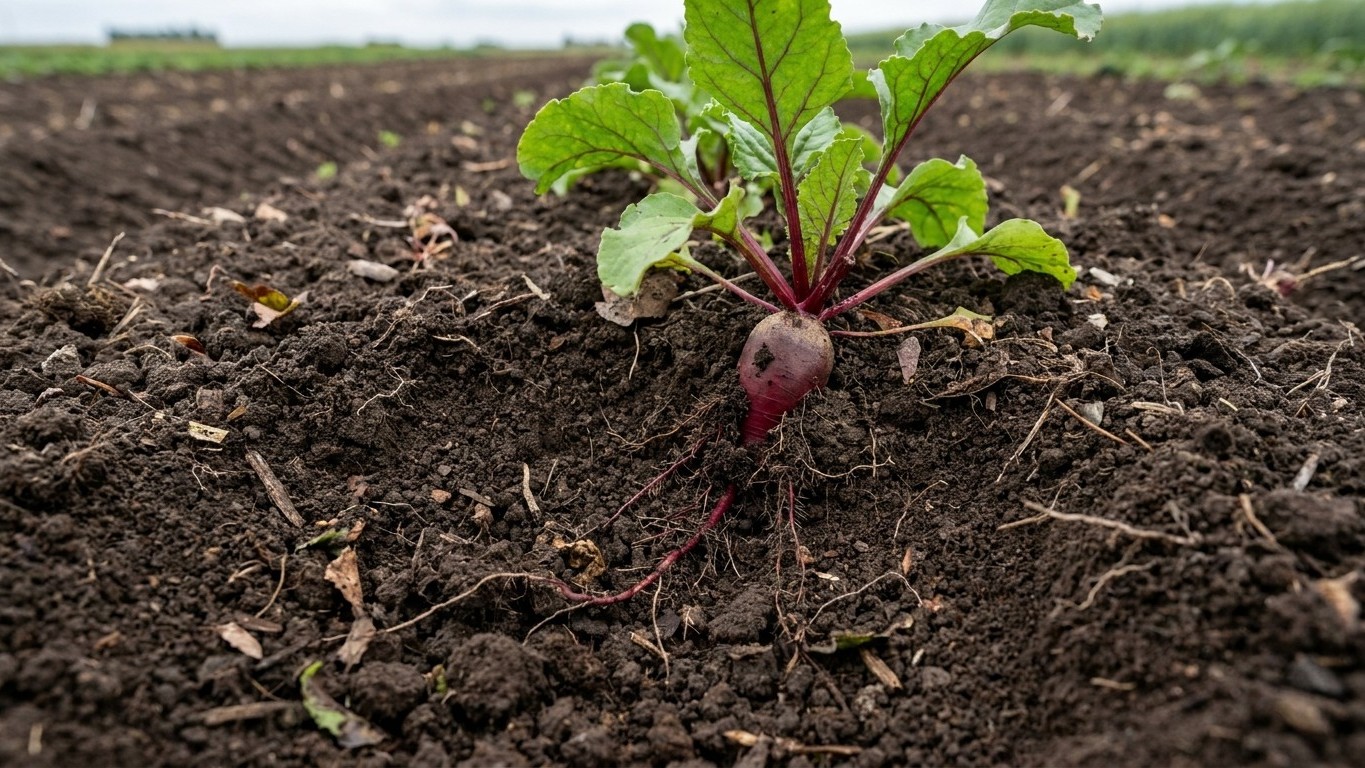

Pull beets when the roots have sized up, then store the topped roots at 33 to 36°F with very high humidity. That second number surprises people. Beets keep worse at 32°F than a few degrees above it, so the coldest corner of the fridge is the wrong spot. Where winters are mild and cellars are rare, hitting the right range takes a thermometer and a little planning.
Why colder is not better for beets
USDA Agricultural Handbook 66 is the standard reference on commercial storage of fruits and vegetables. In the chapter by F. Adamicki, it says beets held at 32 to 34°F develop more black spot and more rot than beets held at slightly higher temperatures. Its target for topped beets, meaning the leaves are cut off, is 33 to 36°F at 98% relative humidity. The gap is only a degree or two, but it points the opposite way from what most gardeners expect.
The usual instinct with root crops is to get them as close to freezing as you can without actually freezing them. That works well enough for carrots, and gardeners carry the habit over to everything else in the crisper. Beets break the rule. Pushing them down to the 32 to 34°F band does not slow decay. It speeds up the black spot and rot the handbook warns about.
What temperature should topped beets be stored at?
Aim for 33 to 36°F with humidity at 98%. Humidity matters as much as temperature, because a beet is mostly water and dry air pulls it out through the skin. A root that has gone soft and rubbery has usually lost moisture, not just aged. In a home setting, a closed container or a perforated bag with a lightly damp paper towel is the practical way to hold moisture near the roots, since no household space naturally sits at 98%.
How long do bunched beets keep with the leaves on?
Bunched beets, with the greens still attached, keep about 10 to 14 days at 32°F and above 98% humidity. Treat that as a ceiling reached only under ideal conditions, not a promise. Leaves keep drawing moisture out of the root, so the beet shrivels faster than it would topped. If the roots are headed for storage and not tonight’s dinner, cut the tops off first. The greens can go into a separate bag and be cooked within a few days.
| Form | Temperature | Humidity | Holding time |
|---|---|---|---|
| Bunched, leaves on | 32°F | Above 98% | About 10 to 14 days at most |
| Topped roots | 33 to 36°F | 98% | Longer storage |
| Cellar or pit | Not below 31°F, not above 41°F | High | Longer storage |
Where in the house that actually is
A refrigerator is the obvious candidate, and it is also the easiest place to overshoot. It can run colder than the 33 to 36°F target, especially along the back wall and on the lowest shelf, and that is the zone where black spot and rot get an edge. Put a thermometer in the spot where the beets will sit, leave it a full day, and read it. If it shows 33 to 36°F, the fridge works. If it reads lower, move the beets to a warmer shelf or a door bin and check again.
A heated room is far too warm, and a kitchen counter does not come close. Many houses where summers are hot and humid sit on slabs or crawl spaces and have no cellar at all. An unheated garage, a utility room on the north side, or a closed-in porch can be cool in winter, but those spaces swing with the weather. A sunny afternoon can push them well above the target, and a hard night can drop them toward freezing. A min/max thermometer, which records the low and the high since you last reset it, shows what the space really does over a few days.
If you do have a cellar, a root pit, or a clamp (a mound of roots covered with straw and soil), the handbook gives a wider band: the temperature should not drop below 31°F or climb above 41°F. That is the outer limit for those spaces, not the ideal. Within it, the closer to 33 to 36°F, the better. A reading outside the 31 to 41°F band means the storage spot needs adjusting, or the beets need a different home.
A spare refrigerator, if you own one, gives the most control, because the dial can be set until the thermometer lands in range. Whichever space you pick, check it again after the first cold snap or the first warm spell. Settings drift.
One more choice affects how long the stored roots last. Keep the big roots for storage and eat the small ones first, because the handbook is explicit that large roots keep much better than small ones. They lose water and shrivel more slowly. Small roots stored beside them will go soft first, and a soft beet gives rot a place to start. Cook or pickle the small ones within days of pulling.
When are beets ready to pull in Mississippi?
Beets are sown directly in the garden and are not transplanted, so the 60 to 80 days on a seed packet count from the day the seed goes in the ground. Where springs are early, that puts the first spring harvest well ahead of summer heat. The NOAA NCEI climate normals for the reference weather station put the last spring frost between March 6 and March 22. Suburban and rural gardens usually see the last spring frost one to two weeks later than an airport station, and more at higher elevation. Your county extension office can give you the local date.
Storage and harvest timing pull against each other. Big roots keep best, so you want to let some size up. But beets that sit too long as the weather warms can turn tough. Heat above 85°F combined with water stress makes the root woody, according to Utah State University Extension. A spring planting therefore needs to come out before the long hot stretch begins. Brush soil away from a root’s shoulder and judge the size by eye, then pull the biggest first.
Bolting and woody roots are different problems, so how do you avoid each?
Bolting means the plant sends up a flower stalk early. Utah State University Extension links it to water stress in the first 6 weeks after sowing. Woodiness is a separate failure that shows up later: heat above 85°F plus water stress hardens the root. Early moisture protects against the first, and keeping the bed evenly watered during hot weather protects against the second. A beet that bolted young will not recover, and a beet that turned woody will not soften.
Does the soil change when you can pull?
Beets want deep, sandy, well-drained soil rich in organic matter, amended with no more than 1 inch of composted organic matter per 100 sq ft. Mississippi’s state soil, the Natchez series, is a young soil (an Inceptisol) that is well drained and slightly acid at the surface, with a pH of about 6.2. USDA NRCS data for its mapped surface layer show 5 percent sand, 13 percent clay, 82 percent silt and about 1.8 percent organic matter. A silty ground like that can pack down, and roots in packed soil swell unevenly. That is one reason to loosen the bed deeply before sowing.
The Natchez series represents the state and is not a reading of your garden. River bottoms, hill country and filled ground vary a great deal. A soil test through your county extension office gives your own pH and organic matter. For more, see Beet Soil in Mississippi: What the Root Will Meet, What Eats Beet in Mississippi, and When and the main guide, Growing Beets in Mississippi.
Common questions
Should I cut the tops off beets before storing them?
Yes. Bunched beets with the leaves on last only about 10 to 14 days, and that is the best case. Topped roots can be held at 33 to 36°F and 98% humidity for longer storage, and the leaves are best cooked soon after harvest.
Is the refrigerator too cold for beets?
It can be. Fridges can run colder than the 33 to 36°F target, and storage at 32 to 34°F brings more black spot and rot than slightly warmer storage. Place a thermometer where the beets will sit and adjust the shelf or the dial until it reads in range.
Which beets keep longest?
Large roots keep much better than small ones because they lose water and shrivel more slowly. Store the big ones and eat the small ones first.
Do the 60 to 80 days count from transplanting?
No. Beets are sown in place, and the days to maturity run from seeding. Plan the harvest for before the long hot stretch, since heat above 85°F with water stress makes the root woody.