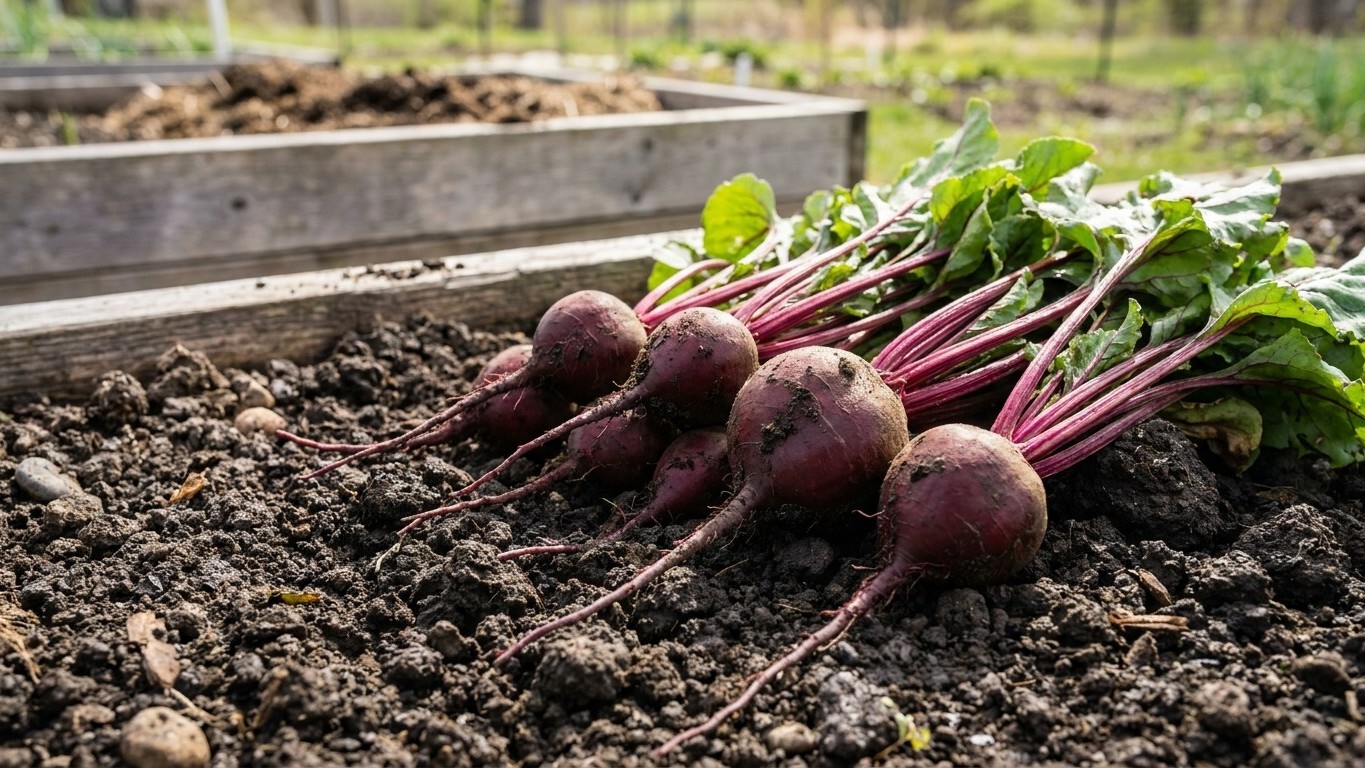

Pull beets when the shoulders reach the size you want to eat. Spring sowings come out before summer heat turns the roots woody, and fall sowings come out before the ground freezes hard. Storage is where gardeners go wrong. Topped beets keep best at 33 to 36 °F, a little warmer than the near-freezing setting most people use for carrots, and the USDA’s own handbook says the colder setting produces more black spot and rot.
Why colder is not better for beets
Most gardeners learn early that cold keeps root crops. Carrots go in the coldest spot available, and they last for months. Beets look like they should follow the same rule, and they don’t. USDA Agricultural Handbook 66, The Commercial Storage of Fruits, Vegetables, and Florist and Nursery Stocks, has a chapter on beets by F. Adamicki. It states that during storage at 32 to 34 °F, more black spot and rot occur than at higher temperatures. The colder room does more harm.
What temperature should topped beets be stored at?
The same chapter gives the target for topped beets: 33 to 36 °F at 98 percent relative humidity. The two numbers work as a pair. Roots lose water steadily, and air that is only moderately humid pulls it out faster than the root can spare. Beets held in a dry spot go soft and rubbery long before they rot.
The window is narrow, and it sits just above freezing. A thermostat that drifts a few degrees low can push a room into the zone where the handbook reports more black spot and rot. That is why the actual temperature where the beets sit matters more than the setting on the dial. A perforated plastic bag or a container of damp sand helps hold the humidity up without leaving the roots sitting in water.
How long do bunched beets keep with the leaves on?
Bunched beets, with the leaves still attached, keep about 10 to 14 days at 32 °F and above 98 percent humidity. Treat that as a ceiling. It describes ideal conditions, and a crowded refrigerator, a warm porch or a car trunk on the way home will shorten it. The leaves go limp well before the root is finished, so plenty of gardeners wait too long to deal with them.
The practical answer is to top the beets first. Cut the leaves off the day you pull, leave a short stub of stem, and the roots move into the longer-keeping category with its own temperature target. The greens are good to eat, so cook them in the first few days and let the roots go into storage.
Gardeners who store carrots in the coldest corner of the cellar tend to carry the habit over to beets without a second thought. The handbook says that habit costs you roots.
Where in the house that actually is
A refrigerator can run colder than the 33 to 36 °F target, especially against the back wall, and a heated room runs far warmer. Neither is a good long-term home for a bushel of beets. The handbook says a pit or cellar should stay between about 31 and 41 °F, and that range is a better guide to which part of a house will work.
In most Missouri homes the closest match is an unheated basement or a true root cellar, particularly along a north or buried wall where the temperature changes slowly. Rural properties with a storm cellar sometimes have a good spot already. A finished, heated basement is usually too warm. An unheated attached garage is a gamble because Missouri winters swing between mild spells and hard cold snaps, and a garage follows the outdoor air much more closely than a cellar does. A garage that sits at 38 °F in November can drop below 31 °F in January.
Before you commit a harvest to any spot, put a min-max thermometer there for a week. Set it at shelf height, where the crates will actually sit, not on the floor and not near the ceiling. Read the low and the high, then check again after the next cold night. If the low stays above 31 °F and the high stays below 41 °F, the space is workable. If you can hold it closer to 33 to 36 °F, better still. A refrigerator crisper drawer can work for a few pounds. Pack the roots in a perforated bag, and check the thermometer there too.
Size matters as much as location. The handbook is explicit that large roots keep much better than small ones because they lose water and shrivel more slowly. Store the big roots and eat the small ones first, or the small roots will be soft by midwinter while the large ones are still firm. Sort at harvest. Put the largest, cleanest roots into storage, and cook or pickle the small ones within the first couple of weeks.
How do you know when beets are ready to pull in Missouri?
Beets are sown in place, so the days on a seed packet count from the day the seed went into the ground. There is no transplant date to start from. Count forward from sowing, then check the roots directly by brushing soil away from the shoulder at the base of the leaves. If it has reached the size you want to eat, pull it. Roots that are big enough for storage often take longer than roots that are big enough for dinner.
For spring sowings, the spring frost date helps you plan. At Kansas City International, NOAA NCEI climate normals put the last spring frost between April 6 and April 20. That station sits well north of the city. The downtown station runs about five days earlier, and southern Missouri is milder still. Use the date as a rough anchor and adjust it for your own county.
Two different problems can ruin a crop, and they have different causes. Water stress in the first six weeks causes premature flowering, called bolting, and the plant stops putting energy into the root. Later, heat above 85 °F combined with water stress makes the root woody. A bed that stayed moist early and dried out in July can still end up with woody roots. A bed that dried out in April can bolt even if July is handled well. Each problem calls for its own timing, so a spring crop should come out before the heat arrives.
Does Missouri soil change the harvest?
Menfro silt loam is the soil USDA lists as representative of Missouri. Its surface layer is about 77 percent silt, 19 percent clay and 4 percent sand, with about 2.0 percent organic matter, a pH around 6.2 and good drainage. Ground like that tends to hold water longer than sand does, and it can crust over after hard rain. Beets want deep, sandy, well-drained soil rich in organic matter, according to Utah State University Extension, so a silty garden needs a little more attention than a sandy one.
That soil is a starting point, not a diagnosis. River bottoms, hill country and ground that a builder has scraped or filled can be very different, so a soil test through your county extension office gives you the number that counts. Utah State Extension recommends no more than 1 inch of composted organic matter per 100 square feet, which is less than many gardeners spread. More detail is in Beet Soil in Missouri: What the Root Will Meet, and the full season is laid out in Growing Beets in Missouri.
Check the roots before they go into storage, too. Roots with gnawed shoulders or tunnels are poor keepers, so eat those first. What Eats Beet in Missouri, and When covers what to look for on the leaves and roots.
Common questions
Do beets need to be topped before storage?
Yes. Bunched beets with the leaves on keep about 10 to 14 days at best. Topped beets have their own storage target of 33 to 36 °F at 98 percent humidity, and they last longer in it. Cut the tops off at harvest and leave a short stub of stem.
Can beets go in the refrigerator?
A few pounds can, but a refrigerator may run colder than the 33 to 36 °F target, and the air is dry. Use the crisper drawer, pack the roots in a perforated bag, and check the temperature with a thermometer. For a larger harvest, an unheated basement or cellar that stays between 31 and 41 °F is a better fit.
Should I store big beets or small ones?
Store the big ones. USDA Handbook 66 says large roots keep much better because they lose water and shrivel more slowly. Eat the small roots first, within the first couple of weeks after harvest.
What happens if beets stay in the ground through summer heat?
The roots can turn woody when temperatures climb above 85 °F and the plants also lack water. That is a separate problem from bolting, which comes from water stress in the first six weeks. Pull spring-sown beets before the hottest weather arrives, and give a late crop steady moisture while the roots are sizing up.